



In heavy-duty mechanical systems such as wind turbines, industrial gearboxes, crushers, rolling mills, turbines, and generators, bearings are small components that play a critical role. When a bearing fails, many people simply think that replacing it with a new one solves the problem. However, for heavy-duty industrial equipment, bearing failure is often not the root cause, but rather a symptom of a deeper underlying issue within the system.
The case of bearing failure in a wind turbine gearbox is a prime example. The equipment is designed for long-term operation, but in reality, bearings can fail prematurely due to localized loads, contact misalignment, lubricant contamination, and harsh operating conditions.
1. Observable Failure Modes
The bearing under investigation is a roller bearing from the planetary gear stage of a wind turbine gearbox. Severe damage appeared on the inner ring surface, characterized by material spalling, surface pitting, indentations, and uneven roller paths.
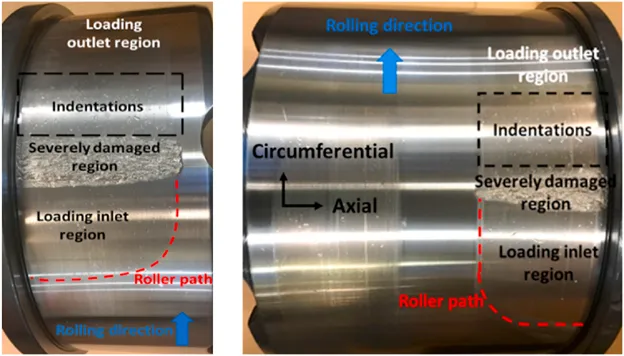
The key point here is that the damage is not evenly distributed across the entire bearing. It is concentrated in a primary load zone. From a failure analysis perspective, this indicates that the bearing operated under uneven loading conditions or experienced repetitive localized loading over a long period.
2. Do Not Jump to the Conclusion of “Poor Quality Bearings”
When a bearing fails early, common conclusions include poor bearing quality, lack of oil, dirty oil, or equipment overload. While these reasons may be true, stopping there is insufficient.
In large industrial equipment, bearing failure can be linked to multiple factors simultaneously:
- Actual loads higher than design calculations.
- Shock loads during startup, shutdown, braking, or load fluctuations.
- Roller misalignment or uneven contact.
- Deformation of pins, shafts, or bearing housings.
- Lubricating oil contaminated with metal debris.
- Oil filters failing to remove hard particles.
- Uneven load distribution within the gearbox.
If you only replace the bearing without addressing the root cause, the equipment is highly likely to fail repeatedly.
3. Contact Overload is a Suspected Cause
During operation, the rollers press against the bearing’s inner ring with immense pressure. In theory, this pressure should remain within allowable limits. In reality, however, wind turbines are constantly subjected to varying loads caused by wind gusts, emergency stops, braking, startup, or generator switching.
These short-term but highly repetitive overload cycles can cause work-hardening, fatigue cracking, and eventually spalling on the bearing surface. This is why equipment can fail prematurely even without running under continuous overload.
4. Damage Concentrated at a Fixed Position
In the planetary gear stage, the bearing’s inner ring is typically mounted on a non-rotating pin. As a result, the load is not evenly distributed around the bearing circumference but is concentrated in a specific area.
When a small zone continuously bears high loads, the surface will exhibit heavy roller paths, work-hardening, dense indentations, and severe spalling. This is a crucial sign for identifying the primary load zone and the initiation mechanism of the failure.
5. Uneven Roller Paths Indicate Contact Misalignment
Surface inspection reveals that the roller paths are not straight and uneven. This is a sign of roller tilting or misaligned contact.
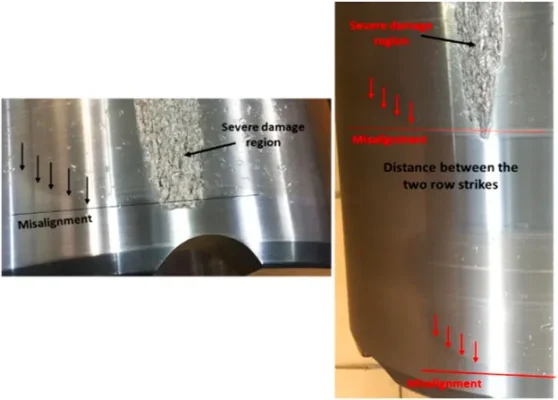
In practice, unless the concentricity, parallelism, assembly clearances, support pins, and deformation status of the gearbox assembly are checked, replacing the bearing with a new one may not solve the issue.
6. Indentations: Evidence of Hard Debris in the Lubricant
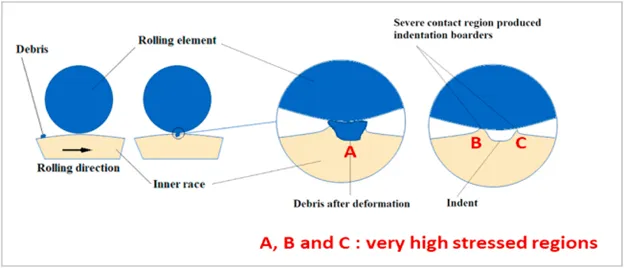
Numerous indentations appear on the bearing surface. This is typically a clear sign that the lubricating oil contains hard particles or metal debris.
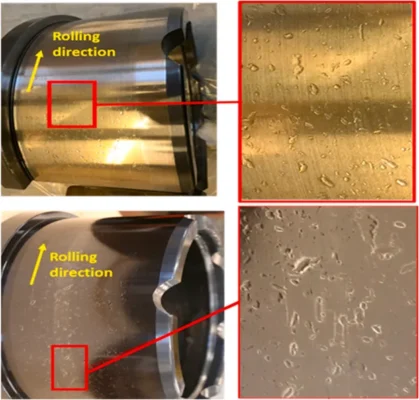
The source of hard debris can originate from gears, other bearings, already spalled areas, shafts, or other wearing components inside the gearbox. Therefore, when indentations are found, it is necessary to inspect the oil, filters, oil lines, and related drive components.
7. Indentation Distribution Helps Decode Failure History
The density of indentations increases sharply near the severely damaged zone. This indicates that this area was subjected to both high loads and the impact of hard particles in the oil.
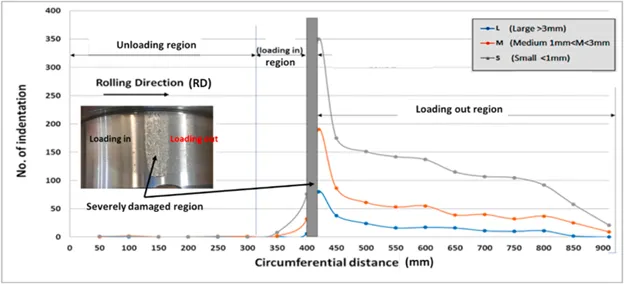
The increased number of indentations near the spalled area shows the correlation between localized loading, oil contamination, and surface destruction.</caption]
Notably, indentations also appear in areas that have not yet spalled.
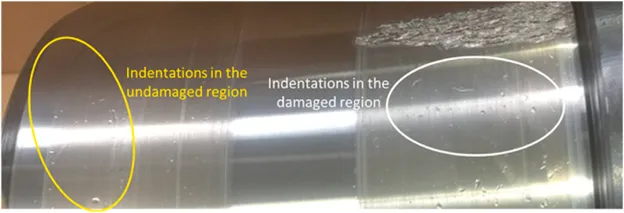 Indentations appear even in undamaged areas, proving that hard debris has circulated throughout the entire oil system.
This proves that you should not just treat the broken bearing individually. The entire gearbox must be evaluated to find the source of the debris generation.
8. When is an In-Depth Failure Analysis Needed?
Equipment owners should call a failure analysis agency when encountering the following scenarios:
- Bearings fail much earlier than their expected lifespan.
- Bearings fail repeatedly even after replacement.
- The gearbox exhibits abnormal vibration, noise, or overheating.
- The lubricating oil contains metallic debris.
- Bearings suffer from pitting, spalling, cracking, or burning.
- The root cause needs to be determined for insurance claims.
- Disputes arise between the asset owner, contractor, maintenance unit, or supplier.
A proper analysis must answer: where did the failure initiate, what is the failure mechanism, what factors accelerated the damage, and what actions are required to prevent repetitive failures.
Conclusion
Wind turbine gearbox bearing failure is not just a story about the bearing itself. Signs like spalling, indentations, misaligned roller paths, concentrated load zones, and debris-contaminated oil show that the entire drivetrain needs a systematic evaluation.
For heavy-duty industrial equipment, replacing components only addresses the symptoms. To fix it correctly and avoid repetitive failures, it is essential to evaluate the root cause stemming from the bearings, lubricating oil, filtration system, gears, shafts, support pins, assembly conditions, and operational history.