Custom engineering and manufacturing

Ultrasonic homogenization and extraction systems engineered for real production processes

VietSonic evaluates the material, processing target, and operating conditions to develop configurations ranging from laboratory equipment to production-scale systems. Businesses can submit samples for technical assessment before selecting the power rating, sonotrode, processing vessel, and cooling or circulation method.

Sample-based configurationMechanical and electrical engineeringProduction-line integration support
Technical consultation: 0938 49 33 66
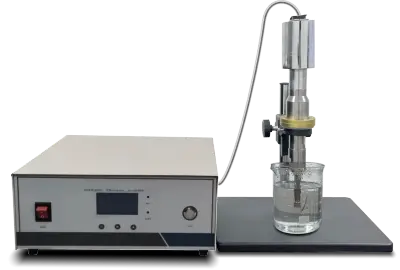
Benchtop ultrasonic homogenizer configuration

Businesses need a configuration matched to the sample, not simply a power rating

Homogenization and extraction results depend on the material composition, viscosity, solid-to-liquid ratio, batch volume, allowable temperature, and target output. Equipment selection should therefore begin with the company’s actual processing requirements.

01

Difficult-to-homogenize samples

Oil–water phases, suspensions, and fine powders can separate easily and require ultrasonic parameters matched to each formulation.

02

Long processing cycles

Businesses may need to increase contact between the raw material and solvent while maintaining control over temperature and batch quality.

03

Scale-up challenges

Parameters that work in a laboratory beaker may not deliver the same results at a larger volume. Vessel geometry, sonotrode position, and heat dissipation must be recalculated.

04

Production integration requirements

The equipment must be compatible with existing vessels, installation space, material loading and discharge methods, and the factory’s operating requirements.

Ultrasonic waves generate mechanical effects within liquids

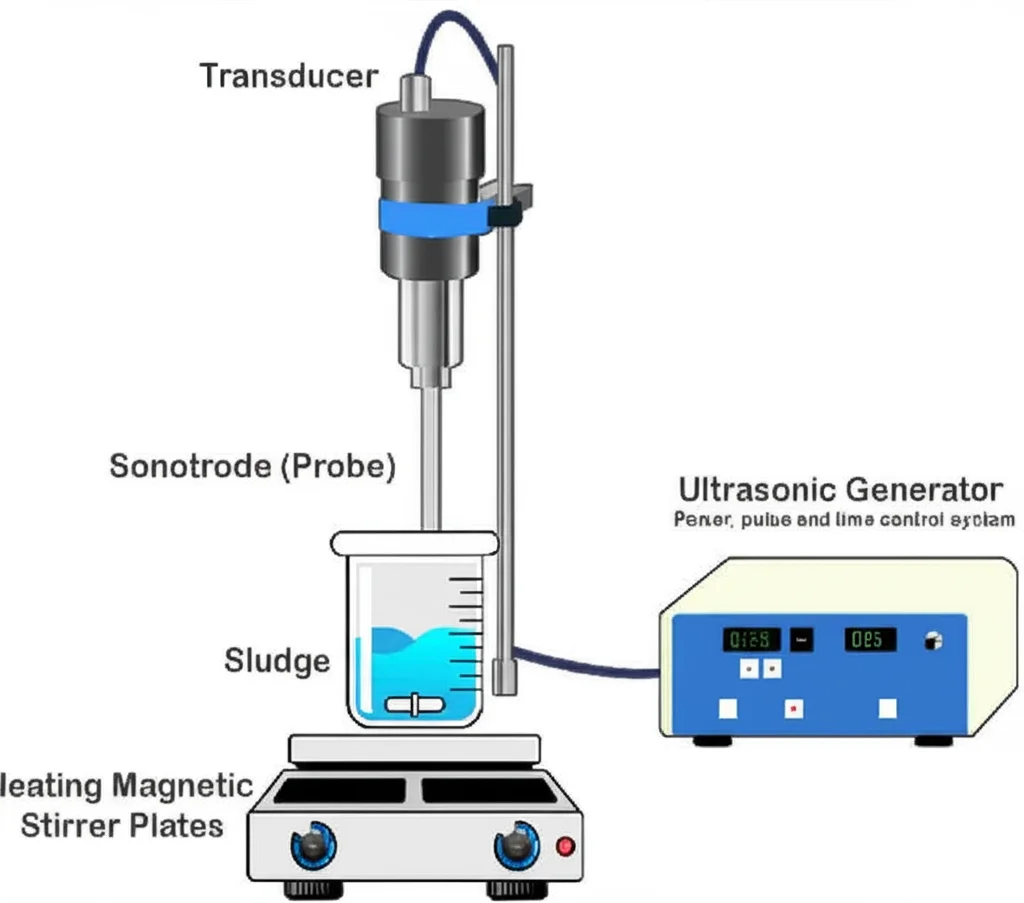
The sonotrode transmits ultrasonic energy into the liquid and produces cavitation. The formation and collapse of microscopic bubbles generate localized shear forces and microstreaming. These effects can help break apart particle agglomerates, disperse phases, increase contact between the raw material and solvent, or disrupt cellular structures.

Actual performance depends on more than nominal power. Amplitude, processing time, sonotrode immersion depth, vessel geometry, batch or circulation mode, and temperature-control method all influence the result.

Businesses should evaluate the process using real samples and measurable criteria such as uniformity, particle size, recovery rate, stability, or processing time.
Diagram of an ultrasonic homogenization system with generator, sonotrode, and sample vessel

Diagram illustrating the basic components of an ultrasonic liquid-processing system.

VietSonic engineers the complete equipment configuration for each process

Manufacturing capability is demonstrated through the appropriate selection, coordination, and calibration of functional assemblies under the customer’s actual operating conditions.

Benchtop ultrasonic homogenizer configuration

Generator and sonotrode assembly

The technical team selects the generator, transducer, and sonotrode according to the required volume, material properties, and intended operating mode.

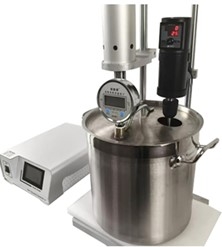
Vessel, gauge, and agitator assembly in an ultrasonic extraction system

Processing vessel and auxiliary systems

The vessel can be equipped with agitation, temperature monitoring, cooling, or circulation when required by the process and operating duration.

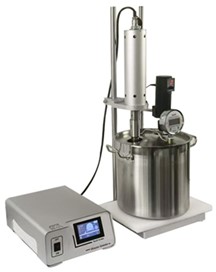
Ultrasonic system with a sonotrode and stainless-steel processing vessel

Machine frame and controls

The support structure, sonotrode mounting position, and control interface are completed to facilitate operation, cleaning, and maintenance.

Equipment development begins with the sample and target output

This approach allows businesses to evaluate process suitability before confirming the equipment configuration and reduces the risk of selecting a system based solely on power.

1

Define the requirements

Record the raw material, solvent, batch volume, viscosity, temperature limit, and required quality criteria.

2

Run sample trials and record results

Perform trials, monitor how the sample responds, and identify the operating range most likely to meet the target.

3

Engineer the system

Calculate and configure the sonotrode, generator, machine frame, vessel, agitator, cooling, circulation, and control system for the intended scale.

4

Test and commission

Verify system functions, provide operating instructions, and support parameter adjustment when the equipment enters the actual production process.

Ultrasonic homogenizer

This solution is suitable when a business needs to disperse particles, support emulsification, break apart agglomerates, or improve the uniformity of a liquid system. Reference applications include food and beverages, cosmetics, pharmaceutical and biological processing, and nanomaterials.

  • Adjustable amplitude and processing time for each sample.
  • Sonotrode selection based on volume and vessel geometry.
  • Optional cooling for temperature-sensitive processes.
  • Scalable from benchtop equipment to circulation systems.
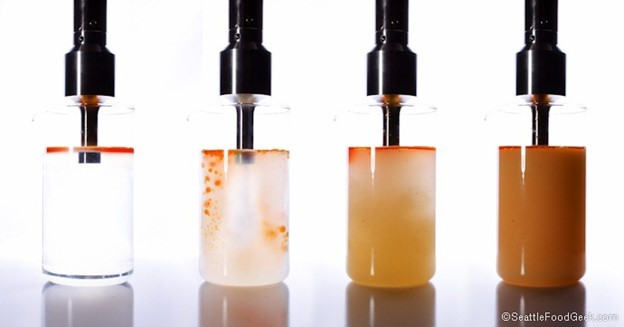
Illustration of sample dispersion and homogenization using an ultrasonic sonotrode

Illustration showing changes in the sample during ultrasonic processing.

Ultrasonic extraction system

This solution is designed to increase contact between the raw material and solvent, support structural disruption, and release target compounds. The equipment can be developed for food ingredients, natural cosmetics, medicinal herbs, or biological materials.

  • Designed for liquid, viscous, or solid-containing samples.
  • Agitation can be integrated to maintain material distribution.
  • Temperature is controlled according to the product limit.
  • Batch or circulation operation is selected according to process requirements.
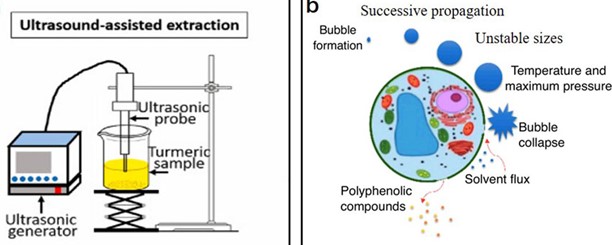
Diagram of ultrasound-assisted extraction and the cavitation mechanism

Diagram illustrating how an ultrasonic sonotrode supports the release of target compounds from raw materials into a solvent.

Reference configurations by processing scale

The following table provides an initial reference for technical discussions. Final power and processing volume should be determined after evaluating the sample, operating mode, and required quality targets.

ScaleReference configurationSuitable requirements
Laboratory100–500 W; approximately 50–1,000 mLFormulation research, sample trials, and identification of the operating range.
Pilot or semi-industrial1,000–2,000 W; approximately 1–20 L per batchScale-up validation and small-batch production.
Industrial systemFrom 3,000 W; batch or circulation operationIntegration with vessels, cooling, agitation, and production piping.
The power and volume ranges above are reference information from the configurations introduced in the original article. They do not represent a performance guarantee for every material.

What should businesses prepare for a faster technical assessment?

The closer the information is to actual production conditions, the more effectively the technical team can propose a sample-trial method and preliminary configuration.

Material information

  • Ingredients, solvent, and mixing ratio.
  • Viscosity, particle size, or physical form of the material.
  • Maximum temperature the sample can tolerate.

Production information

  • Batch volume or required flow rate.
  • Target result and evaluation method.
  • Existing vessels, piping, and available installation space.

Submit your sample so VietSonic can evaluate a suitable configuration

Discuss your material, processing scale, and required results directly with the technical team. We will propose a sample-trial approach and equipment configuration based on actual operating conditions.

VIETNAM ULTRASONIC EQUIPMENT CO., LTD.
Phone: 0938 49 33 66 (Mr. Hai)
Email: info.vietsonic@gmail.com
Website: vietsonic.vn

Featured applications of ultrasonic homogenization and extraction systems

Sorry, no pages was found