



How Do Subsurface WEC Networks Develop in Bearings?
Wind turbine gearbox bearings can fail even before large spalling patches appear on the raceway surface. The reason is that White Etching Crack (WEC) networks form silently within the steel matrix, branching out and gradually advancing toward the surface.
This form of damage is difficult to detect through routine visual inspection. By the time bearing vibration escalates, abnormal noise occurs, or metallic debris appears in the oil, the internal microstructural matrix may have already lost stability.
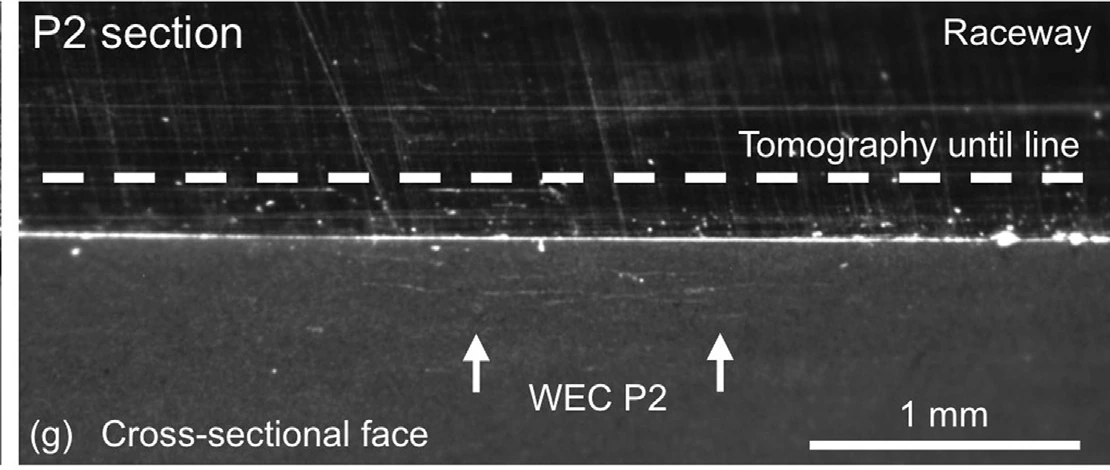
WEC Typically Initiates within High-Stress Zones
Each time a roller passes through the loaded zone, the bearing steel undergoes a cycle of rolling contact fatigue stress. The peak stress does not necessarily occur directly on the surface, but can concentrate at a specific depth beneath it.
When a gearbox operates under dynamic changing loads, slippage, vibration, or unstable lubrication, micro-structural weaknesses within the material can become crack initiation sites. Over millions of rolling cycles, the cracks expand along the vectors of the localized stress field.
Some cracks propagate nearly parallel to the surface, while others travel vertically or obliquely. As multiple branches intersect, they construct a highly complex subsurface crack network.

Microscopic Cracks with Potentially Massive Damage Zones
During early stages, the crack dimensions are purely on a micrometric scale. Therefore, a raceway surface that appears perfectly intact visually does not guarantee that the underlying material profile remains safe.
If engineers rely solely on observable surface flaking zones, they risk underestimating the structural damage severity. The underlying crack network typically propagates far wider than any visible pit spot or surface spalling mark.
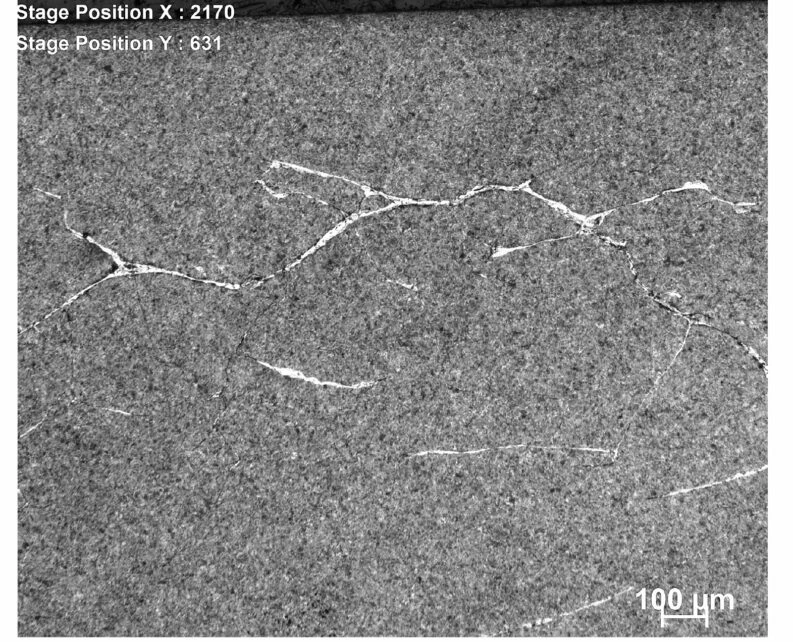
As the crack branches broaden, the intervening steel matrix becomes severely segmented, making the overlying material layer highly prone to structural instability under cyclic rolling loads.
White Etching Matter Layer Framing the Crack Paths
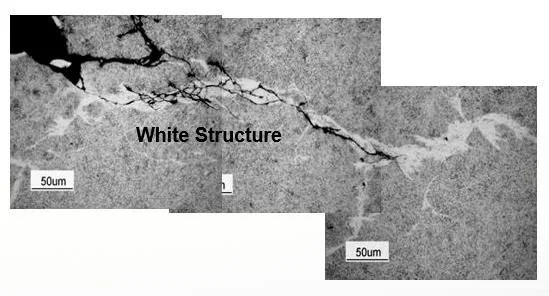
When examining metallographic samples, a white etched zone frequently appears along the crack paths. This represents a region where the steel microstructure has undergone severe transformation.
White etching structure is neither an external coating nor debris trapped inside the crack. It is the base material itself, transformed under the intense combined effects of cyclic stress, microscopic friction, and localized severe deformation.
The presence of this zone proves that structural failure has actively progressed inside the steel matrix and will continue to propagate relentlessly if the machine remains in operation.
From Hidden Subsurface Networks to Active Raceway Spalling
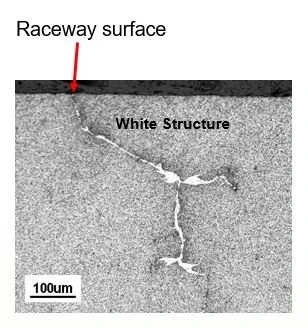
As the WEC network approaches the surface, the overlying steel armor layer becomes thin and structurally compromised. Under cyclic rolling contact fatigue, the cracks breach the raceway surface, triggering micro-pitting, edge fracturing, or sudden macro material loss.
The detached steel fragments infiltrate the lubrication oil, escalating the risk of abrasive wear on rollers, gear teeth, and sister bearings. The visually observed surface spalling area is typically only the terminal phase of a failure chain that initiated long ago.
How Can Engineers Verify WEC Presence in Bearings?
It is impossible to diagnose WEC based solely on visual surface photographs. A valid engineering evaluation must synthesize online vibration spectrums, operating temperatures, fluid oil analysis logs, metallic particle counts, and comprehensive dynamic loading history.
For dismounted bearings, the loaded zones and surface flaking boundaries must be systematically marked prior to core metallurgical sampling. The cross-sectional cutting plane must intercept the exact target site to monitor the depth profile, propagation vector, and branching density of the subsurface crack network.
These inspection results determine whether the structural failure originated from the outer surface or sub-surface, while simultaneously identifying the compounding roles of structural misalignment, slippage parameters, torsional vibration, lubrication failure, and metallurgical quality flaws.
Early Inspections Block Catastrophic Drivetrain Failure Chain Propagation
When rolling bearings exhibit escalating vibration spectrums, abnormal running noises, metallic iron particles in the oil, or chronic recurrent spalling tracks, plants should initiate deep engineering diagnostics rather than looping baseline component replacements.
Our enterprise delivers comprehensive field investigation and failure analysis services for industrial bearings, gearboxes, and high-speed rotating machinery. Our standard professional engineering scopes cover baseline on-site condition monitoring, dynamic live operation data audits, lubrication system audits, structural failure sample metallography, and custom targeted engineering remedies.
Accurately identifying the underlying WEC failure mechanism effectively eliminates chronic recurrent asset faults and mitigates catastrophic financial scrap risks across the entire drivetrain line.
If your equipment is facing operational anomalies, running erratically, or requires specialized deep engineering evaluation, contact VietSonic today for an optimized solution tailored to your line.
VietSonic Ultrasonic Equipment Co., Ltd.
📞 Phone: 0938 49 33 66 – Mr. Hải
📧 Email: info.vietsonic@gmail.com
🌐 Website: https://vietsonic.vn