



Composite delamination in wind turbine blades: danger signs and damage assessment
Wind turbine blades are not simple solid plates of material. Most modern blades are manufactured from multi-layered composite materials, combining reinforcing fibers, resin matrix, shell layers, adhesive bonding areas, and internal load-bearing structures. Thanks to this structure, blades can be lightweight yet still capable of withstanding bending, twisting, and oscillating loads over a long period.
However, this very multi-layered structure creates a highly notable type of damage: composite delamination. This is a condition where the material layers inside the blade lose their bond with one another. The danger lies in the fact that delamination is not always clearly visible from the outside. The blade surface might only show a slight bulge, a small crack, an abnormal paint area, or even no clear signs at all, but internally the material’s stiffness has already begun to degrade.
1. Why do wind turbine blades delaminate?
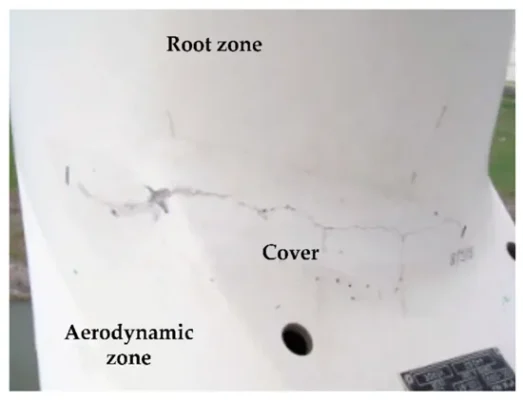
The primary cause usually stems from poor quality manufacturing or repair processes. If the bonding area between composite layers is uneven, contains air bubbles, lacks resin, is contaminated, undergoes an incorrect curing process, or the adhesive layer does not bond well, that area will become a weak point. When the blade goes into operation, this weak point continuously endures repeated loading and gradually develops into delamination.
The second cause is fatigue loading during operation. Turbine blades constantly experience bending and twisting as they rotate in varying wind conditions. Gusts, wind turbulence, yaw misalignment, repeated start-stops, or operating in complex terrains all cause the stress on the blade to change continuously. Over time, material layers can begin to separate in high-load areas.
Additionally, environmental impacts such as lightning strikes, hail, sea salt moisture, UV rays, humidity, leading-edge erosion, or impacts during transport and installation can also create starting points for delamination. For coastal, offshore, or strong wind area wind farms, the material degradation process usually occurs faster if not periodically monitored.
Identifying signs of potential delamination
Certain external signs can suggest delamination, although they are not enough to draw an immediate conclusion. These could be slight surface bulges, hairline cracks, cracks reappearing after being repaired, abnormally peeling paint areas, unusual tapping sounds during direct access inspection, or an area of the blade exhibiting unusual softness.
During operation, delamination can also manifest through increased vibration, changing noise, reduced efficiency, abnormal warnings from the monitoring system, or load discrepancies between blades. These signs should not be viewed in isolation, but placed in the context of the damage location, operational history, wind conditions, and previous incidents such as lightning strikes, hail, or emergency shutdowns.
2. What to check when delamination is suspected?
The first step is to localize the damage via visual inspection. It is necessary to record the location, size, propagation direction, surface condition, and its relationship to load-bearing zones like the blade root, leading edge, trailing edge, blade tip, or areas near internal structural components.
Then, a deeper assessment using non-destructive testing methods is required. Ultrasound can help identify voids, layer debonding, or internal bond loss within the material. Thermal imaging can help detect heat transfer differences in defective areas. For systems requiring long-term monitoring, strain sensors or FBG optical fibers can assist in tracking stress and strain changes during operation.
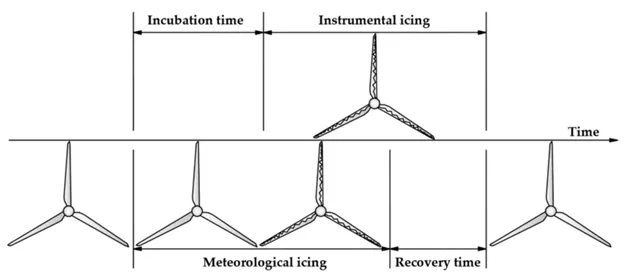
Another inspection approach is acoustic emission monitoring. When composite materials begin to crack, delaminate, or develop internal damage, this process can generate very small elastic waves. Acoustic emission sensor systems can capture these signals to help detect and locate the developing damage zone.
3. When should operation be stopped for a thorough assessment?
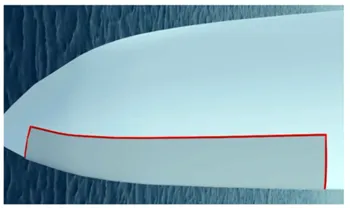
If delamination is located in a high-load area, near the blade root, trailing edge, blade tip, adhesive bonding zones, or is accompanied by abnormal vibrations, operation should not be continued based on intuition. In cases showing signs of rapidly spreading damage, cracks reappearing post-repair, major blistering, or vibration warnings exceeding thresholds, a thorough inspection is required before returning the turbine to service.
Proper initial assessment helps avoid situations where the surface is repaired but internal damage is overlooked. For wind turbine blades, early inspection and repair costs are typically much lower than the costs of prolonged downtime, blade replacement, or handling catastrophic failures that spread to the drivetrain.
4. Conclusion
Composite delamination is one of the dangerous forms of damage because it can develop inside the blade before clearly manifesting externally. A small bulge, an abnormal paint patch, or a slight change in vibration can all be early signals of structural degradation.
For a proper assessment, it is necessary to combine visual inspection, composite material testing, non-destructive methods, and operational data. If a turbine blade shows signs of delamination, recurring cracks, abnormal vibrations, or damage following lightning or hail, an experienced technical unit should be contacted to inspect, determine the impact severity, and propose appropriate solutions before the damage spreads.