



Lightning strike on wind turbine blade: what to inspect after punctures or burns appear?
Wind turbine blades are among the components most susceptible to direct impact during thunderstorms. Operating at high altitudes, often located in mountainous, coastal, or offshore areas, wind turbines are at risk of becoming lightning attraction points in bad weather. Notably, even when a turbine has a lightning protection system, the blade can still be damaged if the lightning current is not conducted safely or if the discharge point does not correctly hit the lightning receptor.
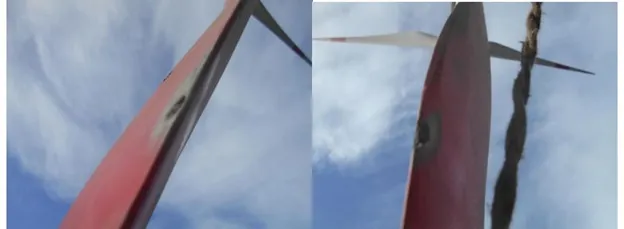
When observing punctures, burns, scorched black areas, or peeling on the blade surface, they should not be treated merely as surface damage. A lightning strike generates a massive thermal pulse in an extremely short time. External burns are just the most visible signs; inside the composite material, there may already be delamination, voids, crack propagation, burnt resin matrix, damaged reinforcing fibers, or degraded bonding between material layers.
According to technical literature on wind turbine blade damage, more than 88% of lightning attachment points occur within 1 meter from the outermost tip of the blade. This area has a very high movement speed, endures significant aerodynamic loads, and is also where the lightning receptor is typically placed. Therefore, punctures or burns at the blade tip must be evaluated very carefully, rather than just patching the surface and resuming operation.
1. Why is the blade still damaged despite having lightning protection?
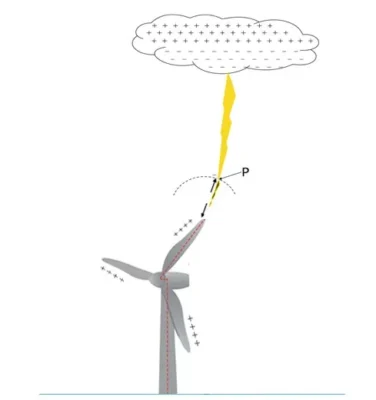
The lightning protection system on a turbine blade typically uses metal receptors to intercept the lightning current, then conducts the electricity down to the ground via internal down-conductors and a grounding system. However, in reality, the lightning current may not entirely follow the designed path.
There are many reasons for this situation. Receptors can be worn, dirty, lose contact, or suffer a decline in reception capability. The internal conductive path might be loose, broken, oxidized, or have increased resistance. The grounding system might not be adequate, especially in mountainous areas with soil and rock that have high electrical resistance. Additionally, a blade surface that is damp, salt-coated, dusty, insect-covered, or contaminated can also become an unintended discharge location.
2. What needs to be inspected after seeing punctures or burns?
The first step is a visual inspection of the entire blade, not just the burned area. It is necessary to record the damage location, puncture size, crack length, extent of coating peeling, scorched areas, blistering signs, or surface deformation. If possible, a high-resolution camera or UAV should be used to inspect all three blades, as lightning can create multiple different impact points.
Next is inspecting the blade tip area and the receptor system. This is the area most frequently struck by lightning. Check if the receptor is intact, burned, loose, missing material, corroded, or misaligned. If the receptor is damaged, merely repairing the composite shell will not resolve the root cause.
The next critical step is inspecting the internal lightning conduction path. The lightning current needs a safe escape route. If the down-conductor, joints, or contact points are damaged, the current can arc through the composite layer, creating new punctures or causing hidden internal damage. For severe incidents, it is necessary to test electrical continuity, contact resistance, and the connection status between the receptor, down-conductor, and grounding system.
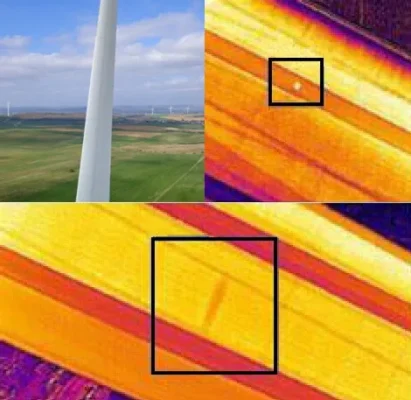
Following that is evaluating composite material damage around the struck area. High temperatures can burn the resin matrix, weaken reinforcing fibers, or cause subsurface delamination. This is the part that is difficult to accurately assess with the naked eye. Therefore, it is necessary to combine non-destructive testing methods such as thermal imaging, ultrasound, or specialized tap testing to determine the true extent of the damaged zone.
Finally, assess the capability for continued operation. A small surface puncture might still allow for localized repair. But if the damage has spread into load-bearing structures, the blade tip, trailing edge, or critical bonding areas, operation must be halted for closer evaluation. If running continues while the blade is weakened, aerodynamic loads and vibrations can cause cracks to propagate rapidly, leading to major delamination or more severe damage.
3. Conclusion
A wind turbine blade struck by lightning should not be handled with a “patch the hole, paint over the burn” approach. Three issues must be inspected simultaneously: surface damage, hidden damage within the composite material, and the condition of the lightning conduction system. Only when correctly identifying the lightning current’s path, the extent of material destruction, and the blade’s remaining load-bearing capacity, can a safe and appropriate repair plan be formulated.