



Small-Format Non-Woven Bag Welding and Cutting Machine Manufactured by VietSonic
Based on actual material samples and production requirements, VietSonic conducts research, develops the mechanical design, integrates the ultrasonic system, and performs trial runs to create equipment tailored to each company’s product.

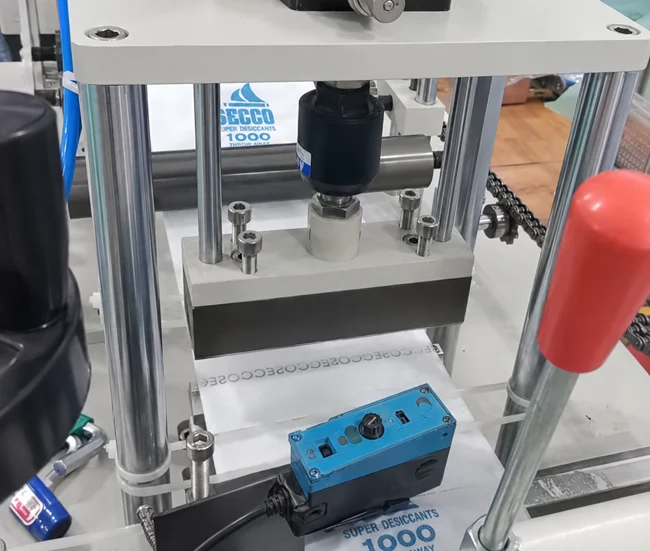
Engineered for the Exact Product Being Processed
When producing small-format bags or non-woven components, manufacturers typically require clean welds, consistent cut edges, and repeatable operation. If the equipment does not match the material width, operators must make frequent adjustments, products can easily become misaligned, and additional finishing steps may be required.
VietSonic receives the product sample, material type, required welding and cutting dimensions, and expected output. Based on this data, the engineering team develops a machine concept incorporating the appropriate guiding mechanism, pressing unit, ultrasonic horn, welding wheel or cutting blade, and control system.
VietSonic Develops the Machine’s Core Systems
Each component is engineered according to the material, product dimensions, material-feeding method, and the company’s preferred operating process.
Mechanical and Machine-Frame Design
The frame, worktable, guiding mechanism, and pressing unit are arranged to suit the available factory space, material width, and actual operator working position.
Ultrasonic System Integration
The generator, converter, horn, and force-transmission mechanism are selected so that ultrasonic energy is concentrated precisely in the required welding and cutting area.
Welding Horn and Process-Tool Manufacturing
The horn profile, welding wheel, or cutting blade is developed according to the product geometry and the required shape of the finished edge.
Process Control and Calibration
Operating parameters are configured so users can easily control speed, pressure, and energy levels for each material type.

See the Welding and Cutting Machine Manufactured by VietSonic
The video shows the machine structure and how the material passes through the ultrasonic welding and cutting unit.
From Product Sample to Completed Machine
The process is designed to reduce the risk of selecting an unsuitable configuration and enable companies to evaluate the equipment using their actual products.
Sample Assessment
Evaluate the material, dimensions, and required welding and cutting positions.
Requirement Definition
Clarify the required output, operating process, and level of automation.
Machine Design
Develop the mechanical, ultrasonic, and control-system concept.
Manufacturing and Assembly
Machine the components, integrate the assemblies, and complete the equipment.
Trial Run and Delivery
Calibrate with actual samples and provide operating and maintenance guidance.
Value for Production
- Combines welding and cutting in a single operation.
- Uses no sewing thread or adhesive at the joint.
- Produces clean material edges and helps minimize fraying after cutting.
- Reduces manual operations and secondary finishing work.
- Improves repeatability from one product to the next.
- Compact design for convenient installation within the production area.
Which Applications Is It Suitable For?
The machine can be developed for products made from non-woven fabrics or synthetic materials that are compatible with ultrasonic welding, including:
- Small-format non-woven bags and packaging.
- Bags for components or auxiliary products.
- Filter components, liners, and technical products.
- Edge-welding processes combined with edge cutting.
- Products requiring an alternative to manual sewing.
Application feasibility must be tested with the actual material and product sample before the machine configuration is determined.
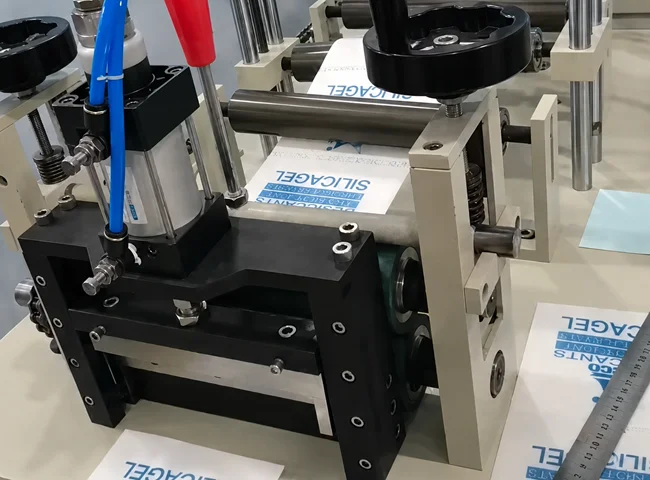

Need a Machine Designed for Your Product?
Send VietSonic your material sample, product dimensions, required welding and cutting positions, target output, and a video of the current process. Our engineering team will assess the feasibility of ultrasonic technology and recommend a suitable configuration.