Custom-engineered for the actual product

Ultrasonic sewing machine for baby tongue cleaners – custom-designed for stable operation

A solution for manufacturers seeking higher productivity, consistent seams, and baby tongue cleaners in custom sizes. VietSonic evaluates actual samples, designs the pattern roller, selects the ultrasonic configuration, and conducts trials before delivery.

The manufacturing challenge

Stable production starts with a machine configuration that matches the product

Baby tongue cleaners are small, have a multilayer structure, and require consistent seams. If the material, roller profile, or ultrasonic parameters are unsuitable, layers may shift, weld lines may become discontinuous, or the sealed edges may become too rigid or come apart during packaging and use.

Manufacturers therefore need a solution engineered around the product sample, material type, finished dimensions, and target output instead of selecting equipment solely by its nominal power.

Common manufacturing requirements

  • Continuous, strong, and visually consistent seams.
  • Stable guidance for all three material layers to minimize misalignment.
  • Accurate dimensions and embossed patterns based on the custom design.
  • Operating speed matched to cutting, inspection, and packaging processes.
  • Easy operation, maintenance, and component replacement.

The VietSonic approach

  • Evaluate the product sample and the material’s ultrasonic compatibility.
  • Design the roller profile to match the required product dimensions.
  • Fine-tune pressure, amplitude, and trial-running speed.
  • Optimize the guiding mechanism for the actual number of material layers.
  • Provide operating instructions, technical transfer, and after-sales support.
Applied technology

Ultrasonic bonding and forming of multiple material layers

The baby tongue cleaner shown in the video is made from PE film, nonwoven fabric, and a soft cotton layer. Ultrasonic energy acts at the contact area between the roller and the ultrasonic assembly, bonding the thermoplastic-containing layers while forming the specified profile.

PE film
+
Nonwoven fabric
+
Soft cotton layer
Manufacturing benefits: the edge-bonding process uses neither sewing thread nor adhesive. A continuous embossed seam is formed as the material passes through the roller, helping manufacturers reduce secondary operations and improve product-to-product consistency.
Actual machine image

The configuration is selected according to the material and product profile

Stable embossed seams depend on the ultrasonic generator, horn, roller, applied pressure, and material-guiding mechanism working together. These components must be calculated and calibrated as one integrated system.

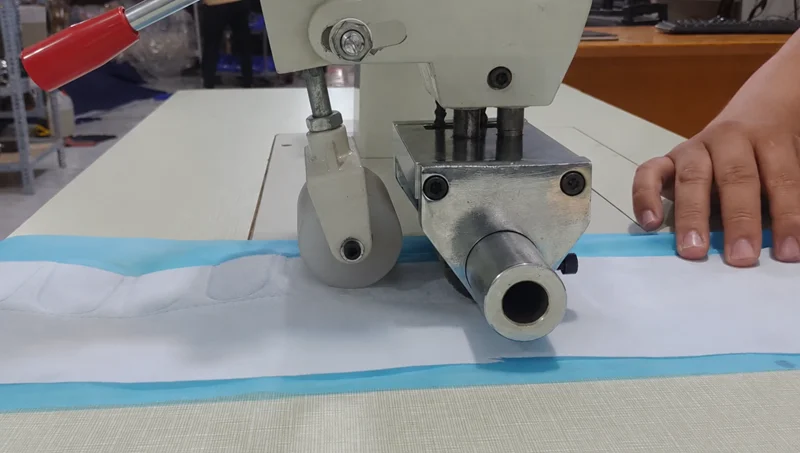
Ultrasonic sewing machine for baby tongue cleaner production
The ultrasonic sewing machine and pattern roller during baby tongue cleaner production.
Design and manufacturing capabilities

VietSonic engineers the system’s key components

Each product has a different material structure and seam requirement. Machine design therefore begins with an actual sample to determine the appropriate mechanical solution and ultrasonic configuration.

01

Sample analysis

Evaluate the number of layers, thickness, material composition, dimensions, and seam-strength requirements.

02

Pattern roller design

Develop the embossing profile, bonding area, and pattern according to the product the manufacturer needs to produce.

03

Ultrasonic optimization

Fine-tune frequency, amplitude, pressure, and speed to create consistent seams while minimizing material damage.

04

System customization

Add guiding, material unwinding, cutting, or connections to downstream processes when required.

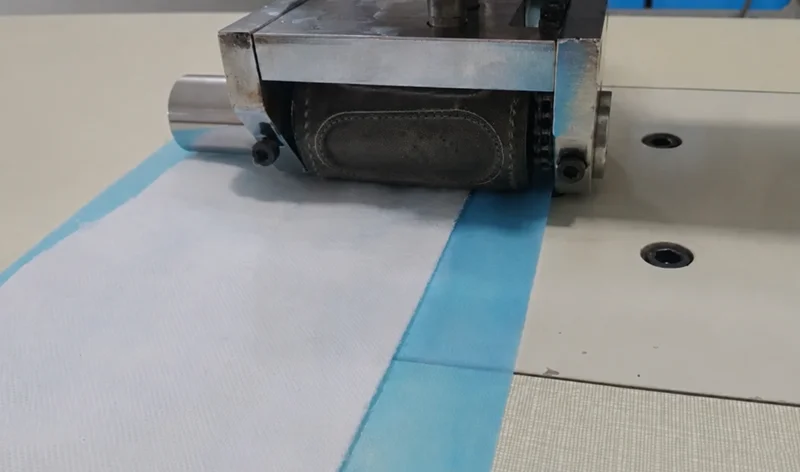
Ultrasonic sewing-machine roller forming the baby tongue cleaner profile
Close-up of the pattern-forming roller designed according to the profile and dimensions of the baby tongue cleaner.
Actual operating video

Watch the ultrasonic production process for baby tongue cleaners

The video lets manufacturers see how the material layers pass through the roller assembly to create the embossed seam and form the product. It also provides a useful reference before sending samples for a custom configuration trial.

Customization capabilities

Machine design tailored to each manufacturer’s production objectives

The final specifications are determined after material evaluation and sample trials. This approach helps prevent oversized power selection or the use of a configuration that does not match the product.

ItemDesign capabilitiesValue for manufacturers
Pattern-forming rollerDesigned according to the dimensions, outline, and embossed pattern of the baby tongue cleaner sample.Enables the development of a proprietary product shape.
Ultrasonic configurationSelects the appropriate frequency, power, and horn for the working width.Maintains stable energy across the bonding area.
Operating speedAdjusted to the material properties and seam-quality requirements.Balances productivity with finished-product consistency.
Material-guiding mechanismCustomized according to the number of layers, material width, and feeding method.Reduces shifting, wrinkling, and misalignment between layers.
Level of automationCan be engineered to integrate additional feeding, cutting, or product-collection mechanisms.Reduces manual operations and supports production expansion.
Suitable users

A solution for manufacturers seeking control over production and product development

Medical-supply manufacturers

For businesses that need consistent seam quality, higher productivity, and standardized production operations.

Mother-and-baby product companies

For companies seeking to develop their own branded baby tongue cleaners with custom dimensions and specifications.

OEM/ODM manufacturers

For factories that need flexible equipment to handle varied contract-manufacturing requirements and expand their product portfolio.

Implementation process

From product sample to an operational machine

The process allows manufacturers to evaluate the finished product before confirming the machine configuration.

What to prepare: a baby tongue cleaner sample, each material layer intended for production, finished-product dimensions, target output, and the required level of automation.

Requirement and sample review

Discuss the product structure, materials, dimensions, and expected output.

Technical solution proposal

Select the appropriate ultrasonic configuration, roller, and machine mechanism.

Design and manufacturing

Manufacture the components according to the solution agreed with the customer.

Trials with actual materials

Evaluate seam continuity, product profile, and operating performance.

Delivery and technical transfer

Provide instructions for operation, calibration, cleaning, and equipment maintenance.

Important information

Product quality depends on the complete manufacturing process

Ultrasonic equipment helps create clean and consistent seams, but the machine alone does not determine whether the finished product meets medical standards. Manufacturers must still control raw-material sources, the production environment, equipment hygiene, packaging procedures, testing, and all applicable regulatory requirements.

Can an existing mould or roller be used?

The dimensions, profile, and materials of the new product must first be compared with the existing design. If the requirements differ from the previous sample, the roller should be redesigned to ensure the correct bonding area.

Does the machine operate at a fixed speed?

The speed is calibrated according to material thickness, the number of layers, the embossed profile, and the finished-product quality requirements.

Can manufacturers send materials for sample trials?

Yes. Testing with the actual materials intended for production is an important step in evaluating bondability and selecting the appropriate configuration.


Send your samples for a suitable machine-configuration consultation

If your company manufactures baby tongue cleaners, develops mother-and-baby products, or needs a custom-engineered ultrasonic system, send material samples and output requirements to the technical team at VietSonic.

Vietnam Ultrasonic Equipment Co., Ltd.Hotline: 0938 49 33 66Email: info.vietsonic@gmail.comWebsite: vietsonic.vn