



A welding solution developed from actual filter bag samples
Ultrasonic water filter bag welding machines engineered by VietSonic for specific products
Weld performance depends on the material, number of layers, weld geometry, sonotrode, fixture, and operating parameters. Our engineering team begins with actual bag samples, conducts welding trials, and finalizes a suitable machine configuration.
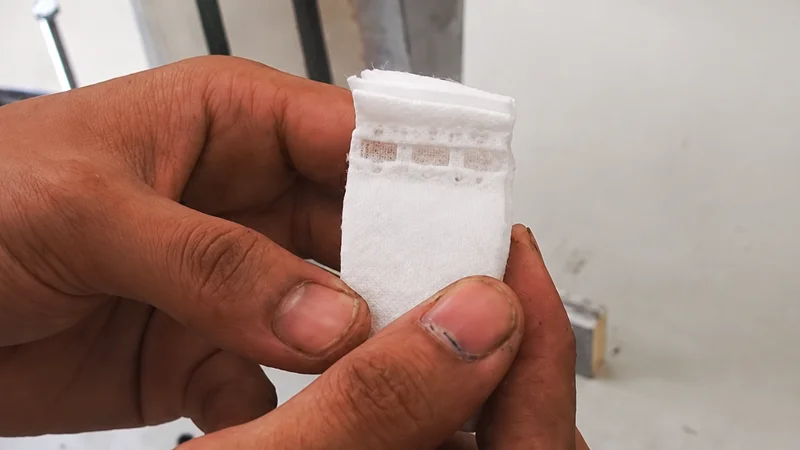
Manufacturers need a welding process suited to the material, not merely a machine
Filter bags differ in material, thickness, number of layers, and sealing requirements. An unsuitable sonotrode or parameter set can lead to incomplete bonding, deformation, or inconsistent welds.
Unstable weld performance
The bag material and construction determine how ultrasonic energy is transmitted. Actual samples must be tested to establish a suitable process window before the machine configuration is finalized.
Difficult weld positioning
The fixture must position the bonding area accurately and support repeatable operation. It is designed around the product dimensions, geometry, and loading method.
Greater repeatability is required
Time, amplitude, and pressure must be controlled through a defined process. Standardized parameters and operating steps make operator training and product control easier.
The video directly demonstrates the filter bag sample welding process
The three frames below show sample positioning, sonotrode actuation, and inspection of the welded edge after the cycle.
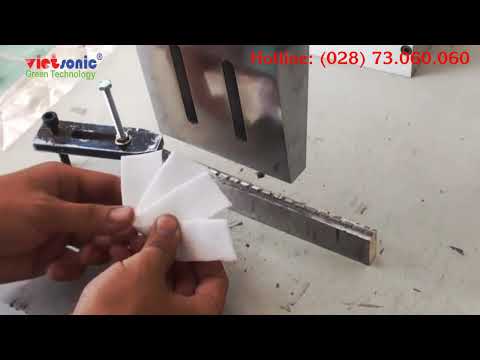
Position the sample accurately
The operator places the bonding area in the fixture and aligns it with the working position of the sonotrode.
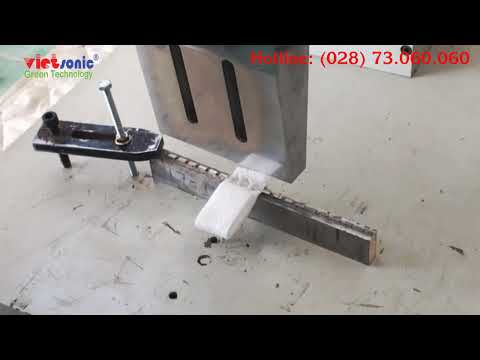
Run the welding cycle
The sonotrode transfers vibrations into the positioned material; the cycle time and energy level are set according to the sample.
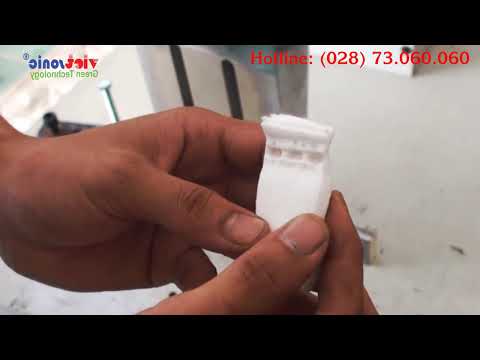
Inspect the welded edge
The bonded area is visually inspected after welding to evaluate the weld profile before further optimization.
VietSonic controls the elements that determine weld performance
The value of a custom machine lies in correctly combining the generator, transducer, sonotrode, fixture, and operating mechanism into a process suited to the product.
- Evaluate the material, number of layers, and weld-area geometry.
- Design the sonotrode and fixture around the filter bag sample.
- Conduct trials to determine suitable time, amplitude, and pressure settings.
- Perform trial runs, provide operator training, and deliver after-sales technical support.
Why is a sample required before the machine is configured?
Thermoplastic content, material thickness, coatings, and weld geometry directly affect bonding capability.
Sample trials allow our engineers to evaluate compatibility, identify process limitations, and recommend an evidence-based configuration.
Specifications are selected according to the sample and production target
The ranges below are for reference. The final configuration is confirmed after material trials and determination of the weld area.
| Item | Reference range | Selection considerations |
|---|---|---|
| Operating frequency | 15–20 kHz | Selected according to sonotrode dimensions, material construction, and application requirements. |
| Power | 2,000–2,500 W | Sufficient capacity must be available for the actual weld area and number of material layers. |
| Amplitude adjustment | 10–100%, 8 levels | Allows the ultrasonic effect to be fine-tuned during sample trials. |
| Program storage | Up to 10 programs | Allows saved parameter sets to be recalled for multiple compatible product models. |
| System protection | Overload protection; monitoring functions vary by configuration | Helps protect the ultrasonic system and supports operating-cycle control. |
A suitable process gives manufacturers better production control
The following benefits apply only after material compatibility has been confirmed and the parameter set has been developed using actual samples.
No adhesive required at the weld area
With compatible materials, ultrasonic energy creates a bond directly at the contact area. The process can reduce adhesive dispensing, curing time, and cleanup of excess adhesive.
Fast welding cycle
Energy is delivered to the bonding area within a short cycle. Actual productivity also depends on part feeding, positioning, product unloading, and the level of automation.
See the ultrasonic water filter bag welding process
The video shows how the sample is positioned, where the sonotrode acts, and how the welded edge appears after the cycle.
Send your filter bag sample to VietSonic for a welding-process assessment
Tell us the material, weld dimensions, required output, and inspection criteria. Our engineering team will discuss the sample trial and a configuration suited to your production process.