



Ultrasonic Welding of Nylon Film on an Automatic Non-Woven Bag Machine
To achieve a stable nylon-film bond on an operating production line, VietSonic designs the welding unit, fixtures, and synchronization solution around the manufacturer’s exact material, weld location, and machine cycle.
Manufacturers Need a Stable, Production-Ready System, Not Just an Ultrasonic Generator
On an automatic non-woven bag production line, weld quality depends on the material, horn profile, pressure, weld time, and feeding-system accuracy. Even with the correct power rating, improper integration can still cause incomplete welds, material scorching, misalignment, or inconsistent quality between products.
The Right Materials
The nylon film and substrate must be tested directly to determine their bonding capability and the appropriate parameter range.
The Right Weld Position
The horn, anvil, and workpiece-holding mechanism must deliver energy precisely to the required bonding area without wrinkling or shifting the film.
The Right Machine Cycle
The ultrasonic unit must be synchronized with feeding, stopping, pressing, and product discharge so it does not become a bottleneck for the entire line.
Easy Operation
Adjustment, tooling replacement, and maintenance points must be readily accessible to minimize downtime when changing product designs.
Integration Capability Is Demonstrated by the Machine’s Welding Unit
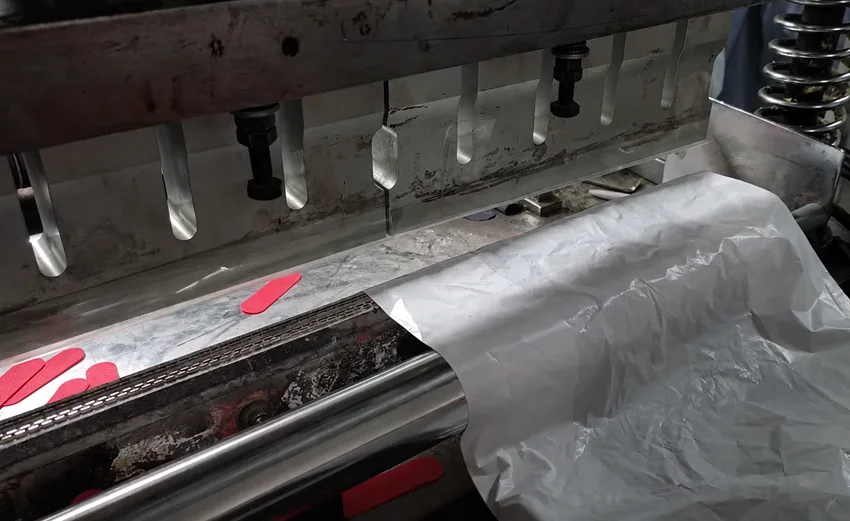
The video frame shows a multi-horn welding unit mounted directly on the non-woven bag machine. This work requires close coordination between ultrasonic technology, mechanical design, material fixturing, and cycle control.
Turning a Welding Requirement into a Production-Ready Machine Unit
VietSonic goes beyond supplying an ultrasonic generator. The solution is developed around the required weld positions, the machine’s working envelope, and the film’s characteristics. The number of horns, spacing between horns, tooling profiles, and pressing mechanism are engineered as one integrated unit.
This approach is ideal for manufacturers looking to upgrade an existing machine, develop a new bag design, or build a dedicated automated welding process without having to assemble multiple standalone devices themselves.
A Complete Welding Unit Must Address
- Rigidity and parallelism of the pressing mechanism
- Uniform pressure distribution across all weld positions
- Horn and anvil profiles matched to the bonding area
- Synchronization of ultrasonic signals with the machine cycle
- Space for operation, adjustment, and maintenance
How VietSonic Delivers a Custom Ultrasonic Welding Solution
Instead of applying one fixed configuration to every application, each solution is finalized using actual samples and the manufacturer’s required output standards.
Receive Samples and Requirements
Identify the materials, weld-area dimensions, appearance, strength, and target production rate.
Conduct Actual Weld Testing
Determine a parameter range that achieves the required weld without puncturing, shrinking, or deforming the film.
Design the Welding Unit
Engineer the horn, anvil, pressing mechanism, fixtures, and adjustment range for the product.
Integrate and Synchronize
Connect the ultrasonic process with the feeding mechanism and control cycle of the non-woven bag machine.
Trial Run and Handover
Verify stability, provide operating instructions, finalize parameters, and establish a suitable maintenance plan.
A Stable Weld Results from an Entire System of Parameters
Ultrasonic vibration generates localized heat at the interface between thermoplastic material layers. Under the correct pressure, the contact area bonds within a short cycle. However, final weld quality cannot be evaluated solely by nominal frequency or power.
- Structure and thickness of the nylon film
- Vibration amplitude reaching the weld area
- Pressure and uniformity of the pressing surface
- Ultrasonic weld time and hold time
- Horn and anvil profiles, plus machine-frame rigidity
A Solution Engineered Around Actual Production Needs
Repeatable Quality
Parameters and mechanisms finalized using actual samples reduce dependence on manual operation and limit variation between weld positions.
No Thread or Adhesive
With a compatible material combination, ultrasonic energy creates a direct bond, reduces auxiliary consumables, and keeps the processing area cleaner.
Responsive Local Technical Support
Local design, integration, and calibration make it easier for manufacturers to change product designs, perform maintenance, or improve the process.
| Business Requirement | Engineered Solution | Value Delivered |
|---|---|---|
| The existing weld is unstable | Test samples, determine the suitable parameter range, and redesign the weld interface. | Reduce trial and error on the production line and establish clearer quality control. |
| Integration into an existing machine is required | Assess the available space, machine cycle, control signals, and existing fixtures. | Use existing equipment while focusing investment on the process that requires improvement. |
| Multiple product sizes or weld positions | Design a multi-horn unit, adjustment range, or product-specific changeover module. | Shorten changeover time and improve production-line flexibility. |
| Support is required during production launch | Conduct trial runs, provide operating guidance, and hand over parameters and the maintenance plan. | Reduce risk when moving from sample testing to actual production. |
Technical Information to Understand Before Selection
The 15 kHz – 3,200 W configuration is the ultrasonic system shown in this application video. It is not a default specification for every type of film or every non-woven bag machine.
| Ultrasonic system frequency | 15 kHz |
| Ultrasonic generator power | 3,200 W |
| Application | Welding nylon film on an automatic non-woven bag machine |
| Welding configuration | Multi-horn unit arranged according to the bonding points to be processed |
| Integration approach | Designed around the bag dimensions, weld area, machine mechanism, and actual production cycle |
| Conditions for finalizing the configuration | Testing with the manufacturer’s actual material sample and required output standards |
Watch the Ultrasonic Welding Unit Operate on an Automatic Non-Woven Bag Machine
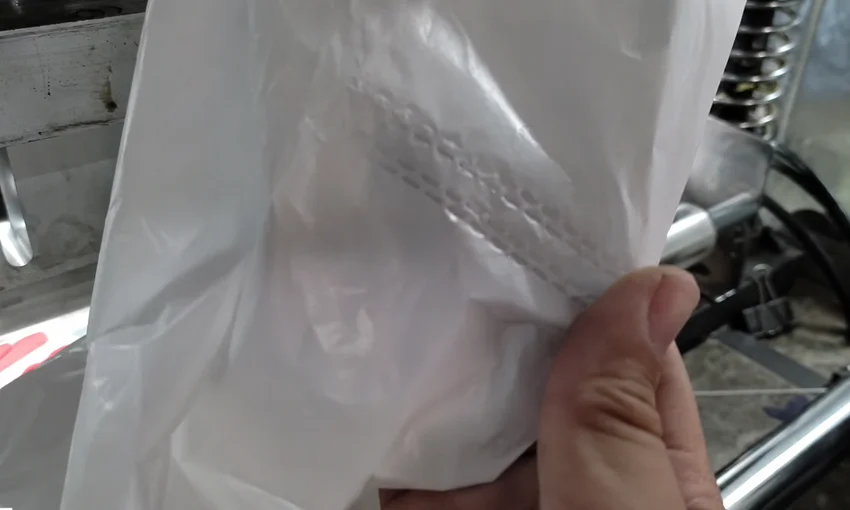
The video shows the arrangement of the welding horns, film processing on the machine, and inspection of the bonded area after welding.
Key Points Manufacturers Should Confirm Before Investing
Can every type of nylon film be ultrasonically welded?
Weldability cannot be determined from the material name alone. It depends on the thermoplastic composition, layer structure, thickness, and substrate. The actual material sample must be submitted for testing and weld evaluation.
Can the welding unit be integrated into an existing non-woven bag machine?
This can be assessed after reviewing the installation space, machine cycle, feeding mechanism, weld position, and control system. These findings determine whether an upgrade is suitable or a standalone module needs to be manufactured.
Why does this article not specify one standard speed for every production line?
Output depends on the complete cycle of feeding, positioning, pressing, ultrasonic activation, and product discharge. Speed should only be finalized after reviewing the sample, product dimensions, and data from the machine to be integrated.
What information should a manufacturer provide for fast consultation?
Prepare samples of the film and substrate, photos or video of the existing machine, weld-area dimensions, target output, and weld evaluation criteria. The clearer the information, the more accurately the testing and design solution can match actual requirements.
Start with Your Material Sample and Required Output
Contact VietSonic for weld testing, integration assessment, and a configuration tailored to your existing non-woven bag machine or production line.