



Periodic maintenance
Inspection of sealing – feeding – blister cutting faults
Professional blister packing machine repair for pharmaceutical and dietary supplement manufacturers
VietSonic provides inspection, repair, and maintenance services for blister packing machines, tablet blister sealing machines, capsule blister packing machines, softgel blister packing machines, and automatic or semi-automatic blister packaging systems. We focus on troubleshooting common faults such as poor blister sealing, film misalignment, missing tablets, inaccurate cutting, heating faults, pneumatic faults, sensor faults, servo faults, PLC faults, and HMI issues.
A blister packing machine is an important piece of equipment in a pharmaceutical packaging line. When the machine develops faults, products may have missing tablets, open seals, misalignment, or poor airtightness, directly affecting finished product quality and production schedules. Therefore, identifying the correct root cause from the beginning helps manufacturers reduce prolonged downtime, minimize packaging material waste, and avoid repeated repairs.
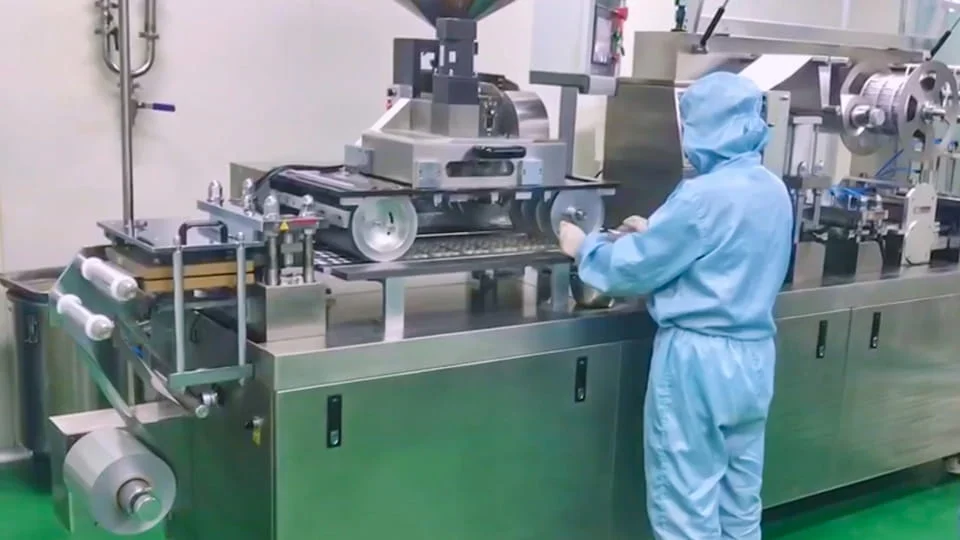
Common faults in blister packing machines
1. Blisters are not sealed properly
This fault often appears around the blister edges. The sealing surface is uneven, with areas that peel, open, or separate easily from the aluminum foil after sealing.
- Incorrect sealing temperature
- Weak or uneven sealing pressure
- Dirty, worn, or misaligned sealing mold
- Powder residue on the sealing surface
2. Poorly formed blister cavities
Blister cavities may become deformed, shallow, wrinkled, pinholed, or too shallow to properly contain tablets or capsules.
- Unstable forming temperature
- Weak air pressure or vacuum
- Unsuitable PVC/PVDC film
- Dirty or worn forming mold
3. Missing tablets or tablet jamming
Products do not fall into the cavities correctly. Tablets may tilt, break, chip, or trigger the camera to report missing tablets continuously.
- Dirty feeding hopper and guide chute
- Misadjusted brush, feeder plate, or feeding disc
- Unsuitable machine speed
- Unstable tablet dimensions
4. Film misalignment or incorrect indexing pitch
Plastic film or aluminum foil runs off-center or fails to align with the registration mark, causing the blister cavities and cutting lines to mismatch.
- Registration mark sensor fault
- Slipping film pulling mechanism
- Incorrect servo/encoder signal
- Film roll not installed concentrically
5. Misaligned cutting blade or blister burrs
Finished blisters may have rough edges, incomplete cuts, attached scrap, misaligned cuts, or jams at the punching/cutting station.
- Dull, chipped, or misaligned cutting blade
- Worn cutting mold
- Unstable film indexing pitch
- Uneven scrap winding
6. Electrical, pneumatic, or PLC alarms
The machine may stop suddenly, display alarms on the HMI, report servo faults, solenoid valve faults, sensor detection failures, or slow cylinder movement.
- Low air pressure or air leakage
- Dirty, misaligned, or damaged sensors
- Faulty solenoid valve, relay, or power supply
- PLC/HMI/servo signal loss
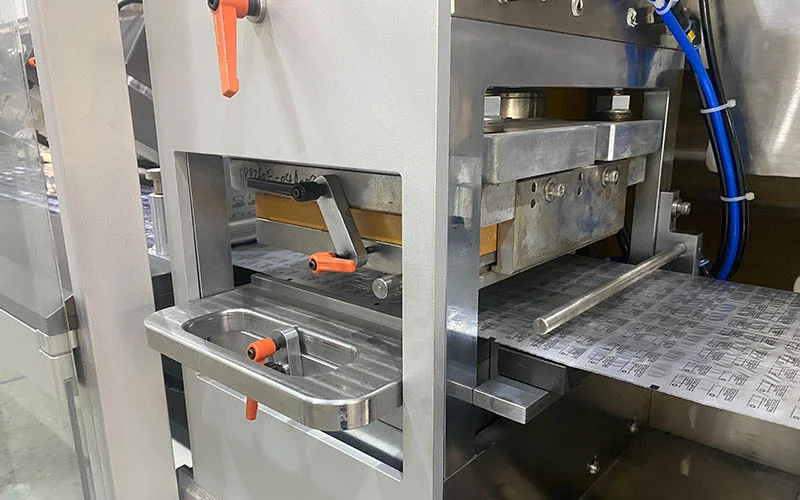
Signs that your blister packing machine should be inspected soon
Signs on finished products
- Blister packs have open edges, uneven seals, or peel off easily.
- Blister cavities are deformed, wrinkled, torn, or not formed deeply enough.
- Blisters have missing tablets, misplaced tablets, cracked tablets, or chipped tablets.
- Cutting lines are misaligned, blister edges have excessive burrs, or blisters stick together.
- Printed information or registration marks do not align with the packaging position.
Signs on the machine
- The machine stops repeatedly and shows recurring alarms on the HMI screen.
- The film pulling servo is unstable, jerks during operation, or indexes incorrectly.
- Cylinders move slowly, feel weak, or produce air leakage sounds.
- The sealing station temperature fluctuates abnormally.
- Sensors, cameras, or registration mark readers give false signals or reject products incorrectly.
What repair and maintenance items can VietSonic support?
| Item | Inspection/repair scope |
|---|---|
| Blister forming station | Inspect forming temperature, cavity forming mold, pneumatic/vacuum system, PVC/PVDC film condition, film tension, and film guiding. |
| Product feeding station | Inspect feeding hopper, guide chute, brush, feeder plate, vibration mechanism, tablet inspection camera, and tablet jamming points. |
| Sealing station | Inspect temperature, pressure, sealing time, sealing mold surface, concentricity, cleanliness, and the sealing capability of the aluminum foil. |
| Film pulling unit | Inspect servo, encoder, pulling shaft, rollers, registration mark sensor, film misalignment, and indexing pitch deviation. |
| Blister punching/cutting station | Inspect cutting blade, cutting mold, blade clearance, scrap, burrs, misaligned cutting, or incomplete cutting conditions. |
| Electrical and control system | Inspect PLC, HMI, inverter, servo driver, power supply, relay, sensors, signal cables, solenoid valves, and alarm history. |

VietSonic blister packing machine repair process
Receive fault information
Record the machine condition, such as sealing faults, blister forming faults, missing tablets, misaligned cutting, alarms, machine stoppage, or cycle-based intermittent faults.
Inspect each machine station directly
Technicians inspect the forming station, feeding station, sealing station, film pulling unit, blister cutting station, electrical system, pneumatic system, and control system.
Identify the root cause
Instead of only fixing visible symptoms, VietSonic focuses on identifying the root cause to prevent the same fault from recurring shortly after repair.
Repair, calibrate, and replace parts when needed
Perform cleaning, calibration, mechanical restoration, electrical control troubleshooting, sensor replacement, valve replacement, blade replacement, component replacement, or propose custom part fabrication when required.
Test run and inspect finished products
After repair, the machine is tested to check sealing integrity, indexing stability, cutting position, missing tablet rate, and operating stability.
Why should blister packing machines be maintained regularly?
Blister packing machines often operate continuously with heat, pressure, compressed air, servo motion, and multiple precision mechanical mechanisms. Without periodic maintenance, small issues such as dust on the mold, sensor misalignment, worn cutting blades, air leakage, or a slipping film pulling shaft can develop into major faults, causing downtime and damaging large quantities of finished packaging materials.
Machine types that VietSonic can support for inspection
Automatic blister packing machines
Support inspection of operating faults, sealing station faults, film pulling faults, punching/cutting faults, servo faults, PLC faults, and HMI faults.
Semi-automatic blister packing machines
Support troubleshooting of feeding faults, forming faults, sealing faults, blister cutting faults, and common mechanical-pneumatic faults.
Alu-PVC / Alu-Alu blister packing machines
Inspect cavity forming quality, sealing integrity, packaging material stability, and operating parameters.
Frequently asked questions about blister packing machine repair
Is poor blister sealing always caused by insufficient temperature?
Not always. Poor sealing may also be caused by weak sealing pressure, a dirty sealing mold, powder residue on the film surface, unsuitable packaging material, or a misaligned sealing station.
Where should I check first if the machine keeps producing missing tablets?
You should check the feeding hopper, guide chute, brush, feeder plate, tablet inspection camera, powder buildup, and machine speed first. If tablets jam or fall into the wrong position, the feeding unit needs to be recalibrated.
When should the cutting blade or cutting mold be replaced?
When blisters have excessive burrs, incomplete cuts, rough edges, sticking blisters, or repeated cutting faults even after calibration, the wear condition of the cutting blade and cutting mold should be inspected.
Does VietSonic provide periodic maintenance?
Yes. VietSonic supports inspection, cleaning, calibration, maintenance, and replacement recommendations for blister packing machines used in pharmaceutical plants, dietary supplement manufacturers, and related production facilities.
Need blister packing machine repair? Contact VietSonic for inspection support
If your blister packing machine has sealing faults, film misalignment, missing tablets, poor forming, inaccurate cutting, or electrical control alarms, send photos/videos of the machine condition so VietSonic can support an initial assessment.
Vietnam Ultrasonic Equipment Co., Ltd.