



Ultrasonic welding machine for inserting metal threaded inserts into ABS plastic
A fast, clean, and more stable solution for inserting metal inserts into plastic parts compared with manual assembly methods. Suitable for ABS plastic boxes, device housings, electronic components, and technical plastic parts that require strong screw-fastening points.
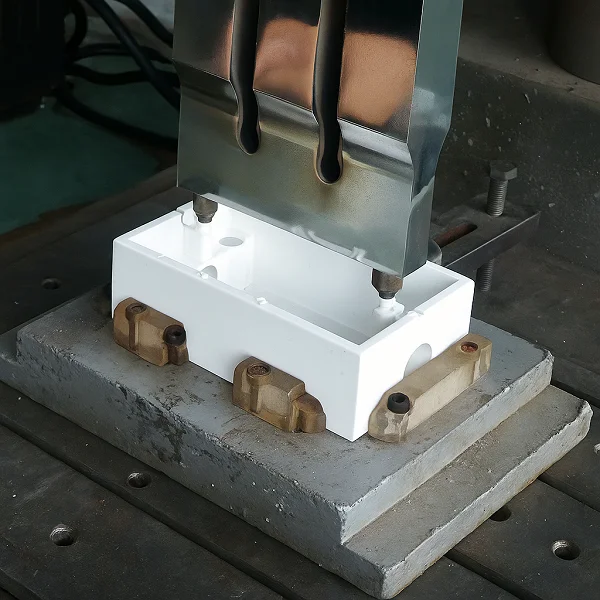
Common problems when screws are fastened directly into plastic
In many ABS plastic products, parts need to be assembled and disassembled multiple times. If screws are fastened directly into plastic, the plastic threads can easily wear out, loosen, or cause the mounting boss to crack after a period of use.
- Plastic threads can easily strip when tightened with high torque or after repeated assembly and disassembly.
- The plastic mounting boss may crack if the insert is pressed in incorrectly.
- Adhesive bonding or manual heating makes it difficult to ensure consistent quality across products.
- Manual operation lowers productivity and makes mass-production quality harder to control.
A more suitable solution
Instead of allowing screws to bite directly into plastic, an ultrasonic welding machine helps insert metal threads into pre-designed positions. During operation, ultrasonic energy locally melts the plastic around the insert, allowing the plastic to tightly grip the grooves on the insert after cooling.
As a result, the product has stronger, cleaner screw-fastening points and is suitable for mass production.
Real operation video: inserting metal threaded inserts into an ABS plastic box
The video below demonstrates the process of using an ultrasonic welding machine to insert metal inserts into an ABS plastic box. This is a common application in the production of device housings, technical plastic boxes, and parts that require screw assembly.
Principle of inserting metal threaded inserts using ultrasonic waves
The ultrasonic welding machine generates high-frequency mechanical vibration through the generator, converter, and welding horn. When the welding horn contacts the metal insert, vibration energy is transmitted to the contact area between the insert and the plastic. Local friction softens the plastic, allowing the insert to move into the correct position.
After the welding cycle ends, the plastic cools and grips the grooves, ribs, or knurled patterns on the insert body. As a result, the insert is firmly fixed inside the plastic part without adhesive, solvents, or surface contamination.
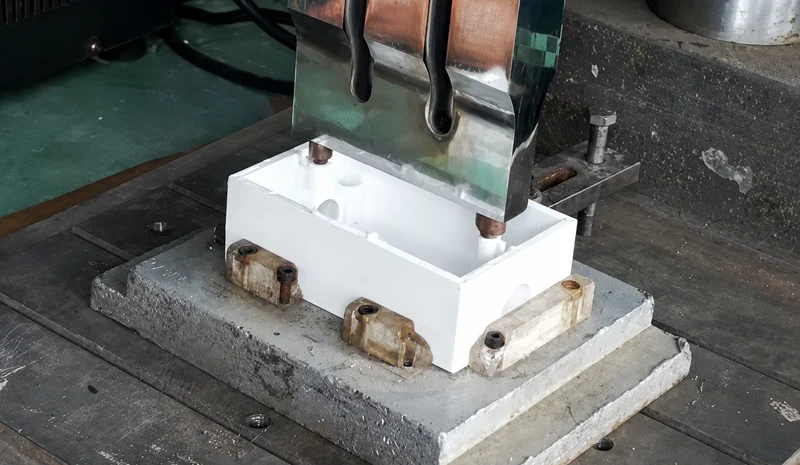
Basic operation process
Place the part into the fixture
The ABS plastic box or plastic part is placed into the fixture to ensure correct positioning. The fixture must hold the product firmly and prevent misalignment when the welding horn moves downward.
Position the metal insert
The threaded insert, nut, or metal insert is placed into the prepared hole. The hole size must match the insert diameter to ensure proper grip after insertion.
Weld and hold pressure
The welding horn transmits ultrasonic energy for a short period of time. The machine then maintains pressure briefly so the plastic can cool and lock the insert firmly in place.
Advantages of using ultrasonic welding for insert installation
- No adhesive required: reduces secondary processes, eliminates drying time, and prevents adhesive overflow on the product surface.
- Fast processing speed: suitable for mass production, with short cycle times and easy process standardization.
- Good repeatability: welding time, pressing force, stroke, and hold time can be controlled.
- Clean surface finish: helps limit scratches and deformation when the welding horn, fixture, and parameters are properly designed.
- Strong bonding: the metal insert is locked into the plastic through its grooves/ribs and the locally melted plastic area.
Practical applications of ultrasonic insert installation technology
This technology is suitable for plastic products that require durable screw-fastening points, repeated assembly/disassembly, or plastic-to-metal joining.
When should you choose an ultrasonic insert installation machine?
Recommended when
The product requires repeated screw assembly: for example, box housings, machine covers, or parts requiring regular maintenance.
Stable productivity is required: suitable for medium to large production volumes that require fast operation and less dependence on worker skill.
A clean surface is required: suitable when adhesive, dust, or auxiliary materials should be avoided.
Things to check before implementation
Plastic material: ABS, PP, PC, PA, or other engineering plastics will require different parameters.
Insert dimensions: diameter, height, gripping grooves, and tolerances directly affect fastening strength.
Prepared-hole design: an oversized hole can cause looseness, while an undersized hole can cause cracking or deformation of the plastic boss.
Key factors that determine insert installation quality
| Factor | Role in the insert installation process |
|---|---|
| Insert design | The insert should have grooves, ribs, or knurled patterns so the plastic can flow into them and lock the insert firmly after cooling. |
| Prepared-hole size | The prepared hole must match the insert. This is an important factor in preventing loose threads or cracked bosses. |
| Welding horn | The welding horn needs the correct profile, even contact, stable energy transmission, and must not scratch the product. |
| Fixture | The fixture holds the product in the correct position, limits vibration and misalignment, and helps the insert move down along the correct axis. |
| Welding parameters | Welding time, pressing force, amplitude, and hold time should be tested on samples to determine the optimal settings. |
Common defects and how to address them
The insert becomes loose after installation
This is usually caused by an oversized prepared hole, insufficient gripping grooves on the insert, or inadequate welding energy. The hole design, insert type, and welding time should be checked again.
Plastic overflow or deformation
This may be caused by excessive welding energy, high pressing force, or unsuitable hold time. Parameters should be reduced step by step, and the welding horn should be checked.
The insert is misaligned
This is often related to the fixture, welding horn alignment, or insert placement. A better positioning fixture should be designed to ensure the insert moves down along the correct axis.
The product surface is scratched
The welding horn material, contact surface smoothness, and part-fixing method should be checked. For products with high aesthetic requirements, the welding horn must be properly machined.
VietSonic provides consultation based on actual product samples
Each plastic material, insert type, and product design requires different welding parameters. Therefore, for the application of inserting metal threaded inserts into ABS plastic, VietSonic not only supplies machines but also provides solution consultation based on the customer’s actual product samples.
- Evaluate the plastic material and bonding requirements.
- Advise on welding horn type, fixture design, and insert positioning method.
- Conduct sample testing to determine suitable welding parameters.
- Support process optimization for mass production.
Frequently asked questions
Can an ultrasonic welding machine insert metal inserts into all types of plastic?
The machine can be applied to many types of thermoplastics, but the result depends on the material, prepared-hole design, insert type, and welding parameters. Each product should be sample-tested before finalizing the solution.
Does ultrasonic insert installation require adhesive?
In most cases, adhesive is not required. The bond is created when the locally melted plastic tightly grips the metal insert after cooling.
Is this application suitable for manual or automated production?
It can be implemented as a standalone semi-automatic machine, a machine with a dedicated fixture, or integrated into an automated production line depending on output volume and operation requirements.
Need to test inserting metal threaded inserts into plastic parts?
Send your plastic samples, metal inserts, and technical requirements to VietSonic. Our technical team will advise on the appropriate welding horn, fixture, and parameters to help your product achieve strength, aesthetics, and production stability.
Email: info.vietsonic@gmail.com
Website: vietsonic.vn