



Precision ultrasonic plastic welding machine for industrial production
Ultrasonic welding machines help join plastic parts quickly, neatly, and consistently without adhesives, screws, or additional materials. This is a suitable solution for businesses manufacturing plastic components, electronic device housings, medical products, packaging, household goods, and many other engineering plastic parts.
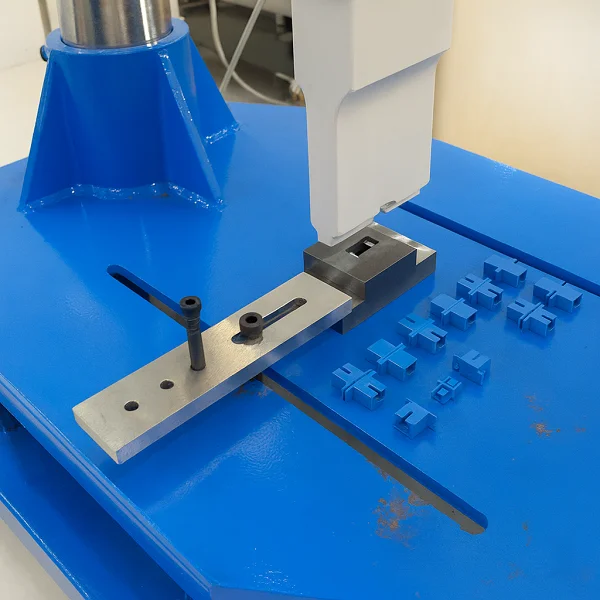
What is an ultrasonic plastic welding machine?
An ultrasonic welding machine is a device that uses high-frequency mechanical vibration transmitted through the welding horn to create friction and heat at the contact area of plastic parts. When the plastic surface reaches a localized molten state, pressing force helps the two parts bond together, creating a strong, sealed, and aesthetically pleasing weld.
Unlike adhesive bonding or screw fastening, ultrasonic welding does not require additional materials, offers fast processing time, and can be easily integrated into mass production processes.
Suitable when businesses need
- Strong, neat, and stable plastic welds across production batches.
- Fast welding speed to shorten operation time.
- No adhesive and no complicated consumable materials.
- Good control of parameters such as welding time, pressure, amplitude, and welding energy.
Practical applications of ultrasonic plastic welding machines
The images below can be replaced with photos from the old article or frames captured from real operation videos of VietSonic.
Welding engineering plastic parts
Applied to plastic parts that require high precision, such as plastic housings, plastic covers, component assemblies, assembled products, and parts with complex shapes.
Welding electronic device housings
Suitable for adapter housings, sensor housings, electrical device housings, plastic boxes, and products that require neat welds without affecting the internal components.
Welding packaging and consumer products
Can be used for edge welding, sealing, spot welding, or joining plastic products in packaging, household goods, medical products, and consumer goods manufacturing.
Advantages of ultrasonic plastic welding technology
- Fast speed: short welding time, suitable for high-volume production.
- Neat and clean welds: minimizes excess adhesive, exposed screws, or surface deformation when the parameters are set correctly.
- Material savings: no need for adhesives, solvents, or joining accessories.
- Easy to control: welding time, holding time, pressing force, amplitude, and energy can be adjusted.
- More suitable for a cleaner production environment: reduces adhesive odor, additional processing steps, and dependence on consumable materials.
Plastic welding process using an ultrasonic welding machine
Place the product
The plastic parts are positioned correctly on the fixture to ensure stable contact at the welding area.
The welding horn presses down
The welding horn contacts the product and transmits ultrasonic vibration into the area to be welded.
Localized plastic melting
Friction at the contact area softens and melts the plastic, creating conditions for bonding the two surfaces.
Hold pressure and complete
The product is held briefly so the weld can stabilize before being removed.
Real operation video of an ultrasonic welding machine
The video should be placed after the principle and application sections so customers can easily understand the actual welding process. Replace the YouTube video code below with the most suitable video from the VietSonic channel or video library.
When should you choose an ultrasonic welding machine for plastic products?
Not every type of plastic and product structure can be welded well by ultrasonic technology. Weld quality depends on the material, welding rib design, contact area, product rigidity, fixture accuracy, and operating parameters.
- Products require strong, sealed, or aesthetically pleasing welds.
- Repeated production with medium to high volume.
- Need to reduce adhesive bonding, screw fastening, or manual processing steps.
- Plastic parts have a suitable design for vibration transmission and welding energy concentration.
Factors to check before welding
| Factor | Items to consider |
|---|---|
| Plastic material | ABS, PC, PP, PE, PA, PBT, PMMA, or other engineering plastics. |
| Welding area design | Welding ribs, contact edges, thickness, and product sealing requirements. |
| Fixture | Holds the product firmly and in the correct position to limit misalignment during welding. |
| Machine parameters | Welding time, pressing force, holding time, amplitude, and energy. |
Why choose VietSonic ultrasonic welding machines?
Consultation based on actual products
VietSonic supports sample review, material assessment, weld type evaluation, and machine configuration recommendations based on production needs.
Support for fixtures and welding horns
Welding horns and fixtures can be designed according to the product shape, helping the welding process become more stable and easier to operate.
Maintenance and operation guidance
The technical team supports installation, parameter setting guidance, maintenance, and troubleshooting of common issues during operation.
Need to test plastic welding samples before investing in a machine?
Send product samples or technical requirements to VietSonic for consultation on a suitable ultrasonic welding solution. Practical sample testing helps evaluate weld quality, sealing performance, strength, and production feasibility.
Email: info.vietsonic@gmail.com
Monday – Saturday: 07:30 – 17:00