



Tablet coating machine: Tablets sticking during operation – Causes, signs, and solutions
Tablets sticking during operation in a tablet coating machine is a common issue in the tablet coating process. This problem may be caused by spray rate, drying temperature, exhaust airflow, spray nozzles, compressed air, solution feed pump, tablet core quality, or the maintenance condition of the equipment.
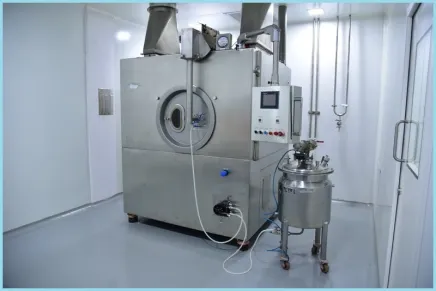
A tablet coating machine operating in a production line.
What is tablet sticking in a tablet coating machine?
During the operation of a tablet coating machine, tablet sticking is a fairly common issue. This occurs when tablets inside the coating pan are not dried in time, the tablet surface remains wet, the coating film has not stabilized, and tablets collide with each other and stick together.
This condition can appear at different levels: tablets sticking lightly in pairs, tablets forming small clusters, tablets becoming tacky, color smearing, uneven surfaces, tablets sticking to the coating pan wall, or the film layer being pulled, peeled, or exposing the tablet core.
Important note: If the root cause is not handled properly, tablet sticking can damage the entire coating batch, increase machine cleaning time, cause material loss, and directly affect product quality.
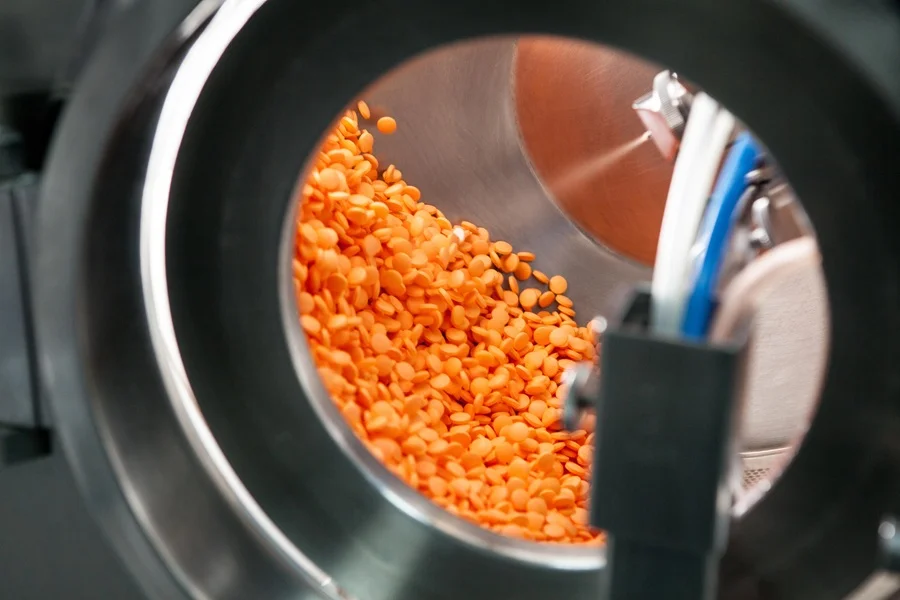
Inside the tablet coating pan, tablets are being tumbled and sprayed with coating solution.
Signs that tablets are sticking during tablet coating machine operation
Tablet sticking does not always appear right from the beginning. In many cases, the machine runs normally at first, but after a period of operation, tablets begin to show signs of tackiness and sticking.
1Signs on the tablets
- Coated tablets stick in pairs or groups of three.
- The tablet surface has color smearing and uneven gloss.
- The film is pulled, peeled, or damaged at certain points.
- When samples are checked, the tablets still feel damp, soft, or the surface is not fully dry.
2Signs on the machine
- Clusters of sticky tablets appear inside the coating pan.
- Tablets stick to the pan wall, baffles, or areas near the air outlet.
- The coating time becomes longer, but the tablets still do not reach the required dryness.
- The machine has to be stopped several times to handle stuck tablets or clean the coating pan.
In the early stage, the issue may appear only in a small part of the batch. However, if operation continues without adjustment, tablet sticking can become more serious and may damage the entire production batch.
Why do tablets stick in a tablet coating machine?
Tablet sticking is often related to an imbalance among three main factors: the amount of coating solution sprayed – drying capability – tablet tumbling and mixing inside the coating pan.
If too much coating solution is sprayed while the hot air system, exhaust airflow, or tablet tumbling process cannot keep up, the tablet surface will remain wet for too long. When tablets continuously collide while still damp, they are very likely to stick together.

Suggested image: coating solution spray gun assembly, spray nozzle, and spraying area inside the coating pan.
1Coating solution spray rate is too high
This is one of the most common causes. When the spray rate is too high, the amount of moisture introduced into the coating pan exceeds the machine’s drying capacity. The tablet surface has not dried in time but continues to receive another layer of solution, leading to an overly wet condition.
Common signs include tablets sticking after the spray rate is increased, the tablet surface appearing unusually wet and glossy, more tablets sticking in the spray zone, or the coating layer becoming locally thick and uneven in color.
In this case, it is not advisable to simply increase the drying temperature to compensate. It is necessary to check the spray rate, spray air pressure, inlet airflow, exhaust airflow, and actual temperature inside the coating chamber at the same time.
2Inlet air temperature is insufficient or unstable
If the inlet air temperature is lower than required, the evaporation of solvent or water in the coating solution will be reduced. As a result, the tablets may stay damp for a long time, especially in batches with a large tablet load or when using a high-viscosity coating solution.
The cause may come from weak heating elements, poor heat exchanger performance, unstable steam or hot air control valves, incorrect temperature sensor readings, a temperature controller that cannot maintain stable heat, or leakage in the hot air duct.
A rather dangerous issue is when the HMI still shows that the temperature has reached the set value, but the actual temperature in the tablet bed is not sufficient. Therefore, when checking tablet sticking problems, it is necessary to compare the machine parameters with the actual condition of the tablets inside the pan.

Heating system

Exhaust fan
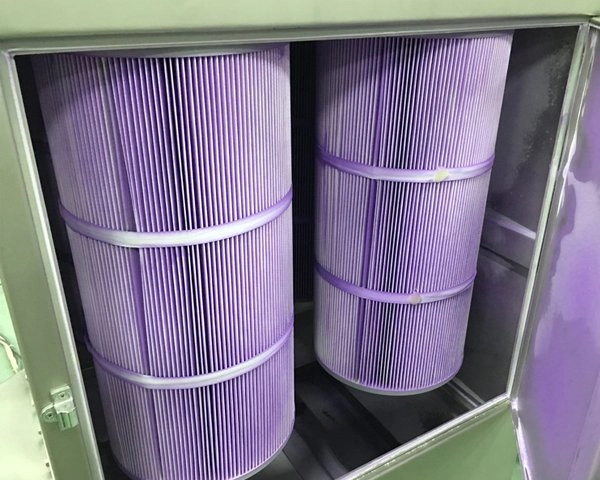
Air filter and air duct
3Weak exhaust airflow, moisture cannot escape in time
In a tablet coating machine, the exhaust airflow system plays a very important role. Hot air enters the machine for drying, but moisture must be continuously extracted. If the exhaust airflow is weak, moisture accumulates inside the coating pan, making the coating environment humid, causing tablets to dry slowly and stick easily.
Common causes include clogged exhaust filters, dust or dried coating deposits inside the exhaust duct, weak exhaust fan, dirty fan blades, incorrectly positioned exhaust damper, leaking seals or exhaust doors, and improper differential pressure in the system.
When the exhaust airflow is weak, operators often notice longer coating time, tablets remaining wet for too long, a hot and humid feeling inside the pan, and uneven tablet surface drying.
4Spray nozzle is clogged, dripping, or does not atomize properly
The spray nozzle directly affects coating quality. If the nozzle cannot produce a fine and uniform spray, the coating solution may fall as large droplets onto the tablet surface. Areas receiving large droplets become locally wet, leading to tablet sticking, color variation, or film pulling and peeling.
Common spray nozzle assembly issues include partially clogged nozzle tips, misaligned spray patterns, nozzle dripping when spraying stops, deposits on the nozzle tip, worn needle or air cap, insufficient atomizing air pressure, and improper distance from the nozzle to the tablet bed.
If tablet sticking occurs but is concentrated in only one area of the pan, the spray direction, spray pattern, and condition of each spray gun should be checked first.
5Atomizing air pressure is not suitable
Atomizing air pressure helps break the coating solution into fine droplets. If the air pressure is too low, the spray droplets become large and heavy, easily making tablets locally wet. If the pressure is too high, the solution may dry too quickly before adhering evenly to the tablets, causing a rough, dusty surface or an unstable film layer.
For tablet sticking, the common situation is low spray air pressure, fluctuating compressed air, or problems in the air filtration system. It is necessary to check the compressed air pressure supplied to the machine, pressure regulator at the spray gun assembly, air filter, water separator, oil separator, spray air solenoid valve, and air piping.
Unstable compressed air can cause the spraying process to fluctuate between strong and weak, making the coating layer uneven and increasing the risk of tablet sticking.
6Coating solution feed pump is unstable
If the solution feed pump operates unstably, the coating solution flow into the pan will fluctuate. At certain times, too much solution enters; at other times, too little is supplied. This makes the coating process unstable, causing tablets to become locally wet and stick together.
Common causes include worn peristaltic pump tubing, uneven diaphragm pump operation, stuck check valves, partially clogged solution lines, coating solution containing sediment or lumps, unsuitable solution filtration, or uncalibrated pump speed.
During inspection, do not only look at the settings on the HMI. It is necessary to observe the actual solution flow, solution line pressure, and spray stability at each spray gun.

Peristaltic pump and coating solution supply tubing.
7Coating solution has high viscosity, sedimentation, or lumps
An unstable coating solution can also cause tablet sticking. If the solution is too thick, has high viscosity, or contains lumps, the spray nozzle will have difficulty producing fine droplets. When sprayed into the pan, the solution may adhere too thickly, fail to spread evenly on the tablet surface, and cause tablets to stick.
Common problems with coating solution include insufficient mixing time, unsuitable mixing speed, solution settling after being left for too long, failure to filter the solution before spraying, unsuitable formulation, temperature changes causing viscosity changes, or air bubbles in the solution.
In practice, many cases do not involve serious machine failure. However, because the coating solution is unstable, the spray nozzle becomes clogged quickly and tablets stick during operation.
8Coating pan speed is not suitable
The coating pan speed affects tablet tumbling and mixing. If the speed is too low, the tablets are not mixed evenly, and some areas receive more solution, becoming easily wet. If the speed is too high, tablets collide strongly, leading to chipped edges, film peeling, or sticking when the film layer is not dry enough.
Signs related to pan speed include uneven tablet tumbling, dead zones, tablets accumulating on one side, sticking accompanied by chipped edges, inconsistent coating among tablets, or unusually loud collision noise inside the pan.
In addition to pan speed, the condition of the baffles, tablet load, and drive system stability should also be checked.
9Tablet load in the pan is too high or too low
A tablet coating machine is designed to operate within an appropriate load range. If too many tablets are loaded, mixing and drying capability will decrease. If too few tablets are loaded, the tablets may fall more freely, collide more strongly, and the coating layer may be damaged more easily.
When the tablet load is incorrect, the spray – drying – tumbling process becomes unbalanced. Even if the settings do not change, coating results may still vary from batch to batch.
It is necessary to check the tablet weight loaded into the pan, tablet occupancy volume, tablet shape, tablet size, mechanical strength of the tablet core, and the actual spray zone compared with the tumbling tablet bed.
10Weak tablet cores, excessive dust, or unstable moisture content
Not every tablet sticking issue comes from the machine. The quality of tablet cores before coating also has a major impact on the operation process.
If tablet cores are too soft, dusty, highly friable, or have unstable moisture content, the coating layer will have difficulty adhering evenly. Dust on the tablet surface can reduce film adhesion, causing film peeling, rough surfaces, or localized sticking.
It is necessary to check tablet hardness, friability, moisture content, dust on the tablet surface, chipped edges before loading into the pan, and tablet size uniformity.
11Temperature, pressure, or flow sensors give incorrect readings
In some cases, the machine displays normal parameters, but the actual coating process does not meet requirements. The cause may be incorrect readings from temperature sensors, pressure sensors, flow sensors, or control signals.
For example: a temperature sensor reads higher than the actual temperature, the spray air pressure sensor appears normal but pressure at the nozzle is insufficient, the airflow signal does not accurately reflect a clogged filter, a control valve opens but does not achieve the actual required flow, or the HMI displays pump speed while the solution feed pump operates unevenly.
Therefore, when handling tablet sticking problems, both the control parameters and actual machine conditions must be inspected.
12The machine has not been cleaned or maintained regularly for a long time
A tablet coating machine works with coating solution, color powder, polymers, hot air, and moisture. Without regular cleaning and maintenance, many components can accumulate deposits, become clogged, worn, or misaligned.
Positions that should be checked periodically include spray guns and nozzles, coating solution pipelines, solution tank and agitator, inlet air filter, exhaust air filter, supply fan, exhaust fan, airflow dampers, door gaskets, air duct seals, motor, gearbox, pan drive system, temperature sensors, pressure sensors, flow sensors, electrical cabinet, inverter, relay, contactor, PLC, and HMI.
A poorly maintained tablet coating machine often does not fail suddenly at first. Instead, it develops recurring quality problems: one batch has tablet sticking, the next batch has color variation, and another batch has nozzle clogging or slow drying.
Inspection procedure when tablets stick in a tablet coating machine
When tablets stick during operation, settings should not be adjusted by guesswork. The machine should be checked according to each group of possible causes to avoid making the problem worse.
Check the tablet condition inside the pan
It is necessary to determine when sticking occurs: right after spraying begins, when the spray rate is increased, in the middle of the batch, near the end of the batch, after changing the coating solution, or after cleaning or replacing parts.
Check the coating solution spray assembly
The spray pattern of each spray gun should be observed directly: whether the spray is even, whether any spray gun sprays off-center, whether dripping occurs, whether the spray droplets are too large, whether deposits are present on the nozzle tip, and whether atomizing air pressure is stable.
Check temperature and airflow system
It is necessary to check inlet air temperature, outlet air temperature, airflow, air filters, exhaust fan, dampers, and any air leakage points at doors, seals, or ducts.
Check pan speed and tablet tumbling performance
Observe the movement of the tablet bed inside the pan: whether tablets tumble evenly, whether there are dead zones, whether tablets accumulate on one side, whether the baffles work effectively, and whether the pan vibrates or produces abnormal noise.
Check coating solution and tablet cores
Evaluate whether the coating solution is well mixed, whether there is sedimentation, lumps, or air bubbles, whether the viscosity is suitable, whether the solution is filtered before spraying, whether the tablet cores contain excessive dust, and whether the tablets are too soft or easily chipped.
Quick on-site inspection suggestions
- Observe the tablet sticking area: whether it affects the entire batch or is concentrated near the spray zone.
- Check whether the nozzle is dripping, clogged, or spraying off-center.
- Compare the displayed temperature with the actual dryness of the tablets.
- Check air filters, exhaust fan, dampers, and the moisture exhaust duct.
- Re-evaluate the coating solution, viscosity, mixing time, and sedimentation or lumping condition.
Should the machine continue running when tablets start sticking?
The machine should not continue running for long when tablets have clearly started sticking. If spraying continues, the film layer will become even wetter, more tablets will stick, the surface may be pulled or damaged, and the risk of batch failure will increase.
Initial handling recommendations
- Pause or reduce the spray rate.
- Increase gentle drying if suitable.
- Check the spray nozzle and air pressure.
- Check exhaust airflow and actual temperature.
- Take samples to evaluate the tablet surface.
- Determine whether the problem is localized or affects the entire batch.
Handling must be done carefully, because increasing temperature or airflow too much can also cause other defects such as film cracking, rough surface, coating peeling, or chipped tablet edges.
VietSonic provides inspection, repair, and maintenance services for tablet coating machines
For issues such as tablets sticking during operation in a tablet coating machine, multiple systems must be checked at the same time: solution spraying, compressed air, heating, exhaust airflow, pan drive system, sensors, and control system. If only operating parameters are adjusted without checking the equipment condition, the problem may repeat in later batches.
VietSonic provides inspection, repair, and maintenance services for tablet coating machines for pharmaceutical, functional food, cosmetic, and other manufacturing facilities using similar coating equipment.
Items VietSonic can support
- Inspecting spray gun assemblies, spray nozzles, and coating solution lines.
- Inspecting solution feed pumps, solution tubing, valves, and filters.
- Inspecting compressed air, atomizing pressure, and pressure regulators.
- Inspecting heating systems, temperature sensors, and temperature controllers.
- Inspecting supply fans, exhaust fans, air filters, dampers, and exhaust ducts.
When should you call a technician?
- Tablets repeatedly stick in multiple coating batches.
- The settings have been adjusted, but the problem remains.
- Tablet sticking occurs together with color variation, film peeling, or chipped edges.
- Spray nozzles frequently clog or drip.
- The displayed temperature is stable, but tablets still dry slowly.
Contact VietSonic
If your tablet coating machine is experiencing tablet sticking during operation, slow drying, uneven spraying, nozzle clogging, color variation, or peeling coating film, contact VietSonic for inspection support and suitable solution consultation.
Vietnam Ultrasonic Equipment Co., Ltd.
Phone: 0938 49 33 66 – Mr. Hai
Email: info.vietsonic@gmail.com
Website: https://vietsonic.vn