



Capsules Do Not Drop Evenly into the Tray/Mold on a Capsule Filling Machine: Causes and Solutions
During the operation of a capsule filling machine, capsules not dropping evenly into the tray or mold is a common issue that can directly affect production speed, defect rate, and the overall stability of the production line.

In the early stage, this issue may only appear as a few capsules dropping out of position, missing the mold, or failing to enter the correct mold cavity. However, when the machine runs at high speed, this problem can easily lead to more serious failures such as capsule jams, failure to separate the capsule body and cap, incorrect powder filling cycles, or frequent machine stoppages for manual handling.
Important note: Uneven capsule dropping is not simply a “capsule jam” issue. It can be a sign of problems in the capsule feeding unit, capsule quality, vibration mechanism, compressed air/vacuum system, or mechanical wear of the machine.
Signs of Uneven Capsule Dropping
- Capsules drop inconsistently into the tray/mold.
- Some mold holes do not receive capsules.
- Capsules lie horizontally, rotate incorrectly, or stand in the wrong direction.
- Capsules accumulate at the feeding hopper or guide chute.
- The machine runs smoothly at low speed but fails when speed increases.
- The operator has to tap, shake, or manually intervene to keep capsules dropping.
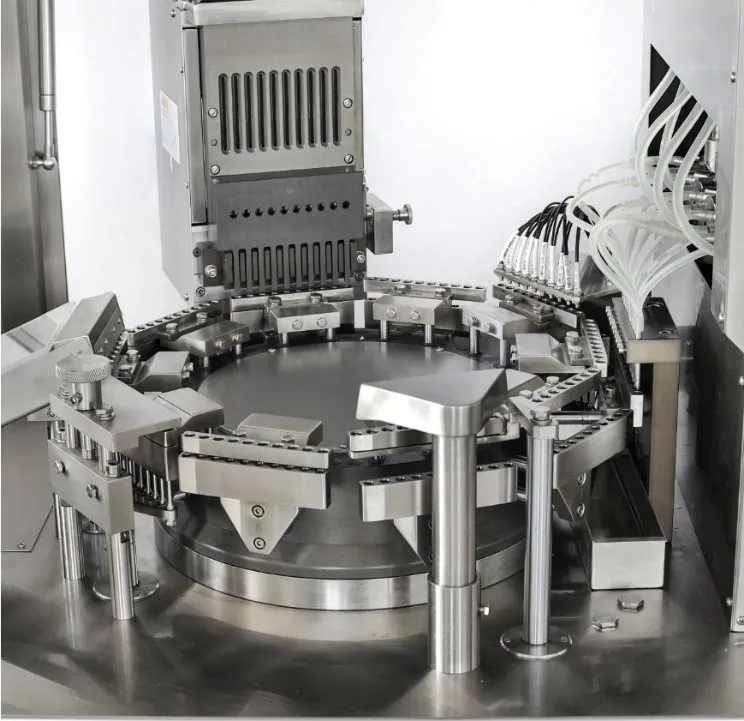
Common Causes
1. Incorrectly Sized or Deformed Capsules
If capsules are dented, bent, incorrectly sized, affected by humidity, or have uneven surfaces, the sliding and dropping process into the mold may be interrupted. This issue often appears after changing capsule suppliers or when capsules are stored under unsuitable temperature and humidity conditions.
2. Powder Dust and Debris Build-Up in the Capsule Feeding Unit
After a period of operation, fine powder dust may accumulate on the guide chute, sliding grooves, capsule feeding disc, or orientation unit. This build-up increases friction, causing capsules to drop slowly, stick together, or change direction when entering the mold.

3. Mechanical Wear or Misalignment in the Capsule Feeding Unit
Components such as guide rails, capsule distribution discs, bearings, drive cams, or positioning mechanisms may become loose, misaligned, or unevenly worn after long-term operation. As a result, capsules are no longer guided downward along their original path.
4. Improper Vibration and Speed Adjustment
If the vibration amplitude is too weak, vibration is uneven, turret speed is too high, or moving assemblies are not properly synchronized, capsules may pile up, bounce back, or drop into the wrong position. This issue is commonly seen when production capacity is increased without recalibrating the machine.
5. Effects of Static Electricity and Environmental Humidity
In overly dry environments, capsules may generate static electricity, stick to the chute wall, or attract each other. Conversely, excessive humidity may soften capsules, increase friction, and make them difficult to drop naturally.
Why Temporary Fixes Should Not Be the Only Solution
Many facilities often apply quick fixes such as increasing vibration, reducing machine speed, performing basic cleaning, or manually intervening. These methods may help the machine run again for a short time but do not solve the root cause.
If the issue comes from mechanical wear, poor concentricity, abnormal vibration, or unsuitable capsule input quality, uneven capsule dropping will continue to occur and may lead to other problems such as:
- Failure to separate the capsule body and cap.
- Empty capsules or insufficient powder filling.
- Capsules not closing tightly or powder leakage.
- Increased defect rate.
- Frequent machine stoppages during production shifts.
Items to Check When the Machine Has This Issue
- Capsule feeding hopper and guide chute.
- Capsule distribution disc, guide rails, and orientation unit.
- Tray/mold, turret, and mechanical concentricity.
- Vibration unit, vibration motor, or transmission mechanism.
- Compressed air and vacuum system if related to capsule separation.
- Capsule detection sensors and control signals.
- Powder dust, cleaning condition, and material build-up inside the machine.
- Input capsule quality and storage conditions.
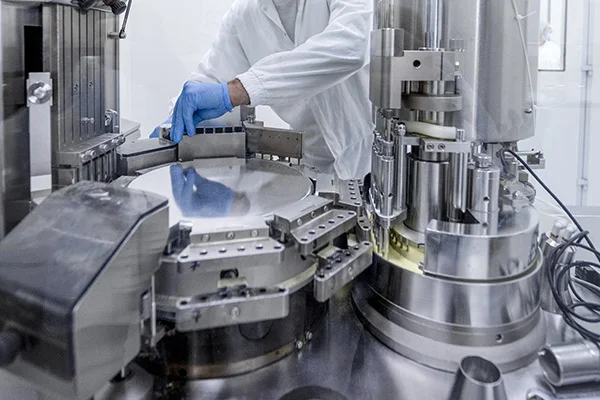
VietSonic Supports Capsule Filling Machine Inspection, Repair, and Maintenance
Vietnam Ultrasonic Equipment Co., Ltd. provides inspection, repair, and maintenance services for production equipment, including capsule filling machines. For issues such as uneven capsule dropping, capsule jams, incorrect capsule feeding position, or abnormal machine stoppages, early inspection helps reduce downtime and minimize the risk of affecting finished product quality.
Is Your Capsule Filling Machine Having Capsule Feeding Issues?
VietSonic can support on-site condition inspection, identify the cause, and propose suitable solutions based on each machine model and actual operating conditions.
- Vietnam Ultrasonic Equipment Co., Ltd.
- Phone: 0938 49 33 66
- Email: info.vietsonic@gmail.com
- Website: https://vietsonic.vn