



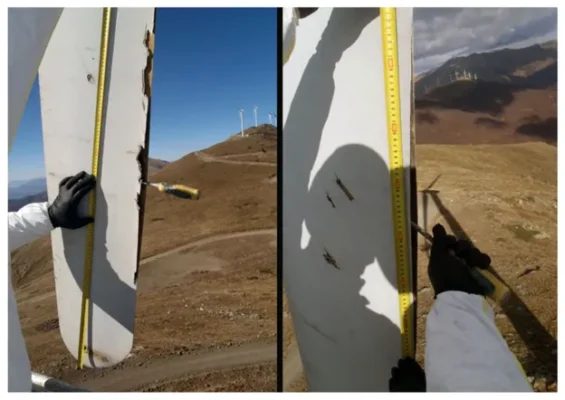
Cracked wind turbine blades: causes, danger levels, and damage assessment
Wind turbine blades directly receive wind energy and transmit force to the entire power generation system. During operation, blades must work continuously under varying loads, gusty winds, rain, dust, sea salt, UV rays, lightning strikes, and repetitive vibrations over a long period. Therefore, cracks on turbine blades should not be viewed as simple surface defects, but evaluated as an early warning sign of structural health.
A small crack located in a low-load area might only require monitoring and surface repair. But if a crack appears at the trailing edge, blade root, blade tip, adhesive bonding areas, or high-stress zones, the danger level is much higher. In composite structures, visible external cracks are sometimes just the manifestation; internally, delamination, debonding, stiffness reduction, or damage spreading along material layers may have already occurred.
1. Causes of wind turbine blade cracking
The first cause is fatigue loading during operation. Turbine blades constantly undergo cyclic bending, twisting, and oscillation. When the wind changes continuously, especially in gusty conditions or operating in complex terrains, the stress on the blade is unevenly distributed. Over a long period, weak areas begin to develop cracks.
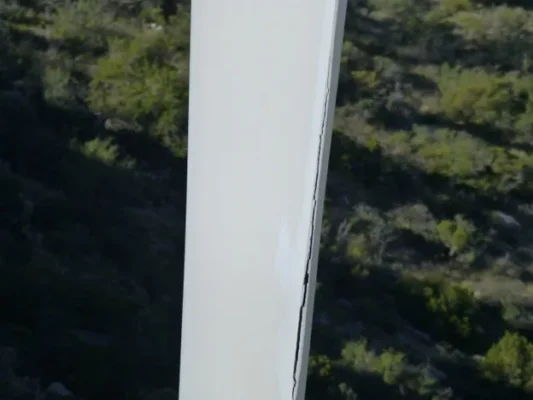
The second cause is the structural characteristics of composite blades. Turbine blades are typically manufactured from GFRP or CFRP materials, consisting of multiple layers and adhesive bonding areas between the two blade shell halves. The trailing edge is a sensitive zone because it is where the two shell halves are joined. If the bonding quality is poor, the shell thickness is reduced, or this area experiences high shear stress, cracks can form and propagate along the blade’s length.
The third cause is defects arising from manufacturing, transportation, or maintenance. Some initial defects may not be visible to the naked eye, such as poor adhesion zones, air bubbles, localized delamination, grinding that thins the reinforcing fiber layer, or impacts during transport. When put into operation, these defects undergo repeated loading and gradually develop into cracks.
In addition, environmental factors such as hail, dust, sea salt corrosion, icing, or lightning strikes can also weaken the blade surface, creating a starting point for cracking. For offshore wind farms or strong wind areas, this process usually occurs faster due to harsh operating conditions.
2. Why are cracks on turbine blades dangerous?
The danger of a crack lies not only in its visible length but also in its location, crack direction, depth, and propagation potential. A transverse crack at the trailing edge area can be more dangerous than a long surface scratch, as it might cut through the main load-bearing zone. Technical documents also emphasize that transverse cracking through the trailing edge is critical because it can weaken the highly loaded area of the blade.
As the crack spreads, the blade’s stiffness can decrease. A change in stiffness will alter the blade’s vibration characteristics. Consequently, the turbine may experience abnormal vibrations, increased noise, reduced efficiency, or higher loads transmitted to the shaft, gearbox, and tower. If operated continuously in an uncontrolled state, the crack can progress into delamination, edge debonding, localized fracture, or severe damage to the entire blade.
3. Damage assessment when cracked blades are detected
The assessment should not stop at the question “how long is the crack?”, but needs to answer the core nature: where is the crack located, which layer does it affect, has it propagated into the load-bearing structure, and will it continue to grow during operation?
The first step is visual inspection. High-resolution cameras, UAVs, or direct access inspections can be used to record the location, size, crack direction, peeling status, erosion, or surface deformation. This method is suitable for detecting surface cracks, punctures, coating delamination, and visible damage.
The next step is inspecting for hidden defects. With composite materials, the possibility of internal delamination, debonding, or voids must be considered. Thermal imaging can help detect abnormal areas due to differences in heat transfer at the crack, delamination, or void locations. Ultrasound is also a crucial method for evaluating the position, depth, and size of internal defects within the material.
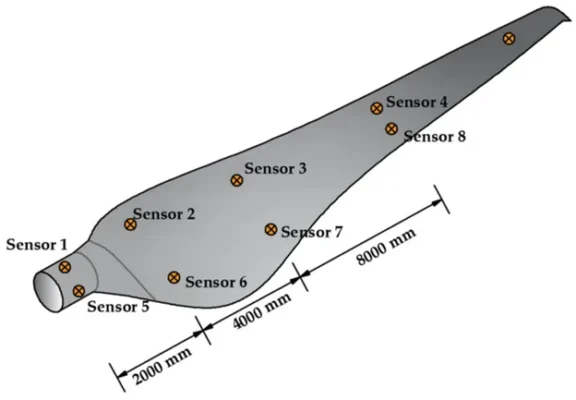
Finally, operational and vibration assessment. When a blade is cracked or loses stiffness, its vibration signature can change. Monitoring vibrations helps identify anomalies during operation, especially for hard-to-reach cases or those requiring long-term monitoring.
4. Conclusion
Cracks on wind turbine blades should not be handled based on intuition. Some cracks are merely surface damage, but others are signs of internal structural degradation. For a proper assessment, it requires combining visual inspection, composite material evaluation, hidden defect testing, and operational data analysis. Early detection and accurate cause identification will help investors avoid prolonged downtime, reduce repair costs, and limit the risk of catastrophic failure for the entire unit.
If your equipment is experiencing issues, operating unstably, or needs in-depth inspection – repair – maintenance, please contact VietSonic for appropriate solutions consulting.
Vietnam Ultrasonic Equipment Co., Ltd
📞 Phone: 0938 49 33 66 – Mr. Hai
📧 Email: info.vietsonic@gmail.com
🌐 Website: https://vietsonic.vn