



Ultrasonic ABS Plastic Welding Machine with Rotary Indexing Table for Stable Production Lines
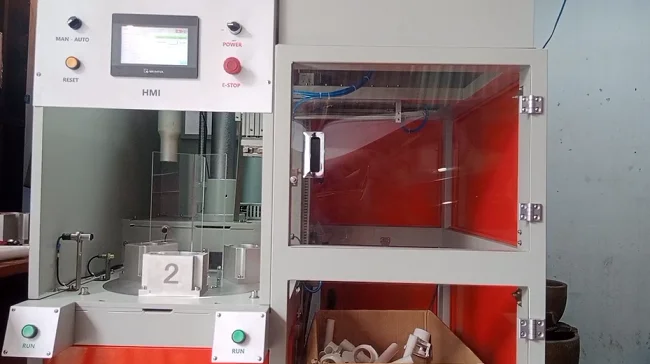
This solution combines ultrasonic welding technology with an indexing rotary table, enabling manufacturers to organize operations by station, control welding positions, and reduce dependence on manual part placement.
As Production Volume Increases, Weld Quality Cannot Depend Entirely on Manual Handling
For ABS plastic parts that require multiple assembly and welding steps, variations in part placement, clamping, or pressure adjustment can make the production cycle unstable. Manufacturers need a system that welds at the correct position while organizing each operation clearly for easier operator control.
Repeatable Welding Position
The fixture must maintain the correct alignment between both product halves and the ultrasonic horn during every cycle.
Multiple Operations Must Be Organized
The rotary table separates part loading, welding, and finished-part removal into dedicated working positions.
The Machine Must Match the Takt Time
The number of stations, indexing time, welding time, and part loading and unloading method must be calculated according to the actual output target.
VietSonic Develops Each Machine from the Actual Product Sample Instead of Applying One Standard Configuration to Every Project
The engineering team analyzes the material, weld joint, part geometry, and cycle requirements before finalizing the solution. This approach ensures that the ultrasonic horn, fixture, and mechanical motions are designed specifically for the product being manufactured.
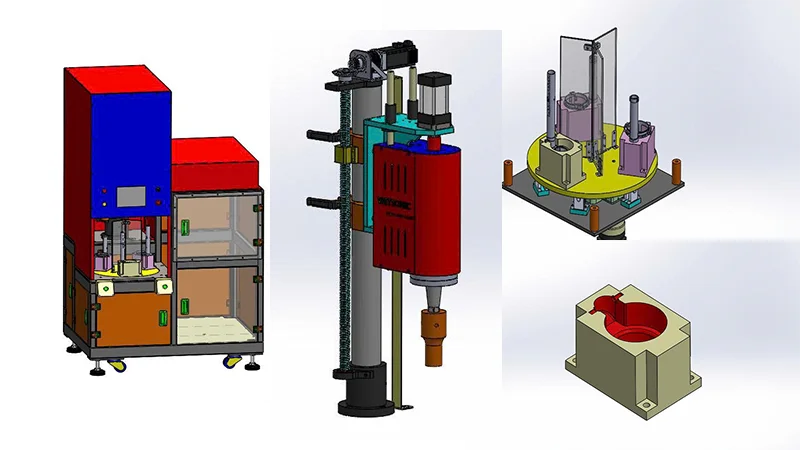
- Profile-Specific Ultrasonic Horn DesignThe contact surface is machined to match the energy-transfer area of the part.
- Custom Part-Positioning FixtureThe fixture supports the part, limits movement, and protects its surface during the welding pressure cycle.
- Rotary Table and Indexing Mechanism IntegrationMachine motions are arranged according to the operating sequence and target cycle.
- Ultrasonic Generator TuningFrequency, amplitude, welding time, pressure, and hold time are verified using actual samples.
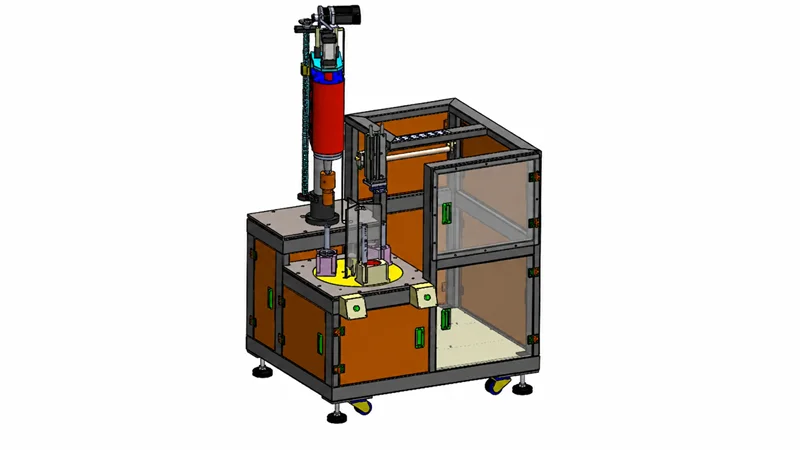
See the Machine Structure and Operating Cycle
The video allows manufacturers to see how the system is arranged in actual operation. For each new project, the machine dimensions, number of stations, fixture, and ultrasonic horn are adapted to the plastic part being produced.
Reference Configuration for This Project
The specifications below are based on the machine featured in this project. The final configuration will be confirmed after sample testing and agreement on the production requirements.
| Reference model | VS1532 |
|---|---|
| Operating frequency | 15 kHz |
| Ultrasonic power | 3.200 W |
| Power supply | 220 V |
| Station transfer mechanism | Indexing rotary table; the number of positions is designed around the product process. |
| Ultrasonic horn and fixture | Machined to match the profile, dimensions, and weld area of the actual part. |
| Expansion capability | Automatic part feeding, product unloading, or interlocking with other equipment can be evaluated when required by the project. |
VietSonic Controls the Project from Sample Testing to the Completed Machine
Manufacturers can discuss their product, weld acceptance criteria, and target cycle directly with the engineering team before fabrication begins. Each step is intended to reduce the risk of major modifications after the machine has been assembled.
Receive and Evaluate the Sample
Record the material, geometry, weld location, current defects, and target output.
Propose the Configuration
Determine the frequency, power, ultrasonic horn, fixture, number of stations, and operating sequence.
Fabricate and Integrate
Machine the mechanical components, install the ultrasonic system, and complete the controls and machine interlocks.
Test and Deliver
Tune the machine using actual samples, provide operating instructions, and agree on the acceptance criteria.
This System Is Suitable When a Manufacturer Needs To
- Repeatably weld one or more locations on an ABS plastic part.
- Arrange multiple operations around one rotary table to reduce part handling.
- Control part placement using a dedicated fixture.
- Provide a foundation for future automation upgrades.
Information to Provide for Technical Consultation
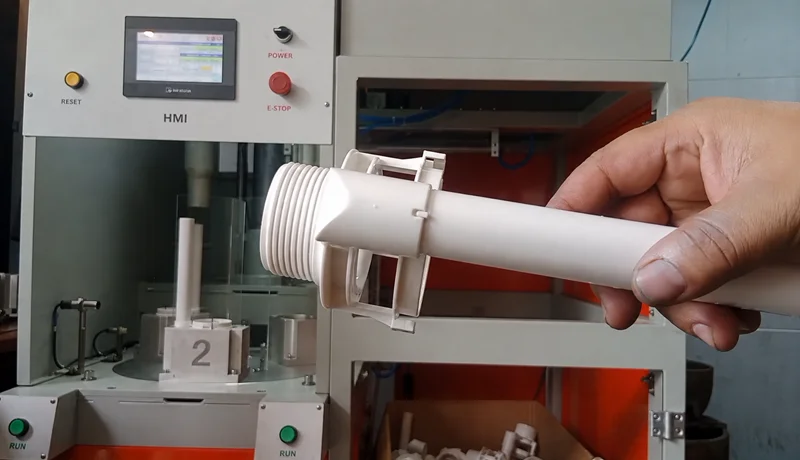
- A product sample or dimensioned drawing showing the required weld area.
- Plastic material, appearance requirements, sealing requirements, or inspection criteria.
- Required output per shift and target cycle time.
- A video of the current process, available floor space, and desired automation level.
Points to Confirm Before Machine Fabrication
Can the Machine Weld Only ABS Plastic?
Weldability cannot be determined from the material name alone. It also depends on the polymer structure, additives, energy-director design, and part geometry. Sample testing is required for technical confirmation.
How Is the Number of Rotary-Table Stations Selected?
The number of stations is determined by the required operations, welding time, part loading and unloading time, and target cycle. Each project may therefore require a different arrangement.
Are the Ultrasonic Horn and Fixture Custom-Made for the Product?
Yes. The ultrasonic horn and fixture must match the part profile, energy-transfer area, and support method. These are essential elements in the engineering scope of each project.
What Should a Manufacturer Provide to Receive an Accurate Quotation?
Please provide a sample or drawing, the plastic material, welding location, inspection criteria, required output per shift, and a video of the current process. The more complete the information, the more accurate the technical solution and quotation scope will be.
Send Your ABS Plastic Sample for VietSonic to Evaluate the Machine Solution
The engineering team will discuss the weld joint, fixture, ultrasonic configuration, and rotary-table mechanism that best match your production targets.