
Custom design and manufacturing for production requirements

Ultrasonic nanoparticle dispersion mixer developed from actual product samples

A solution for businesses facing particle agglomeration, uneven dispersion, rapid settling, or difficulty maintaining stability when scaling up from testing to production.

  • Material and solvent assessment
  • Process parameter testing
  • Suitable ultrasonic probe design
  • In-house manufacturing and calibration
Request technical consultation Send requirements by email

Businesses need to control dispersion results, not just machine power

Two systems with the same electrical power can still produce different results. Processing performance also depends on the material, solids concentration, viscosity, solvent, vibration amplitude, working probe geometry, temperature, and contact time.

01

Particle agglomeration

Particle clusters can be difficult to break apart with conventional mechanical mixing, resulting in an uneven dispersion or rapid settling after mixing stops.

02

Inconsistent results

With the same formulation, fineness and uniformity can vary between batches when processing parameters are not properly controlled.

03

Sample temperature rise

Ultrasonic energy can increase the temperature of the liquid during processing. The machine must be configured according to the thermal limits of each product.

04

Scale-up challenges

Parameters established in a small sample vessel cannot be applied unchanged to a large tank. Energy density and processing time must be recalculated.

Machine operation shown in an actual video

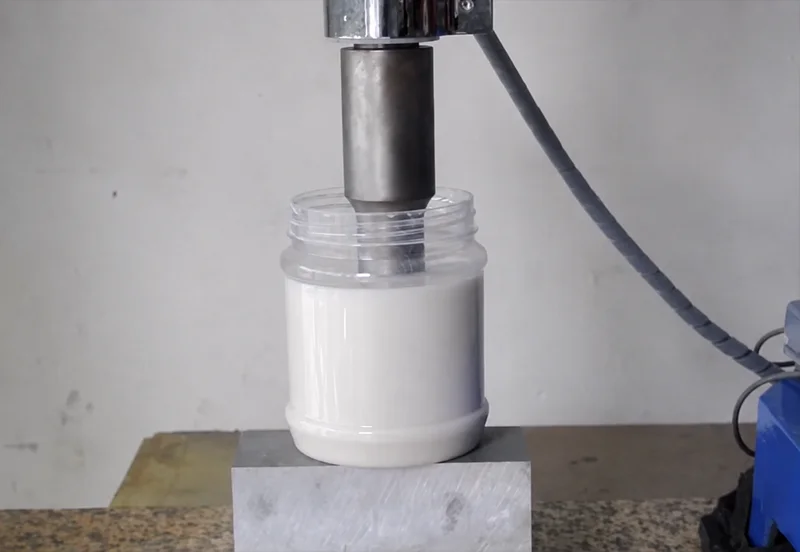
The video allows businesses to observe the ultrasonic assembly, working probe, and condition of the liquid while the machine is running.

VietSonic ultrasonic nanoparticle dispersion mixer in a test video
Ultrasonic nanoparticle dispersion

How does cavitation help break up particle agglomerates?

When the working probe transmits ultrasonic vibrations into a liquid, alternating compression and rarefaction cycles create microscopic bubbles. The formation and collapse of these bubbles generate microstreaming and localized shear forces within the treatment zone.

This energy helps break apart agglomerated particle clusters and distribute them throughout the liquid medium. The ability to maintain dispersion after processing also depends on the particle characteristics, solvent, concentration, and product formulation.

Ultrasonic equipment does not automatically guarantee nanoscale particle size

The final particle size must be verified using an appropriate measurement method. Before manufacturing production equipment, VietSonic needs to assess the sample, target particle size, desired stability, and actual operating conditions.

Sample testing helps businesses reduce the risk of selecting an unsuitable ultrasonic probe configuration, power level, or processing method.

VietSonic develops equipment based on each business’s product requirements

The equipment is configured according to the sample and processing objectives rather than using one fixed design for every type of liquid.

1

Sample intake

The technical team records the material, solvent, concentration, batch volume, current process, and performance criteria the business wants to improve.

2

Trial processing and evaluation

The sample is processed at different amplitude levels, treatment times, and thermal conditions. Results are compared against the agreed criteria.

3

Machine configuration design

VietSonic determines the frequency, power, working probe, mounting mechanism, and batch or recirculation processing method.

4

Manufacturing and calibration

The machine is fabricated, assembled, tested, and adjusted before delivery. The business receives guidance on setting operating parameters for its actual product.

Factors considered when designing the machine

  • Particle type and initial particle size.
  • Solvent, viscosity, and solids ratio in the formulation.
  • Batch volume or required processing flow rate.
  • Material temperature limits during operation.
  • Target fineness, uniformity, or stability duration.
  • Batch, recirculation, or production-line integration mode.
  • Product-contact materials and hygiene requirements.
  • Installation space, control cabinet, and level of automation.

Businesses can request customized features

  • Ultrasonic probe designed for the treatment zone.
  • Lifting and holding mechanism.
  • Mixing tank or recirculation processing unit.
  • Product cooling solution.
  • Processing time and operating mode controls.
  • Integration with existing equipment.

The final configuration is determined after the technical team evaluates the sample and production requirements.

Product groups suitable for ultrasonic feasibility testing

Each application must be tested separately because dispersion mechanisms and quality criteria differ between industries.

Inks, coatings, and chemicals

Evaluate the breakup of pigment agglomerates, particle distribution in the solvent, and improvement in suspension uniformity before subsequent processing stages.

Cosmetics and personal care products

Evaluate the dispersion of active ingredients, colorants, or dispersed phases in serums, gels, and other liquid product systems.

Food and biological materials

Evaluate component distribution in a liquid or support material processing while monitoring sample temperature and sensory characteristics.

Materials and fine-particle suspensions

Evaluate the deagglomeration and dispersion of fine particles in a liquid medium according to research or production requirements.

Ultrasonic nanoparticle dispersion mixer video

The video shows the equipment and liquid treatment process for businesses to review before submitting a sample for testing.

Reference technical configuration

The specifications below provide a basis for the initial technical discussion. Production equipment will be reconfigured according to the sample, processing volume, and operating conditions of the business.

ItemReference configurationCustomization options
Ultrasonic frequency20–40 kHz, depending on equipment configurationSelected according to load and processing requirements
PowerApproximately 1,000 W for the reference configurationAdjusted according to volume, viscosity, and operating mode
Power supply220 VDesigned according to actual installation conditions
Working probeDesigned according to the energy transmission zoneDimensions and geometry customized for the tank and sample
Operating modeBatch processingRecirculation or integration options can be evaluated
ControlsOperating parameter settingsTiming, monitoring, and interlocking functions can be added

Dispersion results must be evaluated using the actual sample. Machine specifications do not replace particle-size measurements or product stability testing.

Questions businesses commonly need to clarify

Does the machine guarantee nanoscale particle size?

A conclusion cannot be based on machine power or frequency alone. Results depend on the material, initial particle size, solvent, concentration, processing time, and measurement method. The sample must therefore be tested before the equipment configuration is determined.

Can the machine be installed on an existing tank?

An integration option can be evaluated if the tank, installation position, volume, liquid depth, and operating mode are suitable. The technical team must review the drawings or actual dimensions before designing the system.

What information should a business provide for consultation?

The business should prepare a sample, solvent composition, batch volume, current process, current processing time, and desired performance criteria.

Submit a sample to determine the appropriate equipment configuration

VietSonic accepts custom equipment development requests based on each business’s product sample, processing scale, and technical objectives.

Providing complete information from the outset helps the technical team recommend an appropriate testing method, working probe, power level, and equipment integration approach.

Call 0938 49 33 66 Send a technical email

Contact information

Vietnam Ultrasonic Equipment Co., Ltd.

Hotline: 0938 49 33 66 – Mr. Hai
Email: info.vietsonic@gmail.com
Website: vietsonic.vn

When contacting us, please include: sample information, processing volume, current process, and the results your business aims to achieve.