



VietSonic Ultrasonic Sewing Machine – Solution for threadless edge sealing, trimming, and embossing
The VietSonic ultrasonic sewing machine is a device used for edge sealing, border trimming, contour pressing, and pattern making on suitable materials such as non-woven fabrics, synthetic fabrics, fabric bags, thin plastic materials, coating films, and certain technical materials.
Unlike traditional sewing machines that use needles and threads, the ultrasonic sewing machine does not “sew” by piercing a needle through the fabric. Instead, it uses ultrasonic energy combined with the pressure of a roller to locally heat and bond the material layers together.
The highlight of this machine series is its ability to create neat, even, and beautiful weld lines without the need for sewing thread, and the welding pattern can be changed simply by replacing the roller mold.
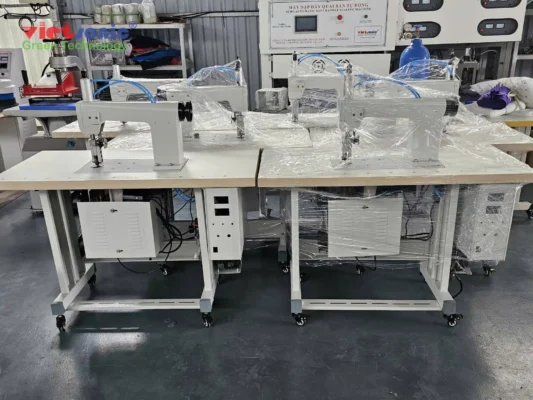
What is an ultrasonic sewing machine?
An ultrasonic sewing machine is a device that utilizes ultrasonic vibrations to create bonds on materials. As the material passes through the working area, the ultrasonic welding head and the roller mold act simultaneously on the surface. At the contact point, the material is rapidly heated and pressed together.
Because it does not use thread, this equipment is also known as a threadless sewing machine, ultrasonic fabric welding machine, non-woven bag welding machine, or ultrasonic edge sealing machine.
In terms of external appearance, the ultrasonic sewing machine has a design quite similar to a table-type industrial sewing machine. However, the difference lies in the front working assembly. Instead of a sewing needle and thread, the machine uses an ultrasonic welding head combined with a roller to create the weld line.
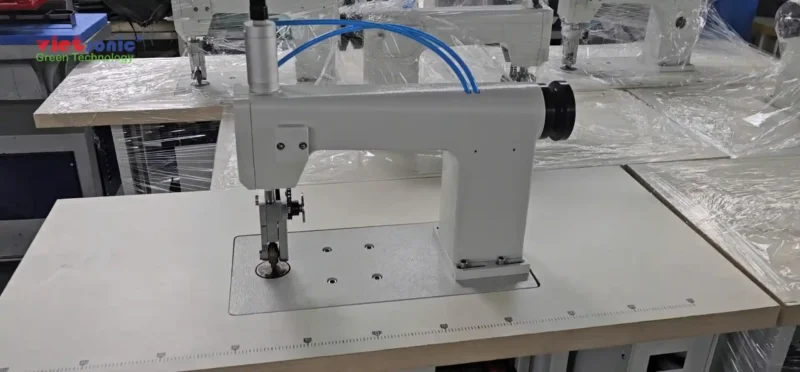
Structure of the VietSonic ultrasonic sewing machine from actual images
To make it easy for customers to visualize, the VietSonic ultrasonic sewing machine consists of the following main assemblies:
1. Machine body and worktable
The machine body is the main frame that supports the entire welding assembly, drive assembly, and operating components. The machine table is where the material is placed during operation.
The operator will feed the fabric or material to be welded through the working area at the front of the machine. Here, the roller and the ultrasonic welding head will press down to create the weld line.
The machine body needs to be sturdy enough to ensure a stable welding process, minimize vibrations, and help the weld lines become more uniform during continuous operation.
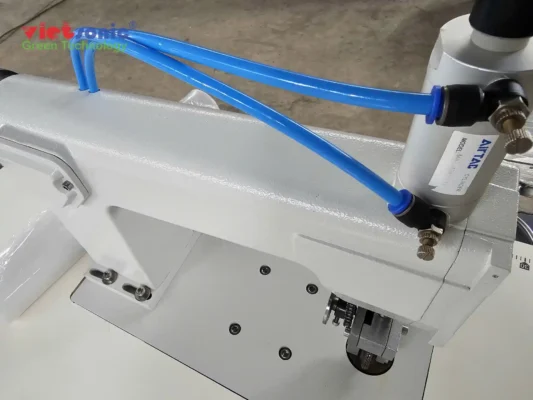
2. Pneumatic assembly and air hoses
On the machine body, you can see blue air hoses connected to the vertical column assembly. This is the pneumatic assembly, responsible for supporting the application of pressure during the welding process.
Simply put: for a beautiful and strong weld, the machine needs not only ultrasonic energy but also appropriate pressing force. The pneumatic assembly helps adjust this force to suit each type of material, thickness, and welding style.
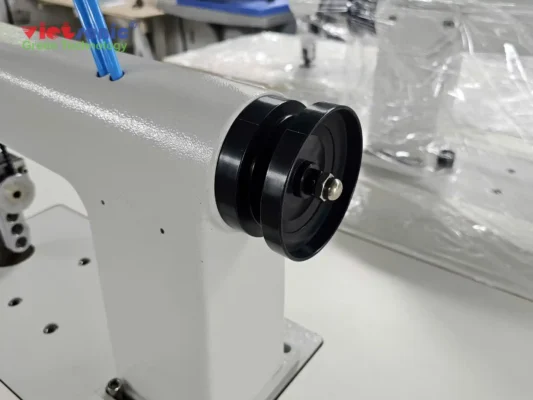
3. Rear drive assembly
At the back of the machine body is a black flywheel or pulley assembly. This is a part of the machine’s drive system, helping it operate stably and synchronizing movements while working.
For customers, this assembly can be imagined as mechanical movement support, helping the process of feeding materials through the welding zone proceed more evenly.
4. Front working head assembly
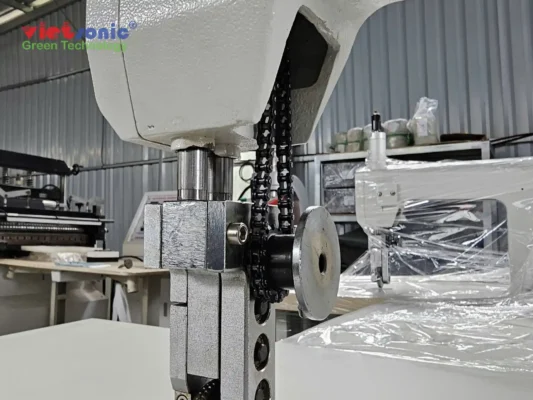
The working head assembly is the most important area of the ultrasonic sewing machine. This is where the material passes through and gets welded.
Looking at the image, it can be seen that the working head assembly includes the upper pressing part, the lower roller, and the side drive mechanism. When the machine runs, the material will pass through this zone to be pressed, welded, and form a bonding line.
5. Welding roller – the part that creates the weld
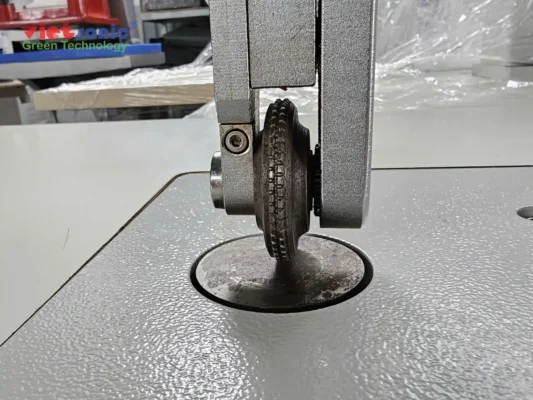
The welding roller is the component that directly contacts the material during operation. As the material passes, the roller will roll over the surface and create a weld line following the exact profile machined on the roller.
The roller can be understood as a “forming mold”. If the roller has a striped profile, the resulting weld line will be striped. If it has a toothed profile, the weld line will be toothed. If the roller is custom-machined with a pattern, the weld line will also follow that pattern.
6. Roller mold – change the welding style according to product needs
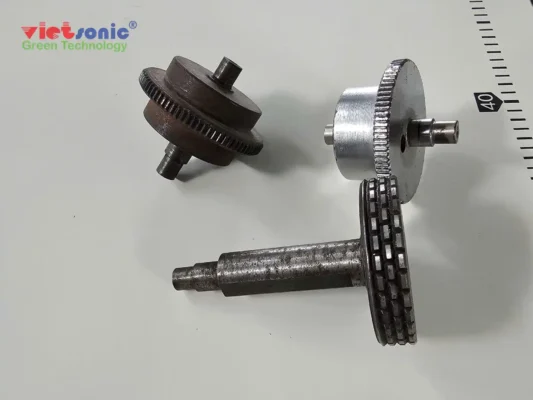
A major advantage of the VietSonic ultrasonic sewing machine is the ability to change the welding style by replacing the roller mold.
Each roller mold has a different profile. When rolling onto the material, the roller will create a corresponding welding style. Thanks to this, the same machine can be used for many different types of products such as sealing bag edges, edge trimming, creating ribbed lines, embossing patterns, or pressing decorative borders.
How does the VietSonic ultrasonic sewing machine work?
The operating principle of the ultrasonic sewing machine can be understood in simple steps:
First, the material is placed on the machine table and fed into the working area. When the machine operates, the ultrasonic welding head assembly generates high-frequency vibrations. At the same time, the roller presses down and rolls over the material surface.
At the contact point between the roller, the welding head, and the material, ultrasonic energy heats the material in a very short time. Under the impact of pressing force, the material layers are bonded together and form a weld line.
The difference compared to traditional sewing machines is that the machine does not use a needle piercing through the fabric and does not require thread. The bond is created by the ultrasonic welding process.
Why are there many different welding styles on fabric bags?
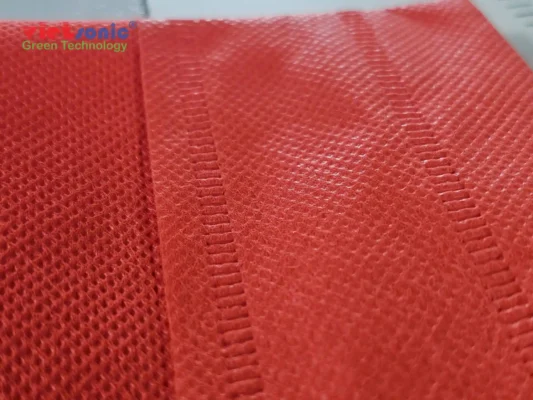
On the surface of fabric bags, straight, even weld lines repeating in a certain pattern can be seen. These lines are not created by sewing threads, but are formed by the roller mold.
Whatever profile the roller has, it will create a weld line following that profile. This is why the same type of machine can produce many different welding styles when equipped with different rollers.
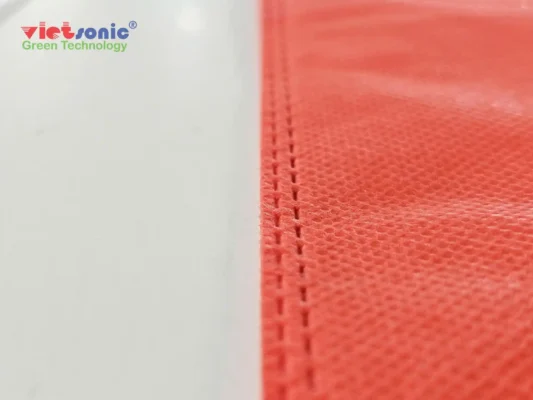
Threadless bag edge welding line
In addition to creating weld lines or patterns on the surface, ultrasonic sewing machines are also used to seal bag edges, press borders, and create edges for products.
With non-woven bags, the bag edge usually requires a neat, even, and highly aesthetic weld line. The ultrasonic sewing machine helps create edge lines without using thread, limiting problems such as thread unravelling, deviated threads, or tangled threads commonly seen when using traditional sewing machines.
Benefits of ultrasonic sewing machines compared to traditional sewing machines
1. No sewing thread required
Traditional sewing machines require needles and threads to bind fabric layers. During production, threads can break, tangle, deviate, or unravel after a period of use.
Ultrasonic sewing machines create bonds through welding, so no thread is needed. This helps reduce consumables and minimizes common errors related to thread lines.
2. No pinholes created on the material
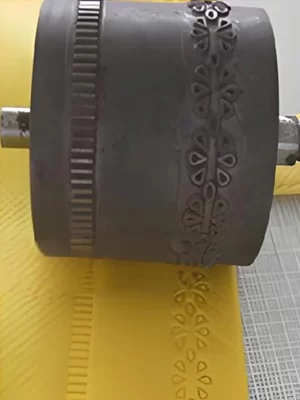
With traditional sewing machines, the needle penetrates the material to create a seam. On certain materials like non-woven fabrics, coated materials, or materials requiring a certain degree of airtightness, pinholes can affect the aesthetics and functionality of the product.
The ultrasonic sewing machine does not use a needle to pierce the material, so the weld line looks neater and does not create pinholes like thread sewing.
3. Even and aesthetic weld lines
When the appropriate material is used and parameters are correctly adjusted, the ultrasonic sewing machine can create even, beautiful, and uniform weld lines. This is an important advantage in the production of non-woven bags, advertising bags, flexible packaging, and products requiring a well-finished surface.
4. Easy to change welding styles with rollers
With traditional sewing machines, the stitching style heavily depends on the type of stitch, thread, and operating technique. With ultrasonic sewing machines, the welding style relies largely on the roller mold.
By simply replacing the roller, enterprises can change the edge trimming style, weld line, or pattern on the product. This is a massive advantage when producing various fabric bag models or different product lines.
5. Suitable for non-woven bag production
Non-woven bags are one of the most common applications of ultrasonic sewing machines. The machine can be used for edge sealing, border trimming, handle pressing, border creation, or embossing patterns on the bag surface.
For large-scale fabric bag production workshops, ultrasonic sewing machines help increase stability, reduce dependence on sewing threads, and improve uniformity across products.
6. Supports continuous production
Table-type ultrasonic sewing machines are suitable for continuous welding operations along straight or border lines. Once the operator is familiar with the process and the material is compatible, the machine can help accelerate processing speed compared to some traditional manual sewing stages.
Applications of the VietSonic ultrasonic sewing machine
The VietSonic ultrasonic sewing machine can be applied to many product groups, such as:
Non-woven bags
Advertising bags
Gift bags
Supermarket bags
Non-woven materials
Flexible packaging
Linings, coating materials
Disposable medical products
Products requiring edge sealing, border pressing, or embossing
Depending on the material, thickness, welding style, and desired output, VietSonic can advise on the appropriate machine configuration and roller mold models.
When should you choose an ultrasonic sewing machine?
Enterprises should consider using an ultrasonic sewing machine when their products require:
Threadless edge sealing
Fabric bag edge trimming
Creating beautiful and even weld lines
Creating patterns using roller molds
Minimizing pinholes on the material
Production of non-woven bags or synthetic materials
However, not all types of fabric are suitable for ultrasonic welding technology. Materials containing thermoplastic components, non-woven fabrics, or synthetic materials usually yield better results. For special materials, sample testing is recommended before choosing a machine.
VietSonic provides ultrasonic sewing machines tailored to production needs
Each type of material, thickness, and welding style will require a different machine configuration, pressing force, and roller mold. Therefore, before choosing a machine, businesses should conduct practical tests on sample products to determine if the weld line achieves the desired adhesion, aesthetics, and production speed.
VietSonic provides consulting support for ultrasonic sewing machines, ultrasonic fabric welding machines, non-woven bag welding machines, and pattern-making roller molds according to actual production needs.
Contact VietSonic today for advice on the right ultrasonic welding machine for your product.
- Zalo/Phone: 0938 493 366 – Mr. Hai
- Email: info.vietsonic@gmail.com
- Web: vietsonic.vn
