CUSTOM-BUILT SOLUTION BASED ON MATERIAL SAMPLES

Ultrasonic Sewing Machine for PP Woven Bags: Stable Seams for Continuous Production

VietSonic receives PP woven bag samples, evaluates their weldability, selects the ultrasonic system, designs the pattern roller, and calibrates the speed for the actual production process. Each business receives a machine proposal based on its material, seam location, and specific production targets.

Call Mr. Hai: 0938 49 33 66 Send a Sample for Testing

Finalize the configuration using actual PP woven samples

The machine model in the previous technical material uses a 20 kHz system and an adjustable-speed roller assembly. Final specifications must be confirmed after material testing.

20 kHzReference frequency
1,500–2,000 WSample power range
0–20 m/minSample roller speed
  • Thread-free welding on compatible materials.
  • Pattern roller designed for the required seam.
  • Sample testing before the business makes an investment decision.
When should a business evaluate this solution?

An ultrasonic sewing machine is suitable for production lines that require repeatable weld seams on PP woven bags made with compatible thermoplastic components. The roller feeds the material through the welding zone at an adjustable speed, allowing the operator to control the production pace and seam geometry.

  • The production line needs to reduce needle replacement, thread replacement, and loose-thread handling.
  • The product requires a consistent seam pattern along the opening edge, bottom, or side.
  • The business needs a machine configuration that fits its existing workstation or production stage.
  • The seam must be tested on the actual material before mass production.

Weldability depends on the material structure

PP woven bags may differ in lamination, additives, thickness, weave density, and printed surface. These factors directly affect the required power, roller pressure, and operating speed. Therefore, VietSonic tests the sample before recommending a configuration.

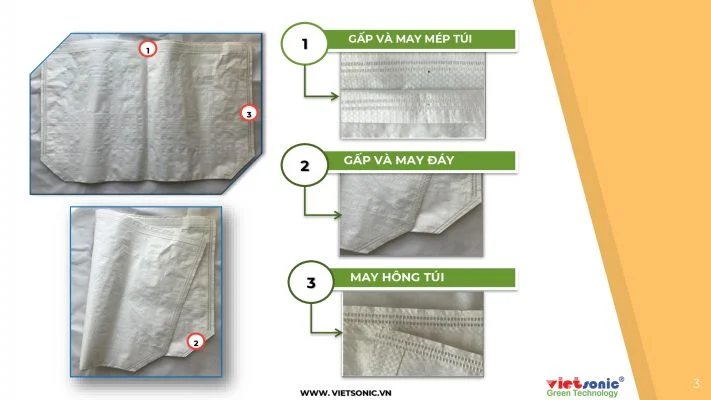
Welding positions on a PP woven bag sample processed with a VietSonic ultrasonic sewing machine

The sample bag is processed at three positions: the edge, bottom, and side.

How does the machine create weld seams on PP woven material?

The generator and transducer convert electrical energy into ultrasonic vibrations. At the contact zone between the welding horn, material, and roller, the vibrations combine with pressure to generate localized heat and bond the thermoplastic surfaces. The roller simultaneously feeds the material and forms the seam according to the selected pattern. With a compatible sample, the process requires no needles, thread, or adhesive.

Machine demonstration: ultrasonic processing of PP woven bags without thread.

Three weld positions shown on the sample

The following images are retained from the previous article so that businesses can directly examine the seam geometry. The folding structure and weld pattern can be adjusted after the technical team evaluates the actual bag sample.

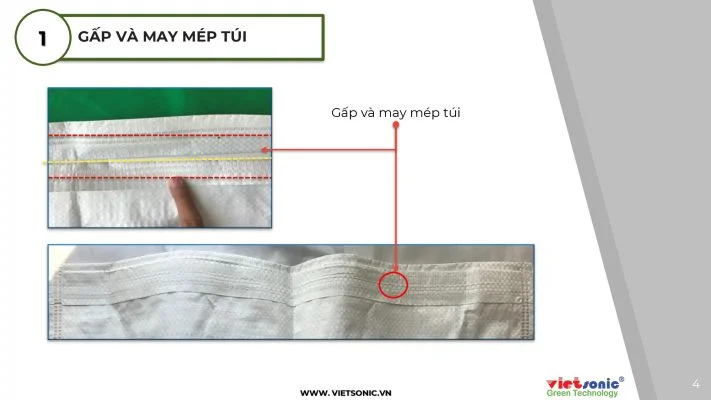
Folding and welding the edge of a PP woven bag

1. Fold and weld the bag edge

The material is folded along a guide before passing through the welding horn and roller to create a bonded seam along the edge.

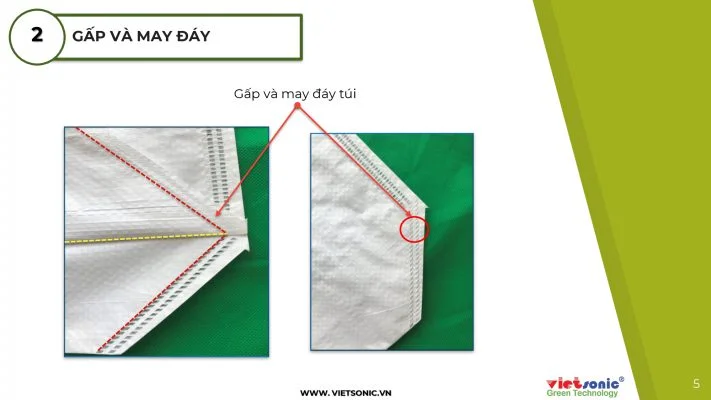
Folding and welding the bottom of a PP woven bag

2. Fold and weld the bag bottom

The bottom is formed according to the sample, then welded where the fold must be secured and the material layers bonded.

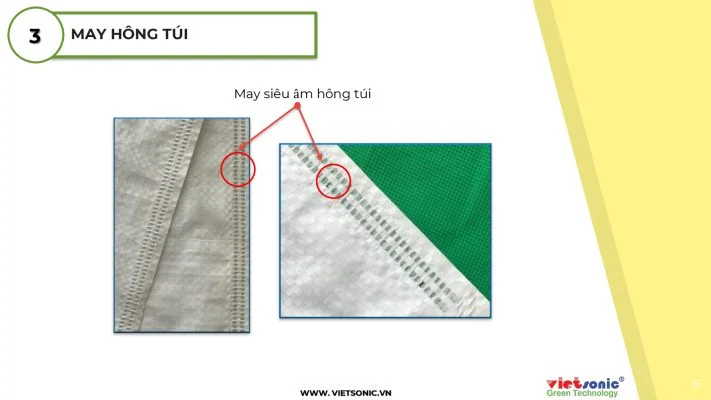
Welding the side seam of a PP woven bag

3. Weld the bag side seam

The side seam is formed with a roller pattern suited to the edge geometry and the requirements of the finished sample.

VietSonic develops each machine configuration in five steps

Manufacturing capability is demonstrated by engineering the machine around the production requirement rather than selecting a power rating from a generic specification table.

Key inputs: material sample, bag sample, required weld position, seam dimensions, target output, and installation space.
1

Receive samples and operating requirements

The technical team determines the material layers, weld position, working width, required speed, and how the machine will connect to the preceding or subsequent process.

2

Test-weld the actual material

The sample is tested to identify a suitable range of power, pressure, and speed. The result is evaluated against the appearance and bond criteria specified by the business.

3

Design the welding assembly and material-guiding mechanism

The welding horn, roller, pattern, guides, and worktable are selected or designed for the actual seam position.

4

Manufacture, assemble, and calibrate

VietSonic installs the ultrasonic system, mechanical assembly, and control cabinet, then conducts trial runs to verify stable material feeding and welding.

5

Approve the sample and hand over the machine

The business inspects samples produced on the machine and receives instructions on operation, cleaning, parameter adjustment, and maintenance of the main assemblies.

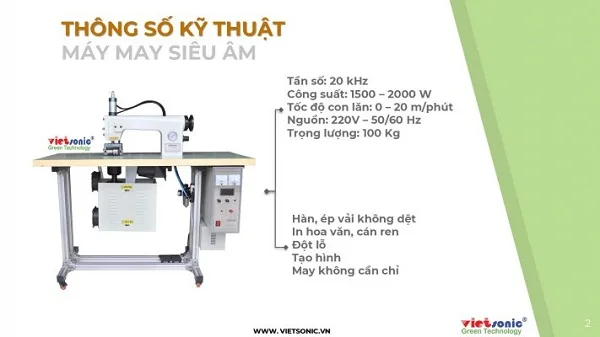
Reference configuration of the machine model in the previous article

The values below describe the machine model introduced previously. Power, speed, roller design, and material-guiding mechanisms may change according to the PP woven sample test results.

Reference specifications for a VietSonic ultrasonic sewing machine

Final order specifications must be reconfirmed for the actual machine configuration.

Ultrasonic frequency20 kHz
Reference power1,500–2,000 W
Roller speedAdjustable from 0 to 20 m/min
Power supply220 V – 50/60 Hz
Sample machine weightApproximately 100 kg

Configuration details to confirm before ordering

Ultrasonic system powerWelding horn widthRoller patternFolding and material guidesOperating speedWorktable and operator positionControls and protection

Confirming these details helps ensure that the machine matches the bag sample, operator workflow, and current production pace.

A solution developed for PP woven packaging production

The machine can be evaluated for bags used to package agricultural products, seeds, fertilizers, plastic resins, industrial chemicals, and other products that use compatible PP woven structures. Applicability must be confirmed according to the lamination, load-bearing requirements, and seam criteria of each business.

01

Reduce sewing consumables

A compatible welding process uses no needles or thread, reducing consumable replacement and loose-thread handling at this production stage.

02

Control seam geometry through the roller

The pattern, width, and geometry are determined by the welding assembly and roller, enabling the same seam design to be reproduced consistently.

03

Adjust to the production line pace

The roller speed and material-guiding mechanism are calibrated for the actual workflow, bag type, and target output.

Send a PP woven sample for a machine proposal tailored to your production line

For a prompt technical evaluation, businesses should provide a material or bag sample, required weld position, seam dimensions, target speed, and the power supply available at the installation site. VietSonic will evaluate weldability before recommending a machine configuration.

Call for Consultation: 0938 49 33 66 Email Technical Requirements

Contact information

Hotline: 0938 49 33 66 – Mr. Hai

Email: info.vietsonic@gmail.com

Website: vietsonic.vn