



Ultrasonic welding machine for plastic children’s toys – A solution to reduce defects, increase productivity and control joint quality
In plastic toy manufacturing, even a small defect such as glue overflow, open seams, loose parts, misalignment or surface deformation can force the entire batch to be rechecked. Ultrasonic welding helps manufacturers join plastic components quickly, cleanly and firmly, while making the process easier to standardize compared with manual gluing or assembly.

Why does the plastic toy welding process often create risks for manufacturers?
Children’s toys often include small components, colorful surfaces, aesthetic requirements and strong assembly needs. When the plastic joining process is unstable, the problem is not only about appearance but also directly affects delivery schedules, inspection costs and credibility with B2B customers.
Glue overflow, glue odor and drying time
Manual gluing can easily cause glue to overflow at the edges, uneven glue application and additional waiting time before packaging.
Inconsistent joints between shifts
Quality depends heavily on operator skill, hand-applied pressure, glue quantity and how the product is held during assembly.
Difficult to scale output for large orders
When output increases, manual methods can easily create bottlenecks in assembly, defect inspection and post-processing.
How does ultrasonic welding solve these problems?
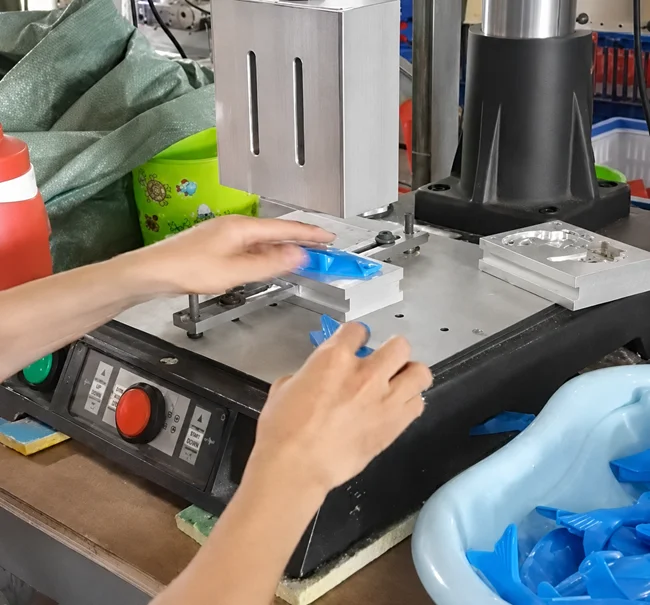
An ultrasonic welding machine uses high-frequency mechanical vibration transmitted through the welding horn to the contact area of two plastic components. Under pressure and vibration, the material at the joint area melts locally and then bonds together as it cools.
The key is not only the machine itself, but also the welding horn, fixture, joint design and parameter set suitable for each product. Therefore, for plastic toys, manufacturers should test real samples before finalizing the configuration for mass production.
- No glue, screws or auxiliary solvents are required at the welding position.
- Fast welding cycle, suitable for repetitive production.
- Clean and neat welds help reduce cosmetic defects on the product surface.
- Can be used for manual machines, semi-automatic machines or integrated production lines.
What should manufacturers check before choosing an ultrasonic welding machine?
To choose the right machine, manufacturers should not only ask about power. It is necessary to evaluate real samples, materials, welding areas, strength requirements and target output.
| Item to identify | Why is it important? | Data to send to VietSonic |
|---|---|---|
| Plastic material | Each plastic material has different energy transmission and melting characteristics. | PP, PE, PET, ABS or actual material samples. |
| Component size and thickness | Affects the required power, frequency, amplitude and pressing force. | Drawings, dimensions, plastic wall thickness and product images. |
| Welding area | Determines welding horn design, fixture design and the ability to create stable joints. | Marked welding position, sealing requirements and cosmetic requirements. |
| Target output | Helps determine whether to choose a single machine, rotary table machine, semi-automatic system or automation integration. | Products per hour, shifts per day and current production process. |
| Post-welding inspection standards | Helps determine whether to prioritize strength, sealing, surface appearance or speed. | Approved samples, defective samples, tensile test, leak test or visual inspection requirements. |
Ultrasonic welding machines are suitable when manufacturers want to reduce defects and standardize the assembly process
Reduce dependence on glue
Helps limit glue overflow, glue odor, drying time and defects caused by inconsistent glue quantity.
Increase operating speed
Short welding cycle, suitable for mass production and orders that require stable delivery schedules.
Clean and neat welds
The weld is concentrated at the joint edge, helping reduce impact on the decorated product surface.
Easy quality control
Welding parameters can be set, repeated and optimized for each product sample.
Suitable for automation
Can be combined with fixtures, rotary tables, sensors or feeding mechanisms depending on production output.
Reduce post-processing defects
When the welding horn and fixture are properly designed, products are less likely to suffer from misalignment, open seams or loose joints.
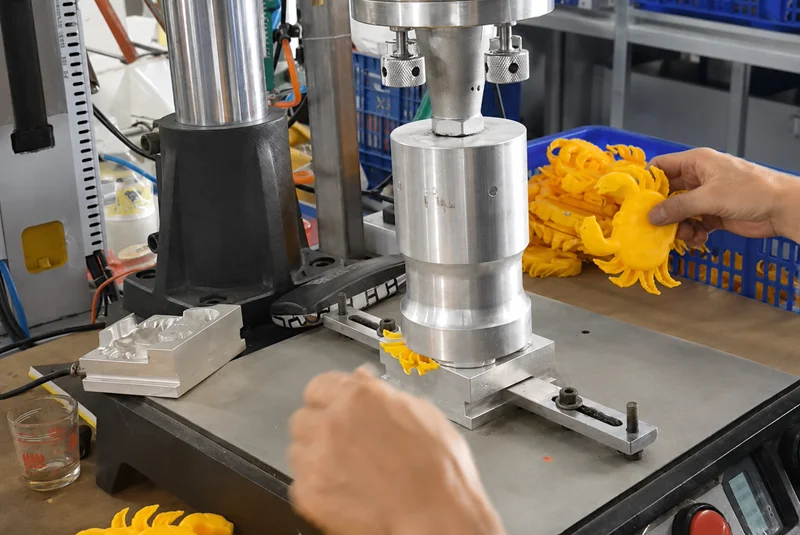
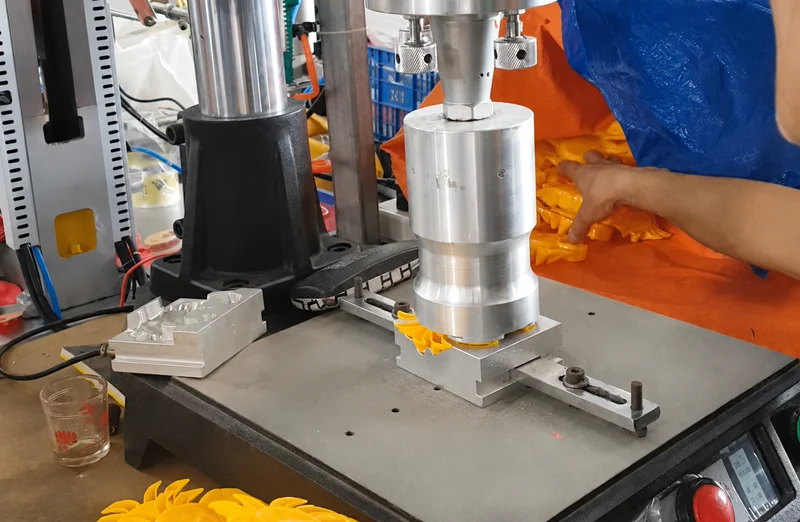
Video of ultrasonic welding machine applied to plastic toy welding
The video helps customers visualize how the product is placed into the fixture, how the welding horn presses onto the plastic component and how ultrasonic technology creates a fast joint on real products.
Product groups that should consider ultrasonic welding
- Plastic toy housings that need to be sealed, strong and visually clean.
- Toy candy containers, small plastic boxes, plastic caps and decorative components.
- ABS components that require attractive surfaces and fewer screw marks or glue traces.
- Consumer plastic products requiring repetitive high-volume production.
- Components that need to minimize the use of glue, solvents or auxiliary materials.
Ultrasonic welding compared with gluing, screwing and heat welding
| Criteria | Ultrasonic welding | Gluing | Screws/pins | Heat welding |
|---|---|---|---|---|
| Speed | Fast and easy to repeat | Requires drying time | Depends on manual operation | Moderate, depends on heating |
| Cleanliness | No glue, no solvent | Prone to glue overflow | Leaves screw/pin marks | May affect the surface |
| Stability | Controlled by machine parameters | Depends on glue quantity | Depends on tightening force | Depends on temperature and time |
| Automation | Easy to integrate with jigs, rotary tables and sensors | Difficult to control glue quantity | Requires additional screw feeding mechanism | Possible but requires heat control |
Note: The table above is used as a reference for selecting the right technology. Actual results should be tested on real product samples, materials and specific inspection requirements of each manufacturer.
From product sample to suitable machine solution
1. Sample and requirement intake
Record the material, dimensions, welding position, current defects and target output.
2. Welding feasibility evaluation
Check plastic type, thickness, joint profile and the feasibility of designing an energy director area.
3. Welding horn and fixture design
The welding horn and fixture are designed according to the product profile to ensure accurate positioning and stable force transmission.
4. Sample testing and parameter optimization
Adjust welding time, pressure, amplitude and holding time to achieve the required weld quality.
Frequently asked questions about ultrasonic welding for plastic toys
Will the machine deform the product?
If the welding horn, fixture and parameters are properly designed, deformation can be well controlled. For small products or products with strict surface appearance requirements, sample testing is recommended before mass production.
Is a dedicated fixture required?
Most plastic products require a dedicated fixture to hold the correct position, reduce part misalignment and ensure stable welds between cycles.
Can one machine weld multiple product models?
Yes, if the welding horn and fixture are changed and the parameters are reset accordingly. However, each product model should be tested separately to ensure strength and appearance.
Can it be integrated into an automatic production line?
Yes. It can be integrated with rotary tables, feeding mechanisms, sensors, PLC systems or automation solutions depending on factory layout and target output.
Need ultrasonic welding for plastic toy components?
Please send product samples, images of the welding position or a video of your current process. VietSonic will support welding feasibility evaluation and recommend the appropriate machine configuration, welding horn and fixture for your actual production needs.