


Silk-screen printing on non-woven bags – integrated directly into the closed production line
The brand recognition quality on non-woven bags is determined by a single factor: the sharpness and durability of the logo printed on the finished bag surface.
Operational reality shows that most printing errors on non-woven bags arise when the process is fragmented across multiple units:
- Logo alignment deviation when finished bags from the processing workshop are moved to another printing workshop – incorrect positioning on the printing table, template offset.
- Ink smudging and blurring due to bag friction during transportation between workshops and storage while waiting for printing.
- Inconsistent printing quality between batches because the printing workshop cannot control input bag parameters (dimensions, surface flatness, fabric type).
Vietsonic eliminates all the above risks by integrating the silk-screen printing stage directly into the A-Z closed bag production process. Bags are finished on the ultrasonic welding line → moved straight to the silk-screen printing table → dried → QC checked → packaged. All at the same factory, on the same production flow.
1. Advantages of integrated silk-screen printing in the A-Z production chain
1.1. Precise control of printing position on finished bags
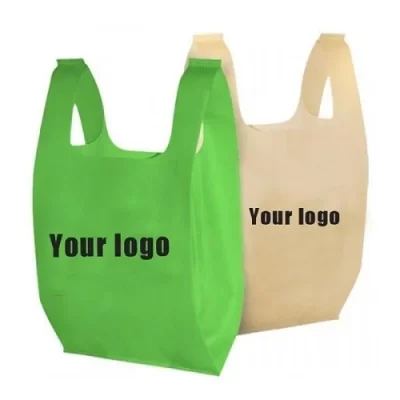
At Vietsonic, silk-screen printing is performed on fully shaped finished bags. This process ensures:
- Logo position is aligned directly on the actual bag body → eliminating deviations due to size differences between fabric blanks and finished bags.
- The printing surface is stabilized after the welding process → no distortion of the printed image due to post-printing processing steps.
- Printing quality is checked directly on the final product → identifying and handling errors on-site, ensuring no defective bags pass the packaging stage.
Core advantage: At Vietsonic, bags come off the welding line with absolute dimensional consistency → the printing template only needs to be set once for the entire batch.
1.2. Eliminating transportation costs and risks
Finished bags after welding are transferred directly to the silk-screen printing table within the same factory.
Reduced costs:
- No 2-way transportation costs for finished bags (processing workshop → printing workshop → customer warehouse).
- No intermediate warehousing fees.
Eliminated risks:
- No waiting phase in external warehouses → eliminating the risk of dust, mold, or friction damaging the fabric surface before printing.
- No parameter discrepancies between the bag manufacturer and the printer → a seamless quality management system from fabric roll to complete printed bag.
2. Technical standards for silk-screen printing on non-woven fabric at the factory
2.1. Specialized ink systems and screen frames
Non-woven fabric has a porous surface structure; its ink adhesion characteristics are completely different from paper or plastic film. The silk-screen system at Vietsonic is configured to be compatible with the various non-woven fabric types we use in production:
Screen frame technical specifications:
Parameters | Values |
Printing mesh | 80 – 120T (adjusted based on design detail and fabric surface characteristics) |
Ink system used | Specialized elastic white / elastic gloss ink for non-woven fabrics |
Ink consistency | Standardized according to the grammage and fabric type of each order |
Quality output standards:
- Uniform color coverage across the entire print area – no smearing, no spotting, no white gaps.
- Durable adhesion on the non-woven base – no peeling when subjected to scratching or mechanical friction during use.
- Operational friction resistance – the logo maintains its sharpness through multiple bag uses.
- No smudging or blurring when exposed to normal levels of water.
2.2. Compatibility with ultrasonic welding technology – no reverse impact on bag quality
At Vietsonic, bags are welded first and printed later. However, in some specific product configurations, the printed area may be near or overlap with additional welding zones (e.g., handle welding, reinforcement welding). The ink system we use ensures:
- No interference with the ultrasonic transmission process if additional welding is required through the printed area.
- Welds passing through the inked area still achieve molecular-level thermal bonding – no degradation in weld strength.
- Logo structure is not distorted by localized heat from the welding process → the print maintains sharpness, with no smudging or edge burning.
Result: The finished product simultaneously meets two standards: the mechanical strength of the weld and the aesthetic integrity of the logo.
3. Capacity to meet brand positioning printing volume – mass processing speed
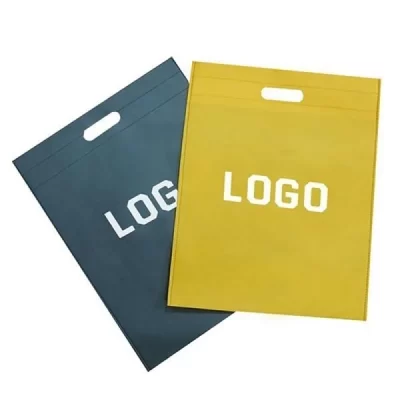
Silk-screen capacity at Vietsonic is designed to sync with the speed of the ultrasonic welding line, creating no bottlenecks in the production chain:
Metric | Capacity |
Printing + drying capacity | Thousands of finished bags/day |
Welding line speed | 60 – 80 bags/minute |
Synchronization status | Bags welded → transferred straight to the printing table, no inventory wait. |
For orders of 50,000 – 500,000 logo-printed bags → the welding and printing systems run in parallel, ensuring delivery schedules as committed.
3.1. Optimizing high-volume printing costs
Silk-screen printing is the most economical solution for logo designs with solid blocks of 1 – 4 colors on a non-woven background:
Cost Factor | Characteristics |
Screen template | Fixed cost / first order. Template stored for repeat orders. |
Printing ink | Variable cost based on printing area and number of colors. |
Labor + operation | Integrated into the all-in-one quote, not separated. |
Cost principle: Higher order quantity → lower allocated template cost per product → unit printing price per bag decreases inversely with volume.
Contact VietSonic
If you are looking for a high-quality silk-screen printing solution, contact VietSonic now for optimal consultation.
- Zalo/Phone: 0938 493 366 – Mr. Hải
- Email: info.vietsonic@gmail.com
- Web: vietsonic.vn