



DOWNLOAD
Tài liệu chia sẻ
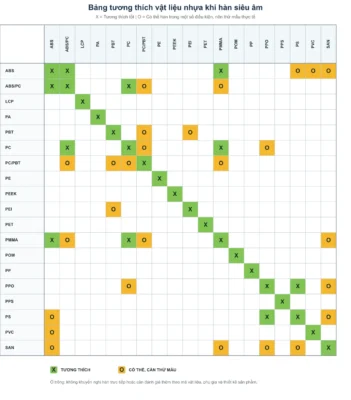
In ultrasonic plastic welding, not all types of plastic can be welded effectively with each other. The ability to create a strong weld depends on many factors, including material type, melting temperature, molecular structure, hardness, vibration transmission capability, and joint design.
The compatibility chart below helps users quickly refer to the ultrasonic welding compatibility between common plastic materials such as ABS, PC, PA, PBT, PE, PET, PMMA, PP, PVC, SAN, and several other engineering plastics.
Chart Legend
X – Compatible: The materials have good compatibility and can usually be ultrasonically welded.
O – Occasionally: The materials may be welded under certain conditions, but actual sample testing is recommended.
Blank cell: Direct ultrasonic welding is generally not recommended, or the welding capability is low.
This document is suitable for product design engineers, R&D teams, mold departments, and manufacturing companies that need an initial evaluation of ultrasonic welding compatibility between two plastic components.
However, this chart is intended for preliminary reference only. Actual welding results also depend on the specific plastic grade, additives, product thickness, energy director design, machine power, horn, fixture, and welding parameters. For products that require leak-tight sealing, tensile strength, load-bearing performance, or high appearance quality, sample welding tests should be carried out before mass production.
VietSonic provides ultrasonic welding consultation and sample testing support, helping customers select the most suitable solution for each material type and product requirement.

Vietsonic support technical:
Tựa đề: Part Design for Ultrasonic Welding.
Tóm tắt:
Ultrasonic energy has been used to join thermoplastics for over 35 years. Ultrasonic welding of thermoplastic materials is by far the most common form of ultrasonic assembly, and is used extensively in all major industries including: automotive, appliance, electronic, toy, packaging, textile, and medical. It offers advantages in speed, economy, and efficiency, and is frequently chosen when parts are too complex or expensive to be molded in one piece.
This bulletin provides guidelines to aid the designer during the initial concept stage of a new product design, ensuring optimum production results. The dimensions given in the designs should be used as guidelines only, since the specifics of your application may require variations. (tải về)
Vietsonic support technical:
Tựa đề: An Optimized Design of the Bearing in Machines for Ultrasonic Machining Processes.
Tóm tắt:
In high-power ultrasonic manufacturing processes, the design of the bearing of the components transmitting ultrasound is of particular importance, since the position of the nodal planes in the vibrating structure is altering as a consequence of changing coupling conditions during the process. A special bearing, which reduces the residual vibrations at the fixing ring by a system of several resonators, has been developed for the use in ultrasonic production processes, such as tube drawing and wire drawing but also drilling and welding. Since the transmitted longitudinal vibrations always involve radial components as well, the dynamic stiffness of the coupling on the interface between the components transferring energy and the components deleting vibration is very important. In the method described in this paper, an optimization of dynamic behavior is attained by stiffness-reduced coupling. (tải về)


Vietsonic support technical:
Tựa đề: Study on ultrasonic stepped horn geometry design and fem simulation.
Tóm tắt:
The paper deals with study through Finite Element Method (FEM) of ultrasonic stepped horn used to aid electro-discharge machining (EDM+US). The thermal phenomena are dominant within EDM machining mechanism. The role of US aiding is to intensify the material thermal removal through cavitational phenomena. Several studies were carried on in order to analyze the influence of steps lenghths and diameters and corner radius size on own frequency of stepped ultrasonic horns. A good agreement between the FEM results and theoretical and experimental data was emphasized. Methods to adjust the own frequen cy of stepped horns by adjusting the lengths, diameters and additional machning of a groove at gravity centre level of horn are presented. (tải về)

- 2021 – Design of a radial ultrasonic horn for plastic welding using finite element analysis
- 2021 – Analysis of process parameters of hypoeutectoid steel ultrasonic horns with different heat treatment processes
- 2022 – Penetration and microstructure of steel joints by ultrasonic-assisted gas metal arc welding
- 2024 – Investigation of surface topography in ultrasonicassisted turning of C45 carbon steel
- 2025 – Optimization of tempering temperature and soaking time of SCM440 steel horn in ultrasonic-assisted metal inert gas welding