VIETSONIC • COSMETIC TECHNOLOGY INSIGHTS

What Is an Emulsion, and Why Do Many Moisturizing Creams Have This Structure?

A jar of moisturizing cream may look uniform, yet it can contain both an aqueous phase and an oil phase. These two groups of ingredients, which do not readily mix, are organized into a structure called an emulsion. Understanding this structure helps explain why a cream can feel smooth and spread easily, and why the mixing process affects product quality.

EmulsionsMoisturizing creamsUltrasonic emulsification

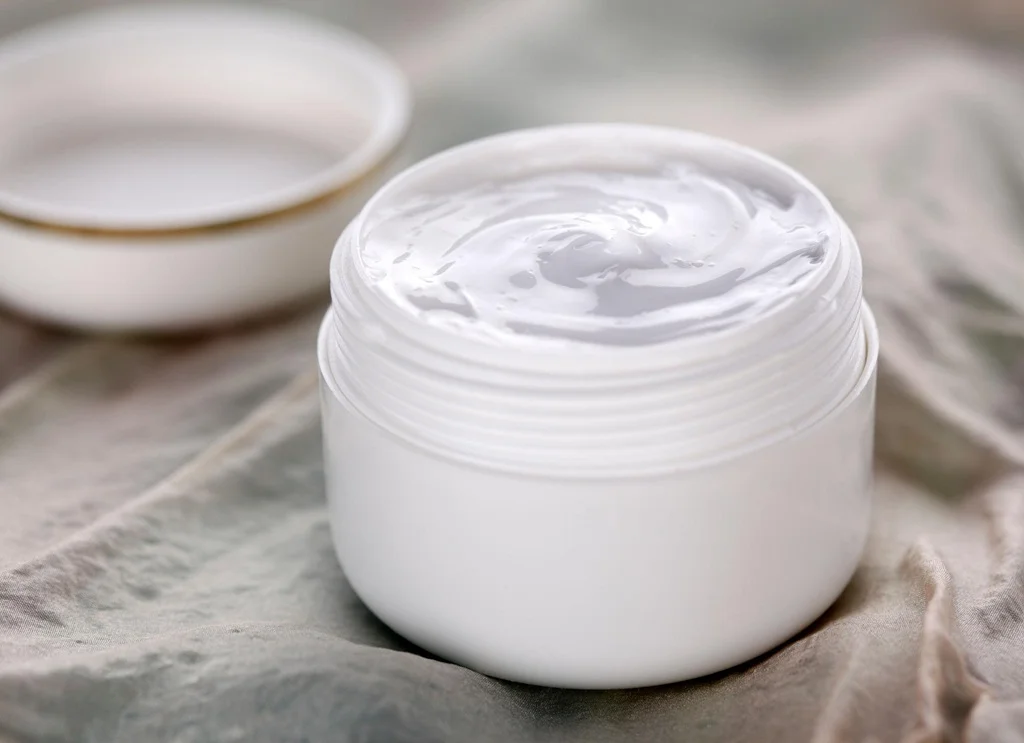
An unbranded jar of white moisturizing cream beside a soft cream smear on a light background
A cream’s appearance to the naked eye does not reveal how its oil and aqueous phases are distributed inside.

1. What is an emulsion?

An emulsion is a system in which one liquid is dispersed as small droplets in another liquid with which it does not readily mix. In cosmetics, a familiar example is the combination of oil and water.

The portion that forms small droplets is called the dispersed phase. The liquid surrounding those droplets is called the continuous phase. Although the mixture may look uniform, oil and water still occupy distinct regions on a small scale.

Imagine a bottle of water with some oil added: shaking temporarily disperses the oil into droplets. When left to stand, the droplets can merge and two layers become more apparent. In moisturizing creams, the formulation and emulsification process are designed to limit this destabilization.

Emulsification differs from dissolution: sugar dissolving in water forms a solution; oil broken into small droplets in water forms an emulsion. A cream looking uniform therefore does not mean that all its ingredients have dissolved.

2. Two common structures: oil-in-water and water-in-oil

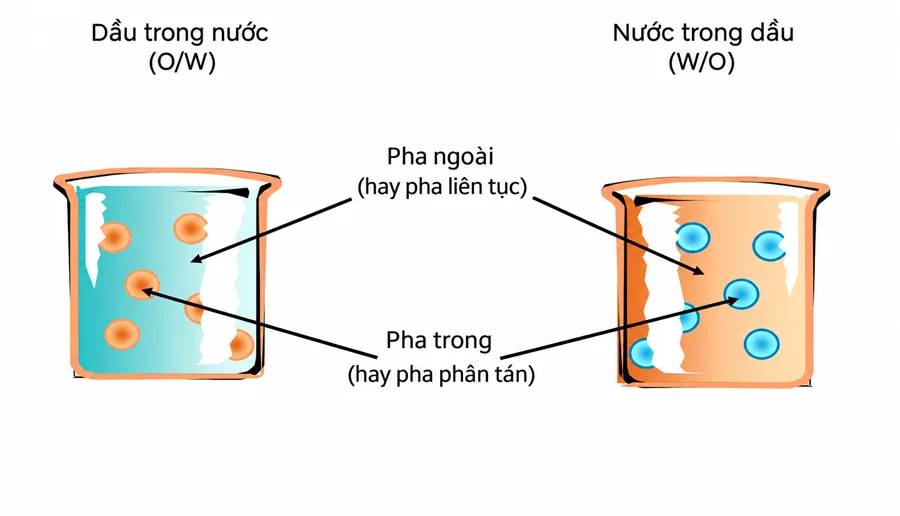
Emulsions are named according to which phase forms the droplets and which surrounds them. The two basic structures are designated O/W and W/O, where O stands for oil and W for water.

FeatureOil-in-water — O/WWater-in-oil — W/O
StructureOil droplets dispersed in an aqueous phase.Water droplets dispersed in an oil phase.
Continuous phaseThe aqueous phase surrounds the oil droplets.The oil phase surrounds the water droplets.
Texture designOften used to create products that spread easily and feel relatively light.Often used to provide a richer, oilier feel and a more noticeable coating.
Points to considerThe actual feel also depends on the type of oil, phase proportions, structuring agents and overall formulation. The O/W or W/O designation alone is not enough to select a product for a particular skin type.

Diagram comparing an O/W emulsion with oil droplets in water and a W/O emulsion with water droplets in oil
O/W and W/O differ in the liquid phase surrounding the dispersed droplets.

3. Why do many moisturizing creams have an emulsion structure?

Combining groups of ingredients with different properties

A cream formulation may require ingredients suited to the aqueous phase as well as ingredients suited to the oil phase. An emulsion structure allows these groups to be combined in one product, provided they are selected appropriately and added at the correct processing stage.

For example, glycerin is commonly incorporated into the aqueous phase, while many emollients belong to the oil phase. Combining the two phases creates more formulation options than using oil or water alone.

Adjusting how a cream feels when scooped out and spread

Users may prefer a light, easily spreadable cream or a thicker cream with a more pronounced soft feel. Formulators adjust phase proportions, oil types and the structuring system to achieve the intended experience.

Consistency does not depend solely on the amount of oil. Thickeners, waxes, structures formed during cooling and interactions between ingredients can all affect how a cream flows.

Maintaining ingredient distribution throughout the product

In a well-designed emulsion, dispersed droplets remain distributed within the cream base, helping to limit differences in texture between portions caused by phase separation. This is an important objective of both formulation and manufacturing.

However, skincare performance must be assessed on the finished product. A smooth appearance, thick consistency or the term ‘emulsion’ alone cannot establish how effective a product is.


4. How do emulsifiers help oil and water coexist?

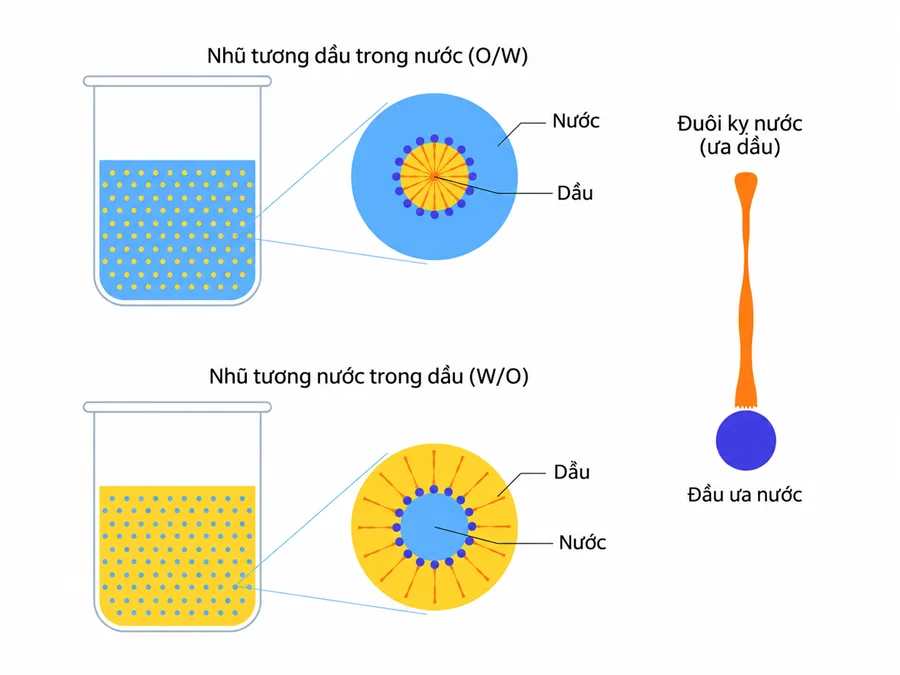
Many common emulsifiers have one part that interacts well with water and another that interacts well with oil. They concentrate at the interface between the two phases, helping droplets form and limiting their tendency to merge.

To obtain the desired cream texture, formulators may also use stabilizing aids or structuring agents. These ingredients affect droplet movement and the flow of the system. Emulsifiers and thickeners therefore have different roles, although both can contribute to stabilizing a formulation.


Diagram of emulsifier molecules surrounding an oil droplet, with oil-loving parts pointing inward and water-loving parts pointing outward
Illustration of an emulsifier at the surface of an oil droplet in an O/W system; the diagram is not drawn to scale.

The formulation and equipment must work together: mechanical action helps form and break up droplets, while a suitable emulsifying system helps maintain the structure after processing. Longer mixing alone cannot resolve incompatibility within an ingredient system.

5. How can ultrasound support emulsification?

In manufacturing, emulsions can be produced using mixers, homogenizers or other suitable methods. Power ultrasound is a processing approach that can be investigated to help break up droplets in oil–water systems.

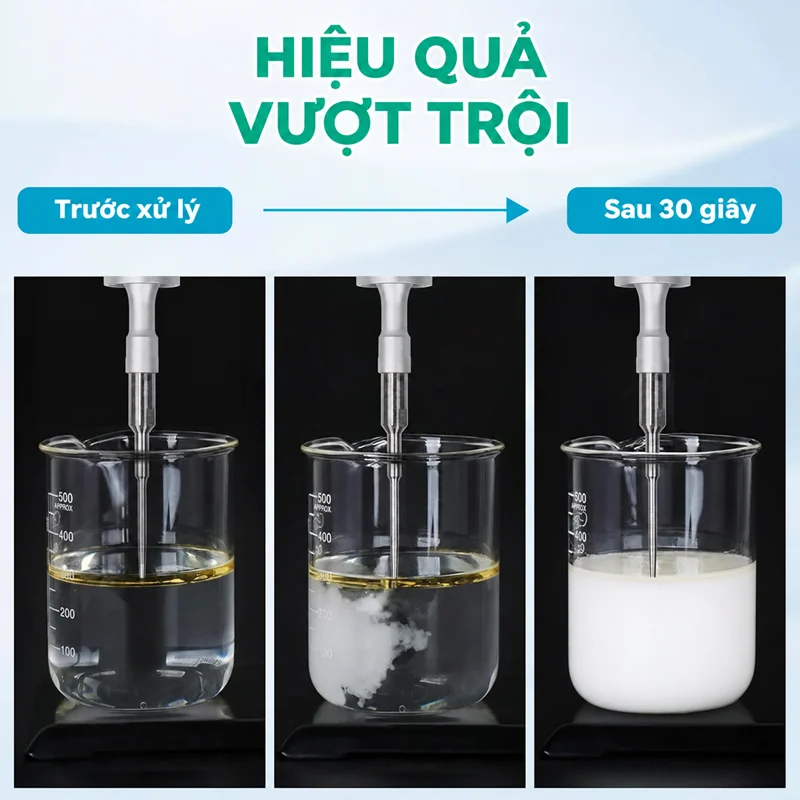
Under suitable conditions, ultrasound transmitted into a liquid produces cavitation: bubbles form, oscillate and then collapse. The resulting localized mechanical effects can help break larger droplets into smaller ones.

Performance depends on the formulation, oil proportion, emulsifying system, processing conditions and temperature control. For highly viscous creams, material movement through the treatment zone must also be considered. Treatment may therefore take place during the coarse-emulsion stage or at another suitable stage before the final texture is established.


An ultrasonic homogenizer probe treating a milky-white emulsion in a laboratory beaker with temperature control
Illustration of emulsification using an ultrasonic probe at experimental scale.

After testing, droplet size and size distribution should be measured, and sample viscosity and stability monitored. Using ultrasound does not by itself demonstrate nanoscale droplets, deeper skin penetration or better brightening performance. Nor does ultrasound automatically replace emulsifiers or a preservation system.

6. Assessing an emulsion requires looking beyond a smooth appearance

A freshly prepared cream sample may look uniform yet change during storage. Evaluating a formulation or comparing emulsification conditions requires monitoring several parameters rather than simply inspecting the surface.

Assessment areaWhat to monitorPurpose
Droplet structureDroplet size and distribution, measured using an appropriate method.Assess the effects of emulsification and changes over time.
Physical stabilitySeparation, layering or free oil or water under defined test conditions.Identify signs of system destabilization.
Viscosity and flowMeasurements at consistent temperatures using a standardized method.Compare texture between samples and time points.
Finished-product qualitypH, microbiological quality, preservative efficacy and formulation-specific parameters.Assess factors that a cream’s appearance cannot establish.

When a manufacturing step is changed, test samples should be compared with an appropriate control. The absence of separation during a short observation period is insufficient to establish a product’s shelf life.

7. Frequently asked questions

Are all moisturizing creams emulsions?

Many moisturizing creams are emulsions, but skincare products also include gels and anhydrous products containing no water. The actual formulation and structure should be examined rather than inferred from the product name alone.

Does a thicker cream mean a more stable emulsion?

A thicker consistency can help limit droplet movement, but it does not establish stability. A thick product may still separate or change texture if the emulsifying system and manufacturing conditions are unsuitable.

Do serums need emulsification like moisturizing creams?

A serum may be a solution, a gel or an emulsion. If its ingredients are dissolved in a single phase, oil–water emulsification may be unnecessary. The formulation system must be identified before equipment is selected.

Discuss ultrasonic applications in cosmetic manufacturing

Emulsions bring together oil and aqueous phases in many moisturizing creams. For this structure to meet product requirements, the formulation, emulsifying system and processing conditions must be developed together.

If your business is investigating ultrasonic emulsification or homogenization, prepare information on the system type, viscosity, batch size and parameters you want to improve for a discussion with VietSonic.

Technology consultation: Mr. Hải — info.vietsonic@gmail.com.