



Cosmetics manufacturing technology
Why does ingredient mixing matter in cosmetics manufacturing?
A cosmetic formula specifies the ingredients to use and their proportions. To produce a finished cream or serum, manufacturers must also determine how each ingredient is incorporated into the system: which phase it dissolves in, when it is added, how it is mixed, and how temperature is controlled. These choices affect product uniformity, texture, and the ability to maintain quality during storage.
1. Each ingredient group requires a suitable mixing approach
In cosmetics manufacturing, “mixing” covers several different operations. Understanding the purpose of each stage helps in selecting suitable equipment and processing methods.
| Operation | Objective | Example in cosmetics manufacturing |
|---|---|---|
| Dissolution | Incorporating a solute into a suitable solvent at the molecular level. | Preparing a solution containing water-soluble ingredients. |
| Dispersion | Distributing solid particles in a liquid while limiting agglomeration. | Incorporating powdered ingredients into one phase of the formula. |
| Emulsification | Breaking one liquid phase into droplets within another liquid phase. | Creating a system of oil droplets dispersed in water. |
| Bulk mixing | Helping distribute ingredients throughout the entire volume. | Maintaining uniformity during ingredient addition and cooling. |
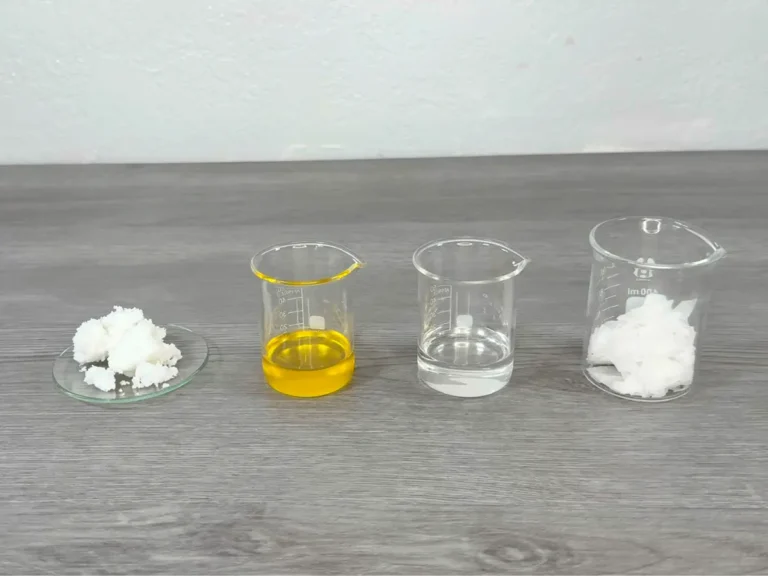
A dissolved ingredient differs from a dispersed solid particle. Similarly, oil emulsified in water remains in the form of oil droplets; describing this process as “dissolving oil in water” misrepresents its nature.
For emulsion-based creams, preparing the water and oil phases and then combining them is an important part of the process. A serum, however, may be a solution, gel, or emulsion, so the mixing approach must be determined according to its specific formula. The name “serum” alone does not establish whether emulsification is needed.
2. What problems can unsuitable mixing cause?
Ingredients form lumps and are difficult to distribute evenly
Some powdered ingredients may agglomerate when added to a liquid. The outside comes into contact with water first, while the inside of the agglomerate remains insufficiently wetted. In this situation, extending the mixing time may not eliminate all lumps.
This can leave the product grainy or prevent it from achieving the required texture. Application documentation from Silverson also identifies ingredient dispersion and agglomerate treatment as issues to address when manufacturing creams and lotions.
The oil–water system does not achieve the desired structure
For emulsion-based cosmetics, emulsification must create a droplet system suited to the formula. The formation and maintenance of this system depend jointly on ingredients, phase ratios, and processing conditions.
A study of an oil-in-water system intended for cosmetic applications showed that the oil proportion, surfactant concentration, and processing time all affect emulsification and stability after storage. These findings indicate that the formula and the process need to be considered together.
Inconsistent quality between batches
If ingredient addition, mixing, and cooling differ from one batch to another, identifying the cause of product changes becomes more difficult.
Manufacturers therefore need to record processing conditions, from ingredient quantities and addition sequence to time, temperature, and equipment configuration. These records provide a basis for comparing compliant batches with those showing deviations.
3. Factors to control when mixing cosmetics
Ingredient addition sequence and rate
It is necessary to determine which ingredients are prepared separately, which are added directly, and when each enters the batch. These steps should be based on ingredient technical documentation and formulation trials.
Temperature at each stage
Heating, holding at temperature, and cooling can all affect structure formation. Suitable conditions must take into account solubility, the physical state of the raw materials, and the heat sensitivity of each ingredient. See the technical documentation on temperature control.
Circulation throughout the batch
Check whether material from all areas of the vessel passes through the treatment zone. In the cream manufacturing systems described in technical literature, the agitator, homogenizer, and recirculation line are arranged to perform this task together.
Processing intensity and duration
Extending processing time is meaningful only when it improves the target parameter. For ultrasonic emulsification specifically, research has reported an initial period of rapid droplet size reduction, followed by a gradual approach to a limit. The endpoint should therefore be determined from measurements rather than by extending treatment based on intuition.
4. At which stages can ultrasound be used?
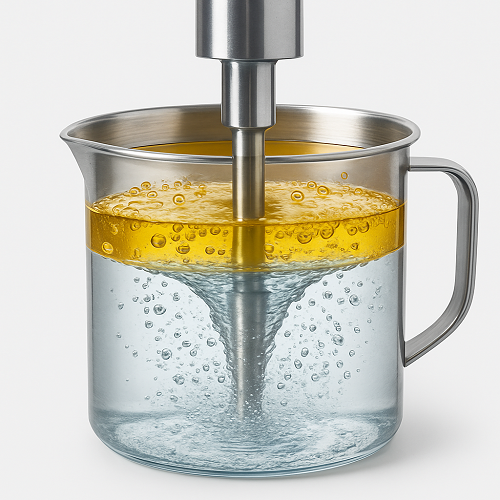
Under suitable conditions, an ultrasonic probe transfers energy into a liquid and generates cavitation: small bubbles form, oscillate, and collapse. This localized mechanical action can help break up oil droplets during emulsification. Research observing the region near the probe has provided evidence of the role of cavitation in this process.
Depending on the objective, ultrasound can be investigated at several points:
- Treating a separate phase: assessing its ability to support ingredient dispersion before incorporation into the full batch.
- Treating after coarse emulsification: investigating changes in oil droplet size and distribution.
- Combining with agitation or recirculation: passing material through the treatment zone and monitoring batch uniformity.
5. How can you determine whether the mixing approach is suitable?
Observing the product immediately after mixing is an initial check. For a systematic assessment, a plan can be developed around the following objectives:
| Objective | Suggested assessment method | Applicable conditions |
|---|---|---|
| Uniform ingredient distribution | Sample multiple locations and compare relevant parameters; quantify a representative ingredient when necessary. | Suitable sampling and analytical methods are available. |
| Limiting lumps and graininess | Visual inspection, microscopy, or an appropriate size measurement. | Systems containing solid particles or ingredients prone to agglomeration. |
| Controlling the oil droplet system | Assess droplet size and distribution. | Emulsion-based cosmetics. |
| Maintaining texture | Measure viscosity or flow properties under consistent conditions. | Creams, gels, and structured serums. |
| Monitoring stability | Monitor phase separation, sedimentation, color, odor, pH, and texture according to a defined plan. | Clearly specify the duration, storage conditions, and packaging. |
| Checking reproducibility | Compare multiple batches made using the same process. | Process records and acceptance criteria are available. |
This is a framework for process assessment. Conclusions about cosmetic shelf life or performance require a separate testing program.
6. Relevance to the development of Mai creams and serums
According to the supplied product documentation, Mai cream uses ultrasonic homogenization to support dispersion and emulsification. For this application, it is necessary to clarify at which stage the technology is used, what it treats, and which parameters are used to assess the results.
For serums, the formulation system must be identified before selecting a mixing approach. A solution-based serum and a serum with a dispersed oil phase have different processing requirements.
A suitable approach starts with a specific objective: breaking up ingredient agglomerates, improving the droplet system, or controlling uniformity. Control samples can then be compared with samples made using a modified process to identify an approach with practical value.
7. Discussing ultrasound applications in cosmetics manufacturing
The mixing approach is part of how product quality is developed. When process stages are clearly defined and checked using suitable parameters, manufacturers have a basis for selecting equipment, adjusting the process, and controlling batch-to-batch consistency.
To discuss ultrasound applications with VietSonic, businesses can prepare information on product type, batch size, expected viscosity, and the problem to be addressed.
Vietnam Ultrasonic Equipment Co., Ltd. – VietSonic
Hotline: 0938 49 33 66 – Mr. Hải
Email: info.vietsonic@gmail.com
Website: vietsonic.vn