
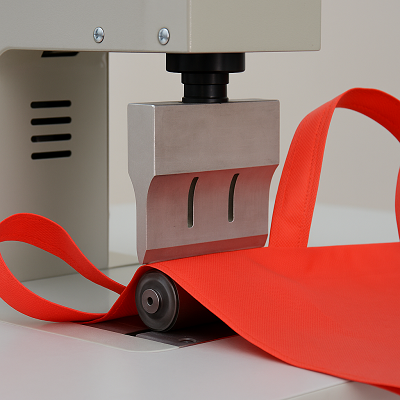
Ultrasonic Sewing Machine for Nonwoven Bags – Configured for Your Production Requirements
Businesses need more than a machine that simply runs. The weld seam must perform reliably on the correct material, bag design, and production cycle. VietSonic evaluates actual samples, tests the weld seam, selects the appropriate welding roller, and configures the machine before recommending an investment solution.
A Machine Creates Value Only When It Solves the Right Production Step
In nonwoven bag production, businesses typically focus on bond stability, operating speed, product-to-product consistency, and the ability to change designs. VietSonic ultrasonic sewing machines are configured around these requirements.
No Needles or Thread
The bond is created by ultrasonic energy combined with pressure, helping minimize issues associated with broken thread, tangled thread, or needle holes along the processed seam.
Consistent Weld Seams
When the material and parameters are suitable, the roller creates a continuous, clean weld seam with consistent results across products.
Flexible Weld Patterns
The roller profile can be changed to create pressing lines, sealed edges, or decorative patterns that match the design of each bag range.
Configured for Real Production
The configuration is determined according to the fabric sample, number of layers, operator workflow, and the company’s target output.

How Does the Machine Create a Bond?
The material passes through the contact area between the ultrasonic horn and the welding roller. High-frequency vibration generates localized heat within the material, while the pressure applied by the roller bonds the layers according to the roller profile.
The process runs continuously without a needle passing through the fabric and without thread. Weld quality depends on the material composition, thickness, number of layers, applied pressure, operating speed, and roller design.
- Best suited to nonwoven fabrics and materials containing thermoplastic components.
- Sample testing is required for coated, multilayer, or specially structured materials.
- Parameters must be calibrated for each product rather than using one setting for every sample.
- 1Feed the Material into the Welding AreaThe operator guides the fabric edge along the specified position.
- 2Apply Localized Ultrasonic EnergyEnergy is concentrated at the contact area between the horn and roller.
- 3Press and Form with the RollerA continuous weld seam is formed according to the roller profile.
See How the Machine Creates a Weld Seam on a Nonwoven Bag
The video allows businesses to observe material feeding, roller movement, and the finished weld surface after processing.
VietSonic Does Not Recommend Machines Based on Catalogue Specifications Alone
The proposed solution is developed from the product the customer needs to manufacture. This allows VietSonic to verify suitability before manufacturing, assembling, and handing over the machine.
Assess Requirements
Identify the material, welding position, weld pattern, product dimensions, and target output.
Test Actual Samples
Run trials to evaluate bond strength, surface finish, deformation, and continuous operating capability.
Design the Right Solution
Select the ultrasonic configuration, mechanical assembly, applied pressure, and roller profile.
Assemble and Test
Verify machine operation and fine-tune it using the approved product samples.
Handover and Support
Provide guidance on operation, roller replacement, calibration, and common troubleshooting situations.

The Machine Is Configured Around the Product, Not the Other Way Around
As a direct technical solution provider, VietSonic can coordinate adjustments to the components that directly affect processing results. The specific scope is determined after evaluating the sample and operating requirements.
- Welding RollerWeld-seam profile, edge sealing, or decorative pattern.
- Pressure and SpeedCalibrated according to thickness, number of layers, and material sensitivity.
- Operating LayoutConsideration of material guidance and the position of the production step within the workshop.
- Technical SupportDirect consultation when changing products or resolving weld-seam issues.
When Should a Business Use an Ultrasonic Sewing Machine?
The machine is best suited when the product requirements and material are compatible with thermoplastic welding. Sample testing is essential to confirm suitability before investment.
Suitable for Evaluation
- Nonwoven bags, gift bags, promotional bags, and shopping bags.
- Continuous edge welding, edge pressing, edge sealing, or pattern-forming operations.
- Products that need to minimize issues associated with needles and thread.
- Workshops requiring repeatable weld seams that can be changed using different rollers.
Samples Should Be Submitted for Testing
- Materials with unknown composition or a high proportion of natural fibers.
- Multilayer or coated fabrics, heat-sensitive surfaces, or unusual thicknesses.
- Products with specific tensile-strength, sealing, or appearance acceptance criteria.
- Applications requiring integration with an existing production line or feeding mechanism.

What to Know Before Selecting a Machine
Can an ultrasonic sewing machine be used with every type of fabric?
No. The technology is best suited to nonwoven fabrics and materials containing thermoplastic components. For blended, multilayer, or coated materials, VietSonic needs to test a sample to assess bonding performance.
Can the weld-seam design or decorative pattern be changed?
Yes. It can be changed by using a suitable welding roller. VietSonic will evaluate the profile, dimensions, and surface requirements before recommending or designing the roller.
Why should a sample be submitted before ordering a machine?
Nonwoven materials can differ in composition, basis weight, thickness, and number of layers. Sample testing helps verify weld quality and determine the appropriate parameters before the final configuration is approved.
Is this a fully automatic bag-making machine?
This is a roller-type ultrasonic sewing machine for continuous welding operations; the operator guides the material through the welding area. If the business requires material-feeding integration or automation across multiple production steps, VietSonic will assess the application and recommend a dedicated solution.
