



Ultrasonic Toy Card Welding Machine: From Actual Plastic Samples to Production-Ready Equipment
For plastics manufacturers, producing an attractive weld on a few trial samples is not enough. The equipment must position parts accurately, deliver consistent results through repeated cycles, be easy to operate, and fit the production floor. VietSonic approaches each project from the actual plastic part, weld-joint design, and output requirements to engineer an integrated solution.
Plastics Manufacturers Need a Stable, Integrated Welding Process
As production volume increases, small deviations in part placement, clamping force, or weld time can cause recurring defects across an entire batch. The equipment must therefore be developed together with the fixture, process parameters, and operator workflow.
Inconsistent Weld Quality
Joint strength varies from product to product, increasing the risk of rework and rejected parts.
Misaligned Part Placement
Thin, small, or printed parts require a suitable fixture to maintain the correct position in every cycle.
Difficult Appearance Control
Incorrect energy or pressure can leave marks, deform the part, or affect printed areas.
Limited Production Scalability
Standalone equipment, multi-step operation, and reliance on operator skill can limit actual output.
Ultrasonic Welding of Toy Cards and Plastic Toy Components
During welding, high-frequency mechanical vibrations are transmitted through the sonotrode to the contact area between the thermoplastic layers. Combined with controlled clamping force, the energy is concentrated at the joint interface, allowing the materials to bond within a short cycle.
This solution reduces reliance on adhesives or surface-heating methods while enabling a compact, clean, and more repeatable production cycle.

Watch the Toy Card Welding Process
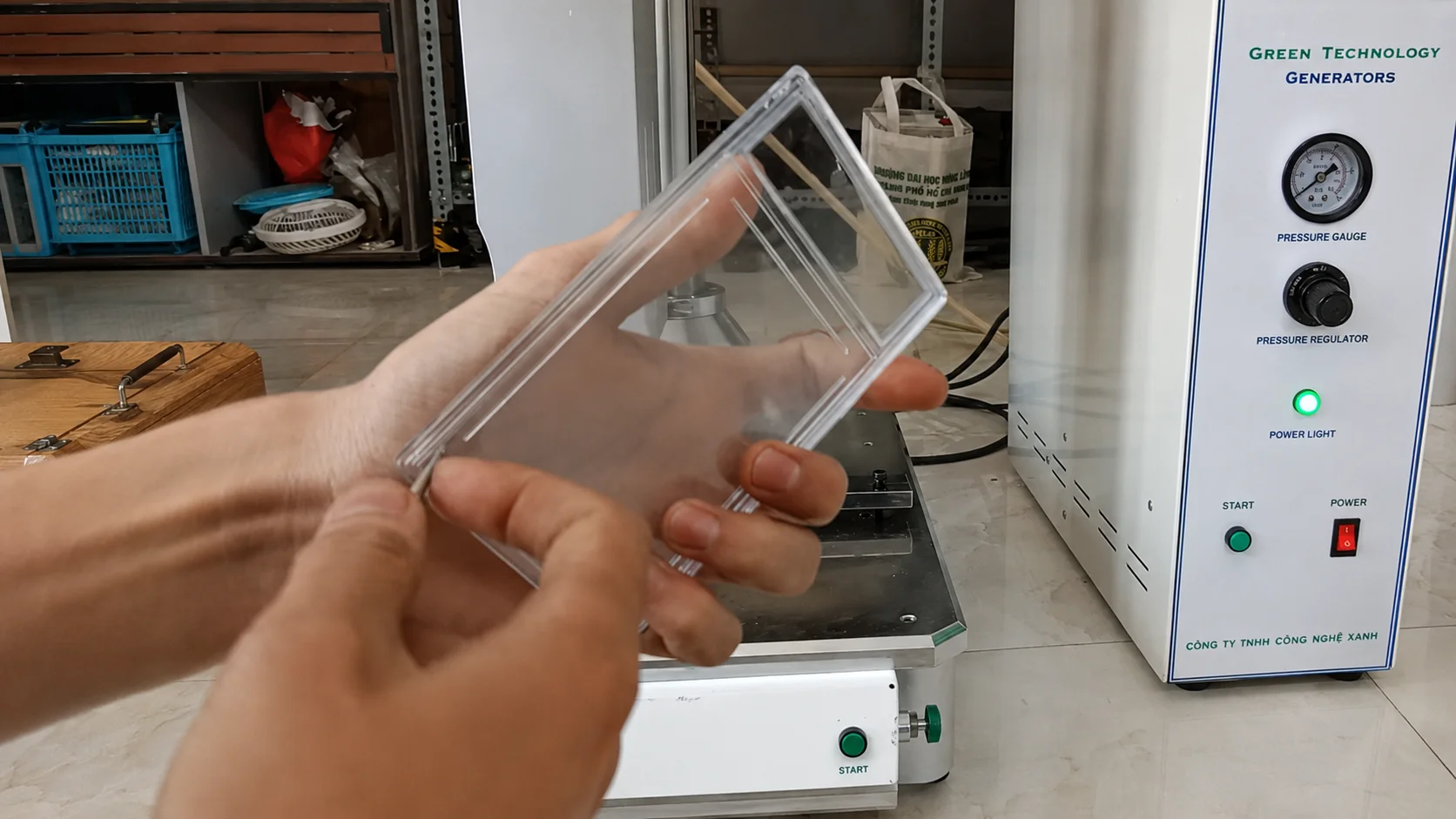
The video shows the equipment performing a toy card welding application, allowing manufacturers to observe the welding-station layout and operating procedure before discussing a solution for their own products.
VietSonic Engineers the Solution Around the Customer’s Product
An effective system requires close coordination between ultrasonic technology, precision mechanics, controls, and operator workflow. Depending on the actual requirements, the machine can be developed as a manual or semi-automatic system or integrated into a production line.
Ultrasonic Stack and Sonotrode
The generator, transducer, and booster configuration is selected, and the sonotrode is designed to suit the area, shape, and location where energy must be delivered.
Product-Specific Positioning Fixture
The support fixture enables quick part placement, limits movement, and protects areas where the product’s appearance must be maintained.
Press Mechanism and Machine Frame
Stroke, structural rigidity, and working space are engineered for stable machine operation and convenient operator access.
Controls and Interlocks
The operating cycle, start and stop signals, and protective interlocks are configured to match the automation level of each project.

Proven Capability Comes from Solving Real Sample Challenges
Power and frequency specifications are only part of the equipment. Greater value lies in identifying the correct weld area, creating an appropriate fixture, establishing a process window, and checking the results on the customer’s actual product.
For this reason, VietSonic prioritizes receiving samples, technical requirements, and output targets before proposing a machine configuration.
Production Goals Manufacturers Can Target
Beyond a Single Toy Card Design
Based on the underlying welding principle and machine platform, the solution can be developed for many plastic parts with similar joining requirements. Each application must still be sample-tested before the configuration is confirmed.
| Toy cards, tags, and toy components | Weld thermoplastic layers or parts at specified positions, with priority given to repeatability and appearance. |
|---|---|
| Plastic housings, covers, and small assemblies | Design the sonotrode and fixture around the product profile, with optional mistake-proofing features. |
| Plastic parts with printed surfaces | Evaluate the energy-transfer position and support area to limit any effect on cosmetically critical regions. |
| Products requiring higher output | Evaluate multi-station layouts, semi-automatic operation, or connection to an existing production line. |
From Sample Receipt to Machine Handover
The project follows clearly defined steps to ensure that the final solution aligns with the product, operating workflow, and production targets.
Requirement Intake
Product samples, materials, weld positions, inspection criteria, and target output.
Weldability Assessment
Analyze the structure, energy-transfer area, and potential appearance risks.
Sample Testing
Establish initial parameters, inspect the weld, and adjust the process based on feedback.
Engineering and Fabrication
Complete the sonotrode, fixture, machine mechanism, and control program.
Trial Run and Handover
Verify operation, provide user training, and agree on the support plan.
Information to Prepare Before Consultation
What should be submitted for a solution assessment?
Provide a finished sample and the individual parts before welding, the material name or data, the required joining position, appearance requirements, the joint-strength test method, and the desired output.
Can the exact weld cycle time be quoted from the start?
The actual cycle must be determined after sample testing because it also depends on the weld area, product structure, loading and unloading operations, and the manufacturer’s quality criteria.
Can the machine be integrated into an existing production line?
Signal integration, product feeding and unloading mechanisms, or an inspection station can be evaluated. The specific configuration depends on the available floor space and operating logic of the existing line.
Have a Plastic Part That Needs More Consistent Welding?
Send your product samples and production requirements so the VietSonic technical team can assess weldability, recommend a machine configuration, and propose a suitable sample-testing plan.