



Ultrasonic Shower Head Welding Machine – Custom Design and Manufacturing Solutions
When manufacturing plastic shower head assemblies, businesses need joints that are strong, visually clean, consistent over repeated cycles, and free from adhesive curing delays. Based on actual product samples, VietSonic evaluates the materials, performs welding trials, designs the horn and fixture, and manufactures a system tailored to the customer’s production process.
Controlled welding parameters
Synchronized horn and fixture
Ready for future automation

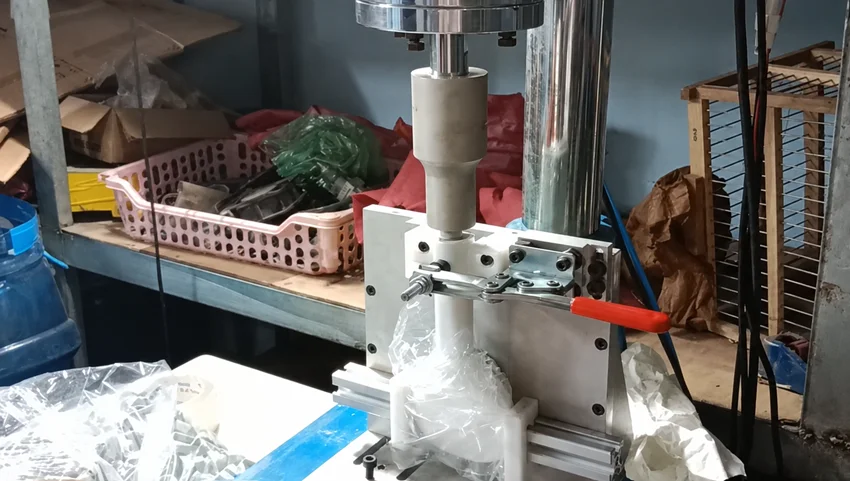
An ultrasonic welding machine used for plastic shower head assemblies.
For plastics manufacturers, choosing a welding technology is not simply about making two components “stick together.” The joint must also meet requirements for strength, sealing performance, appearance, and repeatability in mass production. That is why an ultrasonic welding system must be designed correctly from the product sample onward.
Common Problems When Assembling Plastic Components
Every small joining defect can become a major cost as production volume increases.
Inconsistent Joints
Joint strength varies between products; components that require sealing may also leak or separate at the edges during use.
Surface Deformation
Improper pressure, energy, or contact positioning can cause indentations, scratches, localized burning, or visible marks on the surface.
Dependence on Adhesives and Manual Operation
Using adhesives adds consumable costs, waiting time, surface-cleaning steps, and quality risks that depend on operator skill.
Difficulty Increasing Output
Manual processes make it difficult to maintain consistent cycle times, trace defects, or integrate the operation into an automated line.
Why Is Ultrasonic Welding Suitable for Plastic Shower Head Assemblies?
The system transmits high-frequency mechanical vibrations through the horn to the contact area between two components. Energy concentrated along the joint locally heats the material, after which the bond is formed under an appropriate holding force.
- No adhesive is required at the weld line, helping reduce secondary operations and consumable costs.
- The short welding cycle is well suited to businesses seeking higher productivity.
- Energy, time, and pressure can be configured for the specific product sample.
- The operation can be standardized and expanded with automatic part feeding, unloading, or inspection mechanisms.
A Good Weld Requires More Than “Having Ultrasonic Energy”
Consistent performance can only be achieved when the entire technology package works in coordination:
- The generator, transducer, and booster must operate correctly under the required load.
- The horn must transmit energy to the correct location and distribute force appropriately.
- The fixture must support the component securely while limiting movement and deformation.
- Welding parameters and hold time must be established through testing.
From Plastic Sample to a Welding Machine Ready for Production
Each machine is developed around the product, target output, and operating requirements of the factory.
Receive Samples and Quality Requirements
Gather information about the material, structure, weld-line location, strength or sealing requirements, target output, and machine installation conditions.
Evaluate Component Weldability
Check material compatibility, product rigidity, energy transmission, and joint geometry. When necessary, engineers recommend adjustments to the joint design.
Conduct Welding Trials and Establish the Process Window
Run trials to evaluate appearance, strength, and functional criteria, then determine a suitable parameter window instead of relying on a single setpoint.
Design the Horn, Fixture, and Machine Configuration
The horn and fixture are developed together around the product profile. The press mechanism, stroke, cycle activation method, and safety solution are selected according to actual requirements.
Manufacture, Assemble, and Fine-Tune
VietSonic handles the mechanical manufacturing, ultrasonic system integration, controls, and sample-based fine-tuning required to complete the machine.
Acceptance Testing, Training, and Technical Support
The machine is evaluated against the agreed criteria, then delivered with operating parameters, user training, and maintenance and recalibration support when production conditions change.
Video: Ultrasonic Welding of a Plastic Shower Head Assembly
This footage shows a real application running on equipment built by VietSonic. The video demonstrates the sequence of placing the components, positioning them in the fixture, engaging the welding assembly, and removing the product after the cycle.
Video: Ultrasonic welding machine for plastic shower head assemblies.

Machine-Building Capability Is Demonstrated by Solving the Right Production Problem
Customers receive a solution proven on their actual product, not merely a preassembled standard machine.
Sample-Based Custom Design
The machine configuration, horn, and fixture are adapted to the component geometry, quality requirements, and shop-floor operation.
Testing Before Finalizing the Solution
Samples are tested to reduce the risk of investing in the wrong technology or configuration, or having to modify the machine after production begins.
Direct Technical Support
A Vietnam-based team makes surveys, fine-tuning, operator training, maintenance, and support for product changes more accessible.
Flexible Levels of Automation
The solution can start as a manually operated welding station and later add part feeding, cycle control, or production-line integration as needed.
Better Quality Control
Standardized parameters reduce dependence on individual operator technique and provide a basis for tracing root causes when defects occur.
Expandable to Other Plastic Components
The same design capabilities can be evaluated for housings, covers, containers, home-appliance parts, and many other engineering plastic components.
What Should Businesses Prepare for Fast, Accurate Consultation?
- Component samples: both parts before welding and a finished product that meets the post-weld requirements.
- Material information: plastic type, material grade, additives, and the percentage of recycled resin, if any.
- Quality criteria: breaking force, sealing performance, appearance, dimensions, or internal test methods.
- Target output: the number of products per shift and the desired cycle time.
- Product range: the number of models that must share the machine and the frequency of changeovers.
- Factory conditions: power supply, compressed air, available installation area, and the expected level of automation.
Important Considerations When Selecting an Ultrasonic Welder for Plastic Components
Can ABS, PP, or PC Be Ultrasonically Welded?
Weldability should not be determined solely by the name of the plastic. The exact material grade, polymer structure, additives, thickness, joint geometry, and compatibility between the two components must all be considered. Sample testing is essential before finalizing the solution.
Does the Product Design Need to Be Changed for Better Welding?
Some products already have a suitable joint area and can be tested directly. When energy is difficult to concentrate or the structure lacks rigidity, engineers may recommend adding an energy director, changing the assembly clearance, or increasing the support area.
Can One Machine Be Used for Multiple Shower Head Models?
A shared machine body with interchangeable horn and fixture sets can be evaluated. However, each model must still be assessed for dimensions, ultrasonic load, and process window to ensure quality.
How Is Weld Quality Evaluated?
Depending on product requirements, evaluation may include appearance, tensile or breaking force, sealing performance, post-weld dimensions, and consistency across multiple consecutive samples. Acceptance criteria should be agreed upon before the machine is manufactured.
Send Your Plastic Samples to VietSonic for a Welding Solution Assessment
If your business is experiencing difficulties in the joining process, wants to replace adhesives, or needs a welding station with better repeatability, send us your samples and testing requirements. Our technical team will recommend a suitable configuration before you invest in the equipment.
Consultation • Sample Testing • Horn and Fixture Design • Machine Manufacturing • Operator Training • Technical Maintenance