



Ultrasonic welding machine for water filter cartridge caps – Reliable sealing and consistent production quality
Water leakage at the cap joint, inconsistent welds, product deformation, and excessive dependence on adhesives or manual work can significantly increase the defect rate in water filter cartridge production.
VietSonic provides ultrasonic welding solutions developed around each customer’s actual product samples, covering material testing, horn and fixture design, and process parameter optimization.
▶
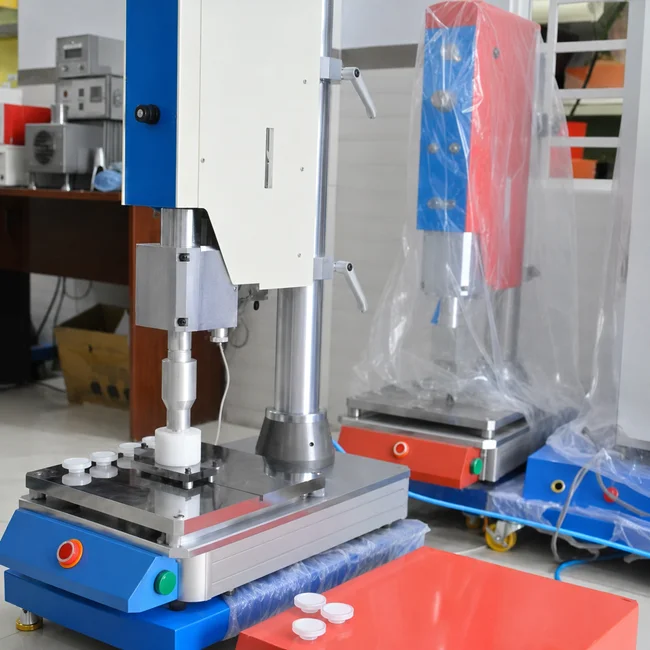
Ultrasonic welding machine for water filter cartridge caps by VietSonic
The cost goes far beyond a single leaking product
When the filter cartridge cap joint is unstable, manufacturers also face inspection costs, rework, returns, and the risk of damaging the reputation of the entire water filtration product line.
Leakage at the joint
Small gaps, uneven pressure, or unstable heat distribution can create weak bonding areas around the cap circumference.
Dependence on adhesives
The amount of adhesive, application position, and curing time are difficult to keep consistent when production volume increases or operators change.
Plastic part deformation
Heating too large an area or applying unsuitable pressure can warp the cap, deform the body, or affect the cartridge structure.
Difficult to scale production
Manual processes create variation between production shifts and increase the time required to train new operators.
Weld directly at the contact surface instead of heating the entire product
During welding, ultrasonic vibrations are transmitted from the horn to the contact area between the cap and the filter cartridge body. Energy is concentrated along the joint, generating localized frictional heat that softens the contacting material and forms a bond under controlled pressure.
Because the energy is concentrated only where the weld is required, the rest of the part is exposed to heat for a shorter time. This helps shorten cycle time, control deformation, and reduce adhesive-related operations.
- No adhesive application or curing time is required.
- Welding time, energy, and pressure can be standardized.
- Repeatable operating procedures can be established for each product model.
- The solution can be developed from a standalone machine into a semi-automatic or fully automated system.
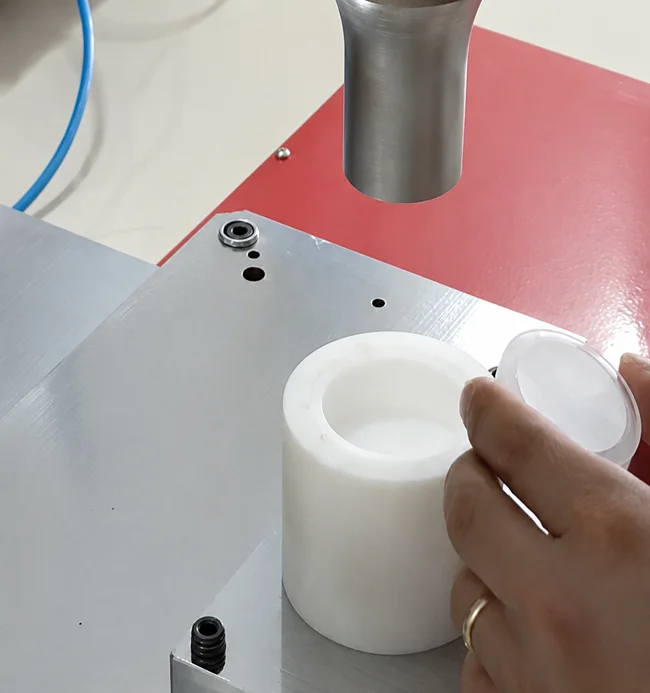
The product sample is positioned in the fixture before the welding cycle begins
See the water filter cartridge cap welding cycle in action
The video shows how the product is placed in the fixture, how the welding horn contacts the cap, and how the machine performs the pressing, ultrasonic welding, and holding stages.
Application testing video conducted by VietSonic using a water filter cartridge
VietSonic provides more than an off-the-shelf welding machine
Each product has different materials, dimensions, weld-joint designs, and sealing requirements. The solution must therefore be validated using actual samples before it is introduced into production.
Sample evaluation
Review the material, product structure, production volume, and current defects.
Weld-joint assessment
Inspect the contact surfaces, flatness, tolerances, and positioning requirements.
Tooling design
Design the welding horn and fixture to match the geometry of each product.
Testing and optimization
Adjust welding time, energy, amplitude, pressure, and hold time.
Commissioning and handover
Provide operating instructions, parameter setup, and post-handover technical support.

Testing actual samples verifies weldability before the manufacturer invests in equipment
What does the manufacturer gain after process optimization?
The objective is not simply to join two parts, but to create a process stable enough for consistent, repeatable production.
Reduce secondary operations
Eliminating adhesive application and curing time helps keep products moving continuously through the production flow.
Consistent welding cycles
Welding parameters are established using approved samples, reducing dependence on operator judgment.
Control sealing performance
A continuous weld can be formed around the contact area when the product, horn, and fixture meet the required conditions.
Minimize deformation
Energy is concentrated along the joint, minimizing unnecessary heating of the cap and cartridge body.
Easier production scaling
The process can be upgraded with part-feeding mechanisms, sensors, and automated control systems.
Responsive technical support
The horn, fixture, and parameters are developed around the actual sample, making future adjustments or product changes more convenient.
Increasing power does not automatically create a stronger weld
A successful weld results from the combined effects of material selection, weld-joint geometry, concentricity, horn design, fixture design, and operating parameters.
Excessive energy can cause plastic flash, deformation, surface burning, or damage to the filter material inside.
What does VietSonic inspect?
Plastic type and compatibility between the two parts.
Flatness, concentricity, and tolerances between the cap and cartridge body.
Energy-transfer position and energy-director design.
The product body’s ability to withstand pressure from the welding horn.
Post-weld inspection criteria, including appearance, bond strength, sealing performance, or pressure testing.
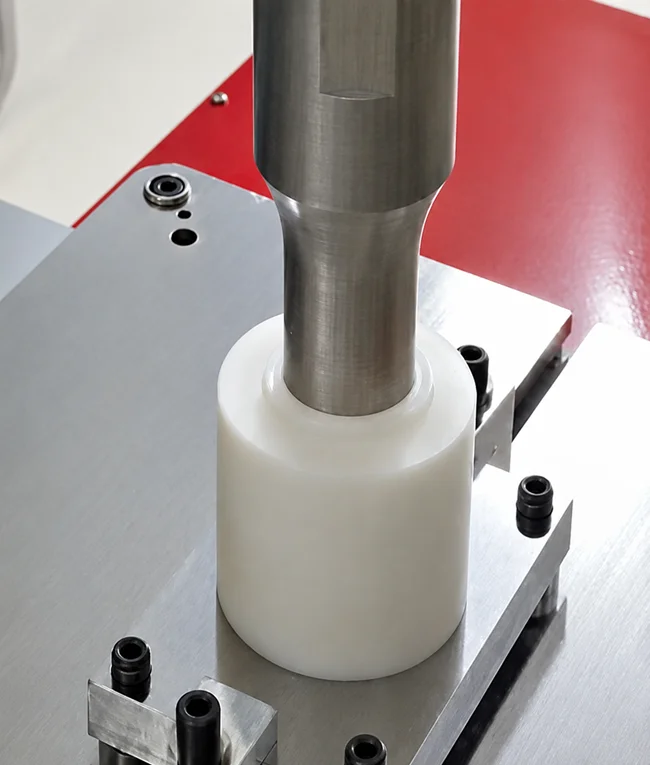
The welding horn and fixture must be designed around the product’s actual geometry
When should a manufacturer consider testing ultrasonic welding?
- Adhesives are currently used, but quality and curing time are inconsistent.
- Products develop leakage or cap separation after packaging.
- Production output needs to increase without significantly increasing labor.
- Welding parameters need to be standardized across multiple production shifts.
- Dedicated equipment is required for a new filter cartridge model.
- Sample testing and feasibility evaluation are required before investment.
Key information manufacturers consider before sample testing
Can ultrasonic welding be used with every type of plastic?
No. Weldability depends on the thermoplastic properties, compatibility between the two materials, and the joint design. Actual samples must be tested before the solution can be confirmed.
Can the machine weld different filter cartridge sizes?
In some cases, the same ultrasonic generator and machine body can be used, but each product geometry may require a dedicated horn, fixture, or parameter set.
How can sealing performance be evaluated?
Depending on the product requirements, manufacturers can perform visual inspection, pull testing, pressure testing, leak testing, or operation under conditions close to actual use.
Does VietSonic provide sample testing before recommending a machine configuration?
Yes. Sample testing helps evaluate weldability, determine the appropriate power level, and reduce the risk of selecting equipment that is incompatible with the product.
Can the machine be integrated into an automated production line?
Part feeding, positioning, sensors, cycle control, and product unloading can be integrated according to the required output and available production space.
Send water filter cartridge cap samples so VietSonic can evaluate weldability
VietSonic receives product samples, analyzes the material and structure, tests welding parameters, and then recommends the horn, fixture, and machine configuration that best fit actual production requirements.
Email: info.vietsonic@gmail.com
Website: vietsonic.vn