



Ultrasonic Welding Machine for PP Plastic Sheets – a VietSonic solution engineered for real-world production
When heat welding or manual methods can no longer meet requirements for speed, consistency, and appearance, businesses need equipment engineered specifically for the material, weld location, and actual production process.
Application-specific horn design
Custom machine manufacturing
Post-delivery technical support

VietSonic ultrasonic welding machine for PP plastic sheet welding
When PP Sheet Welding Becomes a Production Bottleneck
During prototyping or low-volume production, businesses may use heated tools, adhesives, screws, or manual operations to join PP plastic parts. However, as production volume increases, these methods often begin to reveal significant limitations.
Long processing times, operator-dependent quality, surface damage, and inconsistent weld lines make production difficult to control. At this stage, the welding process needs to be standardized with a suitable machine solution.
Inconsistent Weld Quality
Variations in pressure, cycle time, and positioning lead to inconsistent quality from one product to another.
Risk of Material Damage
Heating a large surface area can soften, deform, discolor, or reduce the visual quality of the material.
Operator-Dependent Productivity
Each operator works at a different speed and with a different technique, making it difficult to scale production.
Difficult Cost Control
Adhesives, consumables, waiting time, and post-weld cleaning increase overall production costs.
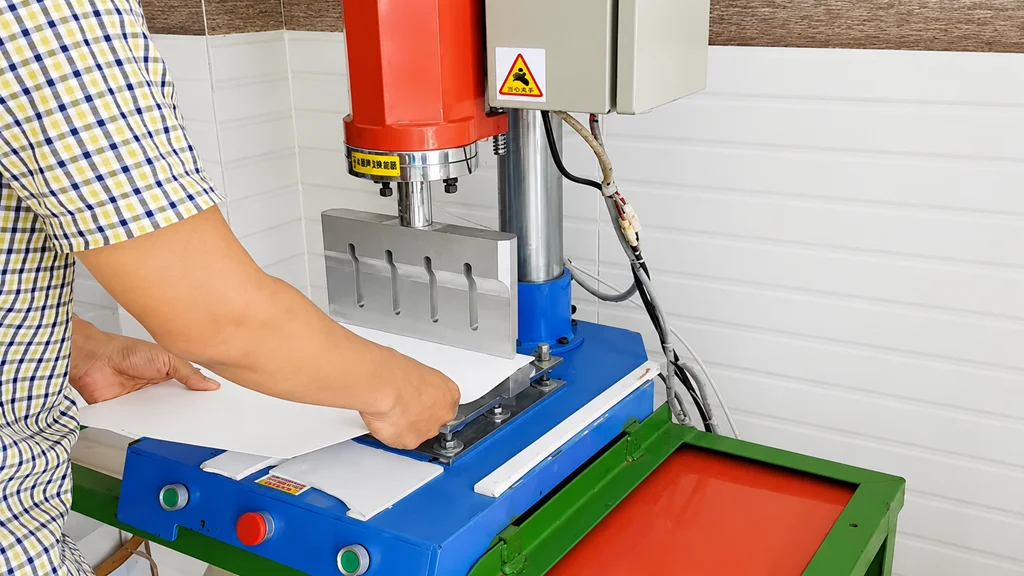
Machine Selection Should Not Be Based on Power Alone
For PP plastic sheets, welding performance does not depend on a single parameter. Material grade, thickness, sheet structure, contact area, weld location, required joint strength, and fixture design all directly affect the result.
Therefore, VietSonic develops each solution around the customer’s actual product sample rather than supplying one standard machine configuration for every application.
Identify the characteristics of the PP sheet, the joint location, and the product requirements after welding.
Adjust weld time, amplitude, pressure, and the operating method to suit the application.
Concentrate ultrasonic energy at the correct location while keeping the product stable throughout the welding cycle.
The system can be configured for manual operation, semi-automatic production, or integration into a production line.
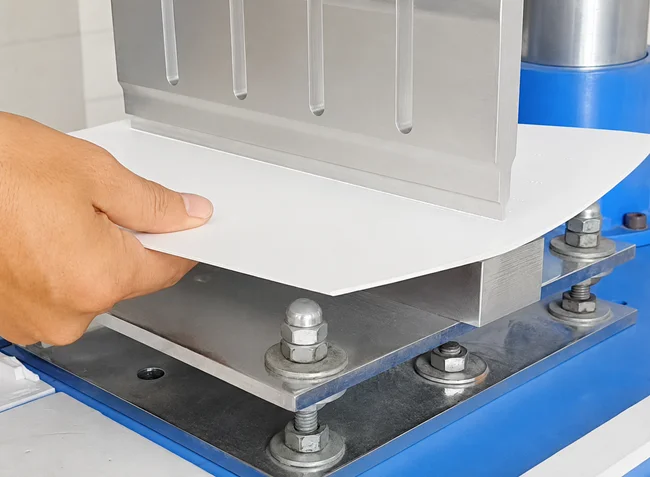
See the VietSonic ultrasonic welding machine in action on PP plastic sheets
The video directly demonstrates horn positioning, energy transfer into the joint area, and sample inspection after welding.
VietSonic provides a complete solution, not just a machine
For equipment to operate reliably in the customer’s facility, the project must be implemented as a coordinated process—from sample testing and mechanical design to calibration and operator training.
Requirement Assessment
Review the product, material, dimensions, production volume, and weld acceptance criteria.
Sample Welding Trials
Evaluate bonding feasibility, select the energy-transfer method, and establish initial process parameters.
Design and Manufacturing
Design the welding horn, fixture, machine structure, and operating method to suit the product.
Commissioning and Handover
Calibrate the equipment, train operators, provide maintenance guidance, and support the customer after production begins.
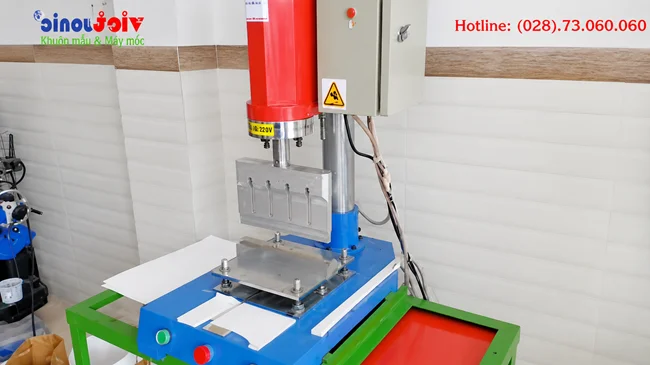
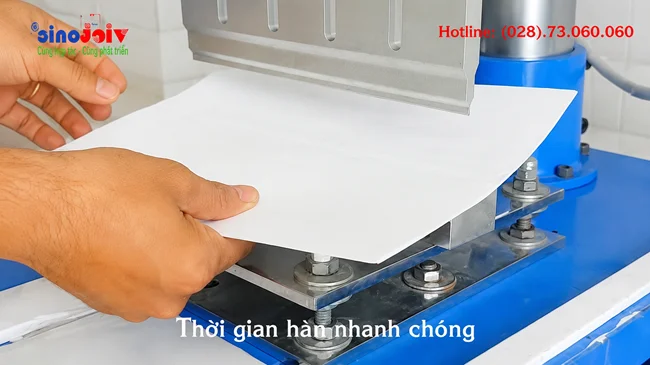
Standardize the Welding Process Instead of Relying on Manual Operations
Shorter Processing Time
Energy is transferred directly to the weld area without waiting for the entire tool or surface to heat up.
Reduced Consumables
Reduce the use of adhesives, screws, and additional fastening components in suitable applications.
Repeatable Quality
Weld time, pressure, and operating cycles can be set to reduce variation between products.
Ready for Expansion
The configuration can be expanded with additional fixtures, pressing mechanisms, worktables, or automation systems.
| Criteria | Ultrasonic Welding | Adhesive Bonding | Manual Heat Welding |
|---|---|---|---|
| Processing Time | Short cycles suitable for repetitive production | Requires application time and curing or setting time | Depends on tool heating time |
| Consumables | No adhesive required in suitable applications | Requires adhesive and application tools | May require welding rods or additional material |
| Process Control | Parameters can be set and repeated | Depends on adhesive quantity and operator skill | Depends on temperature and operator technique |
| Automation Capability | Easy to integrate with fixtures and control mechanisms | Difficult to precisely control adhesive quantity | Requires more complex heating-process control |
Which Businesses Should Consider Ultrasonic Welding for PP Sheets?
This solution is suitable for businesses manufacturing plastic sheet products, plastic boxes, formed components, or PP structures that require joining at one or more locations.
Advertising Panels
Plastic Partitions
Industrial Packaging
Trays and Formed Components
Engineering Plastic Products
Components Requiring Spot Welding
Processes Requiring Automation
Sample Testing Is Required Before Selecting a Machine Configuration
Whether the product can be welded, the achievable joint strength, and any effect on the product surface must be determined through testing on actual samples.
Businesses should send VietSonic a product sample, images of the weld area, material information, and the expected production volume. The technical team can then evaluate the appropriate solution before designing the equipment.
Is Your Business Facing Challenges When Welding PP Plastic Sheets?
Send us a product sample or a video of your current process. VietSonic will evaluate welding feasibility, conduct sample trials, and recommend the appropriate machine configuration, welding horn, and fixture.
Hotline: 0938 49 33 66 – Dr. Hai
Email: info.vietsonic@gmail.com