



Vacuum Aluminum Metallizing System Repair for Uneven Aluminum Heating Temperatures
VietSonic provides on-site inspection, assessment, and maintenance of aluminum evaporation systems to address streaked or blotchy coatings, uneven light and dark areas, and inconsistent quality between production rolls.
Unstable aluminum evaporation
Streaked or blotchy coated film
More rejects and longer downtime
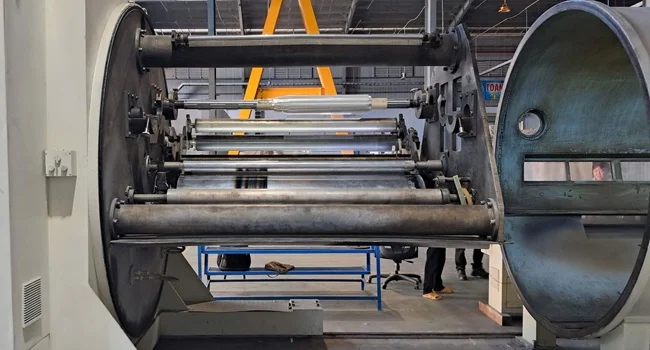
Uneven temperature affects more than the appearance of metallized film
An imbalance in the aluminum heating and evaporation assembly can cause losses in materials, productivity, finished-product quality, and delivery performance.
In a vacuum metallizing system, aluminum wire is fed to heating elements where it melts and evaporates. The aluminum vapor then condenses into an extremely thin metallic layer on the plastic film surface. When temperatures vary between heating positions, aluminum evaporation is also uneven across the full film width.
For packaging-film manufacturers, this defect rarely occurs in isolation. Some areas of the film may achieve the required coating density, while others appear dull, under-metallized, or show alternating dark and light bands. Operators may repeatedly adjust power, wire-feed rate, and film speed, yet still struggle to maintain stable quality.
Streaked or blotchy film
The aluminum layer is distributed unevenly across the film width or along the machine direction.
Repeated adjustments required
The machine must be stopped to inspect evaporation boats, aluminum wire, and power-supply connections.
Higher reject rates
Film rolls that fail to meet coating requirements must be reprocessed, downgraded, or discarded.
Production schedule disruptions
Extended downtime can directly affect delivery schedules.

Temperature differences between positions can create distinct coating bands on the film
The evaporation assembly contains multiple aluminum-wire feeding points and heating elements arranged across the machine width. Each position must maintain reasonably uniform conditions for electrical power, heat transfer, wire-feed rate, and aluminum contact.
When some heating positions operate at lower temperatures, the aluminum may not reach the required evaporation state. Conversely, excessive temperature can make aluminum evaporate too quickly, increase material consumption, or accelerate heating-element deterioration.
- Aluminum wire melts unevenly between positions.
- Aluminum vapor is distributed unevenly inside the coating chamber.
- Dark and light coating bands form in different areas.
- Coating quality varies between the beginning, middle, and end of the roll.

If the root cause lies in electrical connections, heating elements, evaporation boats, the wire-feeding mechanism, or power distribution, continuing to raise the temperature may accelerate equipment deterioration without correcting the coating defect.
Key areas VietSonic focuses on inspecting
Repairs should begin with an on-site inspection of the entire coating-formation process rather than simply changing a few parameters on the operator interface.
Heating elements and aluminum-wire contact points
Inspect each heating position for wear, deposits, deformation, cracking, or reduced heat-transfer performance.
Electrical connections and busbars
Loose clamps, oxidized surfaces, or increased contact resistance can create differences in actual power between positions.
Aluminum wire feeding mechanism
Interrupted feeding, incorrect wire positioning, or unstable contact can change the aluminum melting and evaporation rate.
Deposits inside the coating chamber
Accumulated aluminum deposits and metallic dust can cause electrical arcing, create hot spots, and reduce process stability.
Vacuum conditions
Fluctuating vacuum pressure or an unstable pumping system will affect aluminum-vapor transport.
Roller system and film tension
Misaligned rollers, deteriorated roller surfaces, or unstable film tension can also cause coating irregularities.


Discolored metal areas are warning signs that require inspection, not a final diagnosis
Discolored or darkened metal areas and heat-tint bands indicate that the equipment has experienced significant thermal exposure. However, surface color alone is not sufficient to identify the exact cause.
VietSonic combines visual inspection with an evaluation of power-supply paths, connections, contact quality, heating elements, and actual operating conditions. This approach helps avoid broad component replacement that fails to address the root cause.
- Identify locations with abnormal heat concentration.
- Check for unstable electrical contact risks.
- Assess the impact on rollers, the machine frame, and adjacent assemblies.
- Recommend corrective actions based on the equipment’s actual condition.
What distinguishes VietSonic‘s approach to troubleshooting
VietSonic does not focus only on the location where the defect appears. The technical team examines the relationships among the heating system, aluminum-wire feeding, electrical power, vacuum chamber, roller assembly, and drive mechanism to identify causes that may directly affect coating quality.
Inspection and maintenance by functional assembly
The process is designed to identify the correct root cause, minimize unnecessary replacement, and reduce the risk of recurrence after the machine returns to operation.
Collect defect information from the production team
Record streaking, blotching, incorrect coating density, abnormal aluminum consumption, or the need for continuous power adjustment.
Open the machine and inspect the evaporation assembly
Evaluate heating elements, aluminum feed wire, clamps, busbars, supports, deposits, and signs of thermal exposure.
Inspect the power supply and power-distribution performance
Identify points that may create high contact resistance or cause power differences between heating positions.
Inspect the vacuum chamber and roller assembly
Evaluate sealing integrity, deposits, the pumping system, guide rollers, film tension, bearings, and related drive mechanisms.
Recommend and implement a repair plan
Prioritize the locations most likely to cause thermal imbalance and directly affect aluminum-coating quality.
Perform post-maintenance checks
Verify the operating condition of serviced assemblies before returning the equipment to the production line.

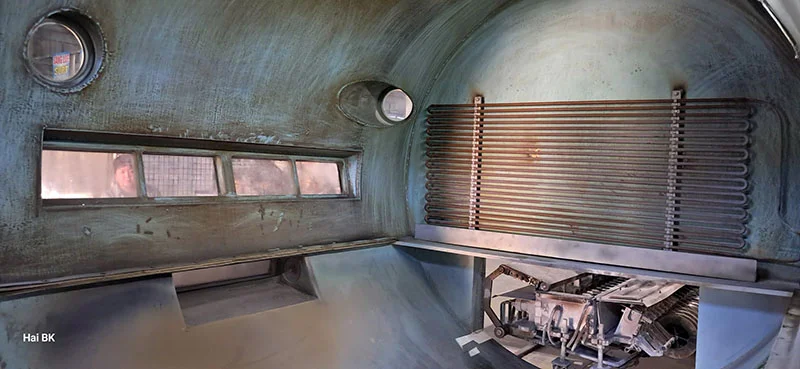
VietSonic inspects the inside of the equipment directly, rather than assessing it only from the outside
A vacuum aluminum metallizing system combines multiple mechanical, electrical, thermal, and vacuum assemblies that operate together. Inspecting only one component can overlook related causes.
Inspect the equipment under its actual installation and operating conditions.
Evaluate the relationships among heat, electricity, vacuum, aluminum feeding, and film movement.
Minimize broad component replacement and focus on locations directly related to the failure.
Balance equipment condition, production requirements, and allowable downtime.
Vacuum Aluminum Metallizing System Repair and Maintenance Services
VietSonic provides inspection and corrective solutions tailored to the actual condition of each system.
Aluminum heating assembly inspection
Evaluate heating elements, aluminum-wire contact points, clamps, busbars, and abnormal heat-generating locations.
Aluminum feeding system maintenance
Inspect the wire-feeding mechanism, alignment, contact positions, and consistency among evaporation points.
Electrical control inspection
Evaluate power-supply paths, connections, and locations that may cause heating-power deviations.
Coating chamber cleaning
Remove aluminum deposits, metallic dust, and accumulated material that may cause electrical arcing or hot spots.
Vacuum system inspection
Evaluate sealing integrity, pumping performance, and the condition of auxiliary assemblies that affect evaporation.
Roller and drive-system maintenance
Inspect roller surfaces, bearings, parallelism, film tension, and the line’s drive mechanisms.
Help manufacturers stabilize quality and reduce downtime risks
Improve aluminum-layer uniformity across the film width.
Reduce the number of nonconforming film rolls requiring rework.
Limit imbalances in aluminum feeding and evaporation.
Operators do not need to continuously change machine settings.
Detect deteriorating areas before major failures occur.
Provide a basis for planning periodic equipment inspections.

Is your aluminum metallizing system experiencing uneven heating temperatures or producing streaked, blotchy film?
VietSonic provides on-site inspection, root-cause assessment, and repair or maintenance recommendations suited to the equipment’s actual condition.