
Professional Non-Woven Bag Manufacturing Process

Professional Non-Woven Bag Manufacturing Process at VietSonic Factory
Discover the non-woven bag manufacturing process at VietSonic – professional, modern, and eco-friendly. Meeting all bulk processing requirements.
To enhance environmental protection, the shift towards using non-woven fabric bags instead of traditional plastic bags is accelerating. Each bag produced requires a rigorous manufacturing process combined with the precision of skilled technicians. Are you curious about how a perfect non-woven bag is created and what stages it goes through? Let’s explore with us.

1. The Non-Woven Bag Manufacturing Workflow

Fabric bags are favored for their environmental friendliness. Additionally, they are lightweight, durable, capable of holding large loads, and fashionable—features that other types of packaging cannot match. To produce a high-quality fabric bag, it must undergo a strictly controlled inspection process.

Non-woven bag manufacturing process


  • Stage 1: Material Selection (Non-woven Fabric).
   Depending on client requirements, appropriate fabric colors and weights (GSM) are selected. Selections are typically based on international standard color charts to ensure consistency.
     

  • Stage 2: Pattern Drafting & Design.
   Once the material is selected, the pattern is designed according to the client’s specifications. All patterns are drafted on computers using specialized CAD software, ensuring near-absolute precision.
     

  • Stage 3: Pattern Plotting and Cutting.

After the design meets requirements, the pattern is sent to a plotter to be drawn on specialized paper, simulating the actual fabric. The advantage of this computerized process is the optimization of pattern nesting to minimize material waste. Once plotting is finished, the pattern template is complete.


  • Stage 4: Mass Fabric Cutting.
   The patterns are used to guide the fabric cutting process. To save time and costs, technicians stack dozens to hundreds of fabric layers to cut simultaneously using industrial cutters. Therefore, the pattern design stage demands absolute accuracy.
     

  • Stage 5: Surface Printing/Branding.
   After cutting, the fabric panels undergo printing for logos or images according to the specific branding needs of the client.
     

  • Stage 6: Assembly & Fabrication.
   The printed fabric components are transferred to the workshop for final assembly and sewing (or ultrasonic welding depending on the bag type).
     

  • Stage 7: Quality Control (QC) & Packaging.
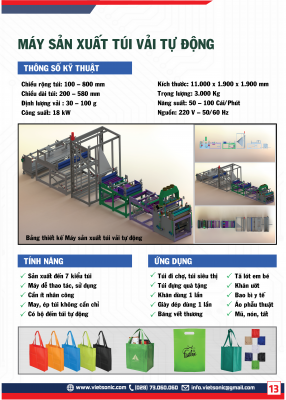
   Upon completion, a QC team inspects every detail, such as dimensions and seam integrity, correcting any defects to ensure the most perfect product output before packaging.
Non-woven bag production steps
Production process of non-woven bags at the factory

2. Benefits of Non-Woven Fabric Bags

   The primary benefit of non-woven fabric bags is undoubtedly their environmental friendliness. These bags are water-resistant, washable, reusable multiple times, and possess rapid decomposition capabilities, making them a preferred choice. Furthermore, using non-woven bags contributes to protecting public health, as plastic bags made from PTE often contain toxic additives like lead and heavy metals, which are harmful to the body and potential carcinogens.
   Beyond eco-friendly characteristics, non-woven bags are antibacterial and breathable. This is a standout product suitable for businesses, supermarkets, and companies to use as gifts or promotional items.
Non-woven wine bag
   As the world faces the “plastic bag hazard,” using non-woven fabric bags is a smart and effective solution. It not only protects the natural environment but is also a safe method to protect our own health. Start changing habits and switching to fabric bags today!

   Visit the website vietsonic.vn to update more about automated production lines as well as other ultrasonic equipment such as: ultrasonic sewing machines, ultrasonic welding machines, ultrasonic cutting machines, and ultrasonic mixing machines. As a leading unit specializing in manufacturing ultrasonic products, we are committed to delivering the highest quality products, providing diverse, eco-friendly services suitable for users with the most dedicated after-sales support.

Contact now: VIETNAM ULTRASONIC EQUIPMENT CO., LTD

Address: 43/5B, National Highway 22, My Hoa 4, Xuan Thoi Dong, Hoc Mon, HCMC

Hotline: 028 73 060 060

Website: vietsonic.vn

Leave a Reply

Your email address will not be published. Required fields are marked *