



At Which Stage of Cream Production Should Ultrasound Be Evaluated?
In skincare cream manufacturing, the stage at which ultrasonic energy is introduced into the mixing system can affect emulsion droplet size, viscosity, and product structure. The process stage should therefore be identified before selecting equipment and operating parameters.
This article examines the stages worth investigating in cream production, particularly emulsification, and explains how to assess performance before scaling up.
1. Why does the timing of ultrasonic treatment matter?
An emulsion-based skincare cream typically contains a water phase, an oil phase, emulsifiers, and structure-building ingredients. Depending on the formulation, active ingredients, moisturizers, and extracts may be added at different stages.
During mixing, the two phases combine to form an emulsion. In an oil-in-water (O/W) system, oil droplets are dispersed throughout a continuous water phase. Droplet size and its distribution are among the factors to monitor when assessing emulsion quality.
High-intensity ultrasound can produce acoustic cavitation in liquids. The resulting mechanical effects may help break up dispersed droplets or agglomerates in suitable systems.
However, as the cream thickens, energy transfer and material circulation may change significantly. The same equipment may therefore produce different results when used at different process stages.

2. Stages at which ultrasonic treatment can be evaluated
For an emulsion-based cream formulation, three main stages deserve consideration. Each serves a different purpose, so the decision should be based on the specific issue encountered in the formulation.
Before emulsification
Ultrasound can be tested on an individual ingredient phase to assist the dispersion of solid particles or agglomerates, if present. Solvent compatibility, heat tolerance, and the risk of ingredient changes must be considered.
After coarse emulsification
This stage should be prioritized when the goal is to reduce oil-droplet size and modify droplet-size distribution. A preliminary emulsion has formed, but the cream may not yet have reached its final viscosity.
During cooling
This can be studied if the system remains sufficiently fluid and the formulation permits it. Viscosity increase, structure development, and the effects of added energy must be monitored.
After the cream is finished
This should only be considered for a specific, demonstrable processing objective. Cream that is too thick or has developed a shear-sensitive structure may not be suitable for direct ultrasonic treatment of the entire batch.
3. Why prioritize the stage after coarse emulsification?
During preliminary emulsification, a mixer or mechanical homogenizer has already dispersed the oil phase into droplets within water. However, the droplets may still be relatively large and their distribution may not meet the design target.
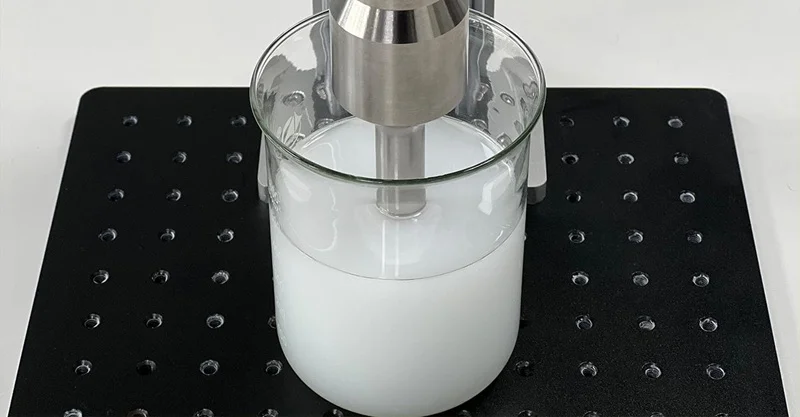
When ultrasound is applied to an emulsion under suitable conditions, cavitation and local fluid flows may provide additional droplet-breakup effects. Formulation developers can then investigate whether oil-droplet size and distribution can be adjusted.
Cucheval and Chow’s study of ultrasonic oil emulsification used a preliminary emulsion to examine the effects of power, duty cycle, and processing time. This supports investigating ultrasound as a stage following initial mixing.
Nevertheless, findings obtained with one oil-and-emulsifier system cannot be applied directly to every skincare cream. Structure, phase ratio, and stabilizers can all change how a formulation responds.
4. What needs to be controlled during ultrasonic trials?
To assess the technology, ingredient conditions, equipment, and sampling methods must all be controlled. Relying solely on the machine’s rated power or sonication time makes it difficult to explain changes in the finished product.
| Factor | What to monitor | Reason |
|---|---|---|
| Emulsion state | Emulsion type, phase ratio, initial viscosity | Affects energy transfer and processability |
| Amplitude and time | Vibration amplitude, actual sonication time, on/off duty cycle | Defines the conditions applied to the sample |
| Temperature | Initial, peak, and final temperature, plus cooling method | Ultrasound can heat the sample |
| Equipment | Probe type, immersion depth, volume, tank or flow-cell geometry | Affects the distribution of the treated zone |
| Sensitive ingredients | Stability of actives, extracts, and structure-forming ingredients | Potential quality changes must be assessed |
One important point is that equipment rated power does not mean all that energy reaches the sample. When comparing tests, document how the actual energy delivered was estimated and the corresponding thermal conditions.
5. Which indicators should be used to assess the results?
A smooth-looking cream alone is not enough to conclude that ultrasound has improved emulsion quality. Measurements should be chosen to match the objective of the trial.
| Objective | Evaluation method | What must be confirmed |
|---|---|---|
| Oil-droplet distribution | Microscopy and suitable droplet-size and distribution measurements | Changes compared with a control sample |
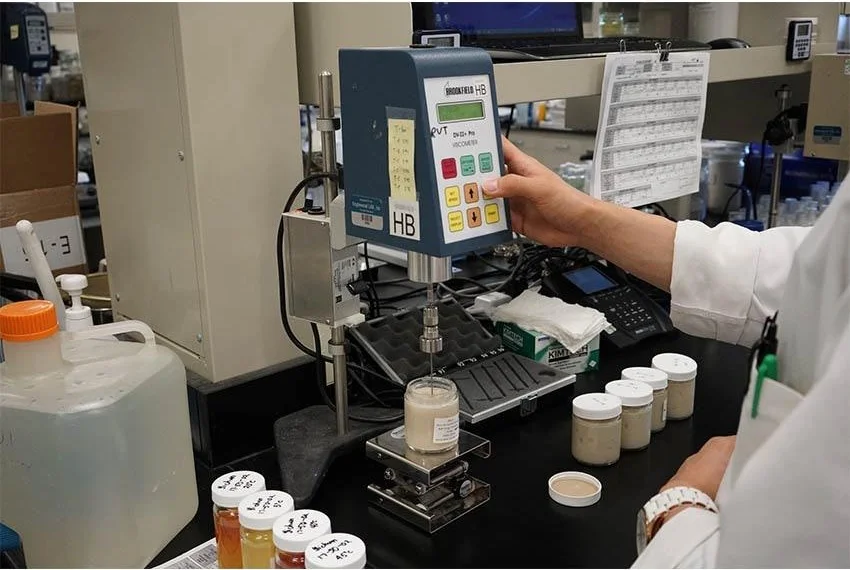
| Cream texture | Viscosity, rheological behavior, and structural recovery measurements | Whether the texture meets formulation requirements |
| Stability | Monitor phase separation and changes in size, color, odor, and pH | Ability to maintain quality during sample storage |
| Active ingredient quality | Assay ingredient content and, where appropriate, degradation products | Whether important ingredients are affected |
| Reproducibility | Trials on independent batches | Whether results can be reproduced consistently |
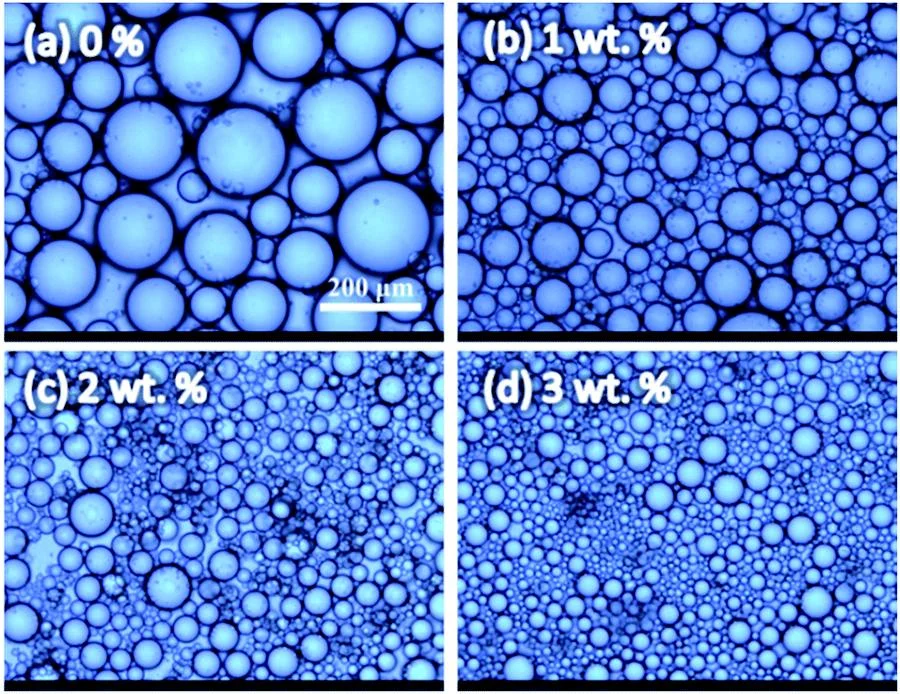
When investigating emulsions with very small droplets, the analytical method must suit the sample matrix and expected size range. A single average value should not be used to conclude that all droplets are the same size.
6. Proposed investigation procedure for a cream formulation
Process development should begin with small-scale testing, a control sample, and predefined assessment criteria.
- Define the objective. Select the issue to address, such as droplet size, oil-phase distribution, clumping, or emulsion stability.
- Prepare a control sample. Keep the formulation, raw-material lots, and basic mixing conditions of the current process unchanged.
- Investigate the ultrasonic stage and conditions. Prioritize the preliminary emulsion, then consider treating individual phases if needed. Record amplitude, time, temperature, and volume.
- Compare quality. Measure droplet size, viscosity, pH, stability, and relevant indicators. A thermal control may also be needed to distinguish heating effects from ultrasonic effects.
- Confirm scalability. Once small-scale samples meet their targets, evaluate circulation, flow rate, heat exchange, and uniformity at a larger scale.
7. Relevance to MAI cosmetics technology development
Within MAI’s cosmetics development direction, ultrasonic homogenization is being considered as a method to support mixing and emulsification.
For skincare creams containing ingredients such as Tranexamic Acid, Alpha Arbutin, Niacinamide, and moisturizers, the timing of ultrasonic treatment must be based on the actual formulation, individual ingredient properties, and chosen mixing sequence.
Ingredients added during cooling or subject to temperature limits require separate consideration. It should not be assumed that every active ingredient must undergo direct ultrasonic treatment.
To establish the role of this technology in a particular product, comparative data on emulsion structure, viscosity, stability, and active ingredient quality are needed. Results from other formulations serve only as references when planning trials.
8. Frequently asked questions
It can be investigated, but when the goal is to modify emulsion droplet size, consider first creating a coarse emulsion and then applying ultrasound. The choice depends on the equipment and formulation.
It may be investigated in certain suitable systems, but high viscosity can limit processing and alter product structure. It requires a separate evaluation rather than routine application.
There is no universal solution. Ultrasound can be added as a processing stage alongside mixing or mechanical homogenization. Any replacement must be demonstrated by technical trials.
Using ultrasonic equipment alone does not demonstrate that a product is a nanoemulsion. Droplet size and distribution must be measured using a suitable method before making that claim.
9. Conclusion
For many emulsion-based cream formulations, the stage after coarse emulsification and before the final thick structure develops is a priority point for evaluating ultrasound. This is a suitable time to investigate adjustments to droplet size and distribution in systems that respond to the technology.
However, choosing the stage must be tied to the specific formulation, equipment conditions, and measured results. A controlled trial process helps determine whether ultrasound provides a useful change that can be sustained at production scale.
Discuss ultrasonic applications in cosmetics manufacturing
VietSonic provides ultrasonic equipment solutions for various industrial sectors. Businesses exploring ultrasound for dispersion, homogenization, or emulsification can discuss their ingredients and proposed processing conditions with VietSonic.
Hotline: 0938 49 33 66 – Mr. Hải
Email: info.vietsonic@gmail.com
Website: vietsonic.vn