



VIETSONIC · TECHNOLOGY INSIGHTS
Stirring, Dissolution, Dispersion and Emulsification: What Is the Difference?
In the manufacture of skincare creams and serums, the same act of “mixing ingredients” can serve very different purposes: distributing components evenly, dissolving a substance, breaking up powder agglomerates or forming oil droplets in water. Understanding stirring, dissolution, dispersion and emulsification helps define the purpose of each processing step, select suitable equipment and determine what to check after processing.
1. At a glance: four processes with different target outcomes
Stirring describes how movement is generated within a batch. Dissolution, dispersion and emulsification describe specific changes in the ingredients within a system. A stirring step can therefore support dissolution or dispersion at the same time; these four concepts are interconnected.
| Process | Main objective | State after processing | Illustrative example |
|---|---|---|---|
| Stirring | Generate flow, increase contact and distribute components | Material circulates throughout the batch volume | Stirring the aqueous phase to reduce concentration differences between locations |
| Dissolution | Incorporate a solute into a suitable solvent | The solute exists at the molecular or ionic level in solution | Salt dissolving in water when the amount added is within its solubility limit |
| Dispersion | Wet and distribute particles, breaking up agglomerates when needed | Solid particles remain present in the liquid medium | Distributing insoluble pigment powder in a cosmetic base |
| Emulsification | Form droplets of one liquid in another liquid with which it is not fully miscible | The system consists of a dispersed droplet phase and a continuous phase | Forming oil droplets dispersed in the aqueous phase of an oil-in-water cream |
2. Stirring: moving ingredients and bringing them into contact
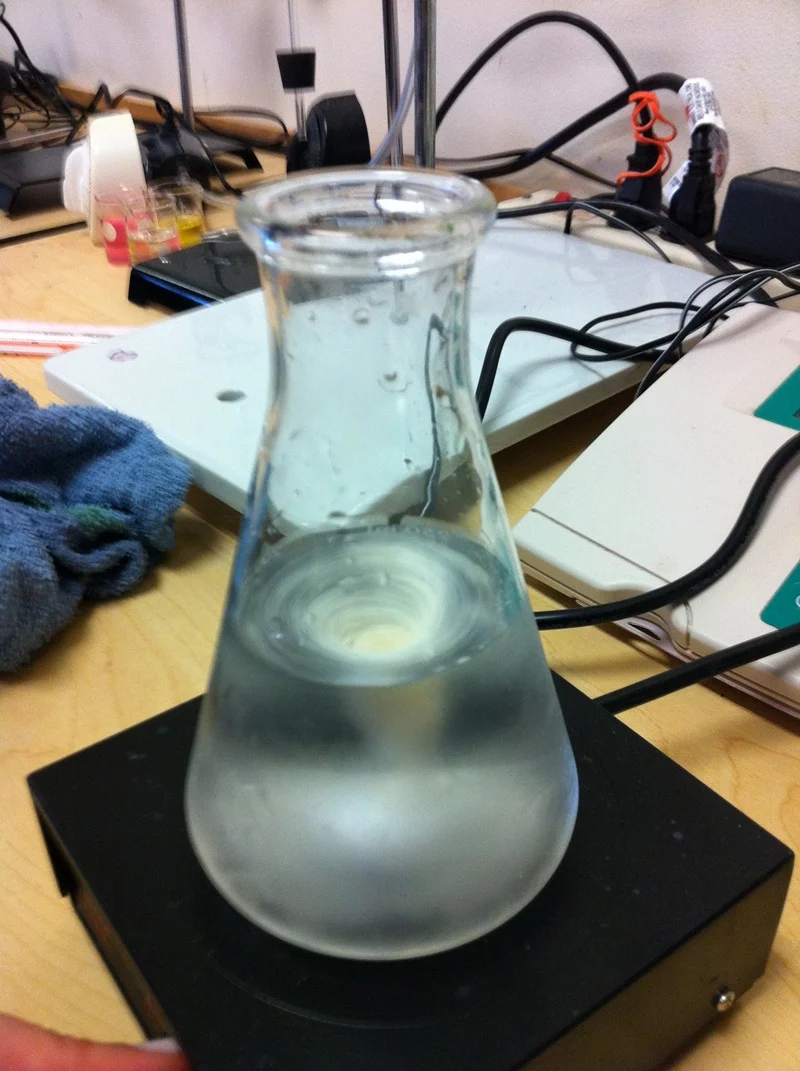
An impeller or stir bar generates flow in a liquid. This flow moves ingredients from one region to another, supports heat transfer and reduces concentration differences within the batch. Performance depends on viscosity, vessel geometry, impeller type, speed and fill level.
A vigorously rotating batch is not necessarily evenly mixed at every point. Material near the impeller may move well while regions close to the wall or bottom have limited circulation. Increasing speed can also entrain more air, so both flow and foaming need to be assessed.
3. Dissolution: a solute enters a solvent at the molecular or ionic level
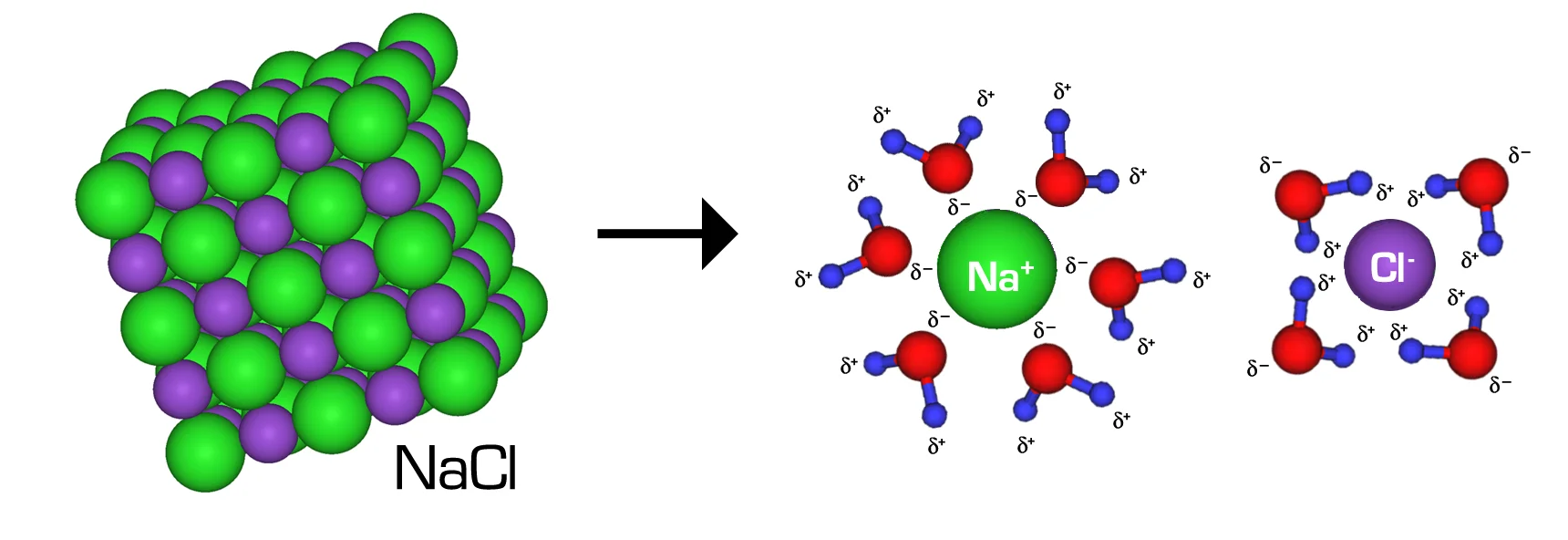
When salt dissolves in water, ions leave the crystal lattice and become surrounded by water molecules. For molecular solutes, solute molecules become distributed in the solvent. The result is a solution that is homogeneous at the molecular or ionic level, rather than the solid particles initially present.
Stirring can bring a solute into contact with a solvent more quickly. However, dissolution rate and equilibrium solubility are different concepts. If the solvent is unsuitable or the amount added exceeds the solubility limit under the conditions considered, solid material may remain even after prolonged stirring.
When developing creams and serums, the solubility of each ingredient, its use concentration, pH, temperature and interactions with other components must be checked. An ingredient that dissolves during hot preparation may recrystallize after cooling or during storage.
4. Dispersion: particles remain, but are distributed in a liquid
For a solid ingredient that does not dissolve in the medium being used, the objective may be to wet particle surfaces, incorporate the particles into the liquid phase and distribute them more evenly. If the ingredient forms agglomerates, the dispersion step must also address these clusters according to the formulation requirements.
For example, an insoluble pigment powder can be distributed as small particles in a cosmetic base. The mixture may look quite uniform to the naked eye, while solid particles are still present. The system must be assessed for particle size, degree of agglomeration, settling tendency and redispersibility.
5. Emulsification: forming droplets between two liquid phases
Oil and water usually separate into two layers when left to stand. During emulsification, one phase is broken into droplets and distributed in the other. An oil-in-water (O/W) emulsion has oil droplets within an aqueous phase; a water-in-oil (W/O) emulsion has the opposite structure.
Mechanical energy helps form and break up droplets. A suitable emulsifier system or interfacial stabilization mechanism helps limit droplet coalescence. Stability also depends on composition, phase ratio, viscosity, droplet size and storage conditions.
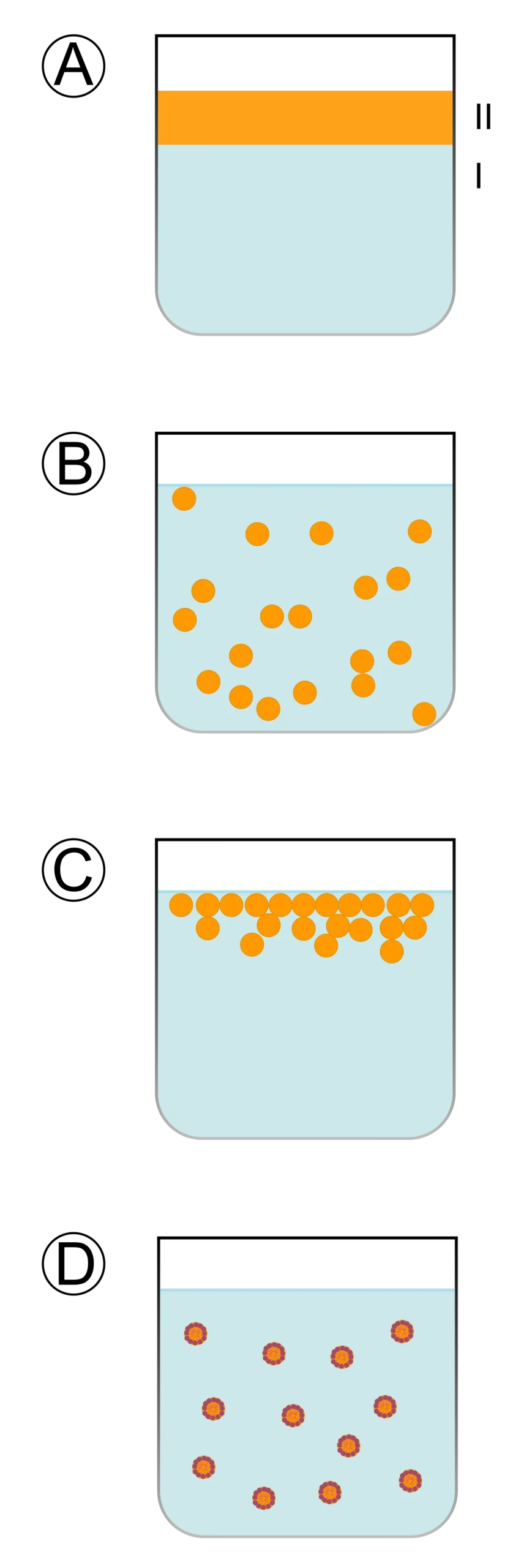
Reading the emulsification diagram
A: The two liquid phases are separate and have not been emulsified.
B: One phase is divided into droplets distributed within the other phase.
C: An unstable emulsion may separate into layers again.
D: A surfactant is located at the boundary between the phases, helping stabilize the droplets.
The image illustrates a principle; it does not represent the formulation or test results of a specific product.
Emulsification is often directly relevant to skincare creams containing both oil and aqueous phases. For serums, the formulation structure must first be identified: a serum may be a solution, gel, oil-based system or emulsion. The name “serum” alone does not determine whether emulsification is needed.
6. Which processing steps can ultrasound support?
Under suitable conditions, power ultrasound transfers energy into a liquid and creates cavitation: bubbles form, oscillate and collapse, producing localized mechanical effects. This mechanism can help break up particle agglomerates and reduce droplet size in suitable systems. Research on oil-in-water emulsification using an ultrasonic probe shows that the outcome depends on processing conditions and the cavitation zone.
For dissolution
It can be investigated as a way to increase contact and support dissolution rate. A suitable solvent and control of concentration and temperature are still required.
For dispersion
It can help break up agglomerates. Size measurements and monitoring of re-agglomeration and settling after processing are needed.
For emulsification
It can be used to process a coarse emulsion to reduce droplet size. The formulation still requires a suitable stabilization system.
When applied to creams or serums, circulation throughout the batch must be coordinated with the ultrasonic treatment zone. Temperature, time, volume and ingredient properties must also be monitored. The use of ultrasound alone does not demonstrate that the finished product is nanoscale or provides greater skincare benefits.
7. Choose the processing step according to the problem
A cream batch may require dissolving suitable components in their respective phases, dispersing insoluble ingredients, emulsifying oil and water, and continuing stirring during finishing steps. The sequence and conditions must be developed for the specific formulation.
| Observed issue | What to investigate | Assessment criteria |
|---|---|---|
| Concentration varies between locations | Flow and overall batch mixing | Compare samples from different locations using an appropriate quantitative method |
| Crystals remain or reappear after cooling | Solubility, solvent, concentration, pH and temperature | Amount dissolved, remaining crystals and monitoring during storage |
| Powder agglomerates, lumps or settling | Wetting, dispersion and the particle stabilization system | Microscopy, size distribution and settling over time |
| Large droplets, creaming or phase separation | Emulsification, stabilization system and viscosity | Droplet size distribution and stability testing under an appropriate plan |
These observations are starting points for investigation. Colour, clarity or apparent smoothness to the naked eye alone cannot confirm that a processing step meets its requirements.
Frequently asked questions
Will longer stirring dissolve every ingredient completely?
No. Dissolution also depends on the ingredient, solvent and formulation conditions. Once a system is saturated, the formulation or conditions should be reviewed instead of simply extending the stirring time.
Does a uniform-looking mixture mean that dissolution has occurred?
Not necessarily. A fine-particle dispersion or an emulsion can also appear uniform. The state of the material in the system must be checked using an appropriate method.
Does every serum need an emulsifier machine?
No. It is necessary to determine whether the serum contains immiscible liquid phases that require emulsification. A solution-based serum has different processing objectives from an emulsion-based serum.
Discuss ultrasound applications in cosmetic manufacturing
Start with the ingredients, formulation structure and the issue to be addressed: supporting dissolution, breaking up particle agglomerates or emulsification. Defining the objective correctly provides a clearer basis for selecting and evaluating the technology.
VietSonic — ultrasonic equipment solutions consultancy
Hotline: 0938 49 33 66 — Mr. Hải
Email: info.vietsonic@gmail.com