



How Is an Oil Droplet Dispersed in a Moisturizing Cream?
A jar of moisturizing cream may contain both water and oil. To the naked eye, it looks like a uniform mass of cream. At the microscopic level, however, the oil phase may exist as countless tiny droplets dispersed throughout the water phase.
What causes a large oil droplet to break into smaller ones? Why can these droplets remain dispersed in cream, and how does ultrasonic technology contribute to the process?
1. Why do oil and water resist mixing?
Add a little cooking oil to a glass of water and observe. At first, the oil may float as a layer on the surface. Vigorous stirring temporarily breaks that layer into small droplets, making the mixture look cloudier.
Without suitable stabilizing ingredients, the oil droplets can collide, merge into larger droplets and eventually separate into layers.
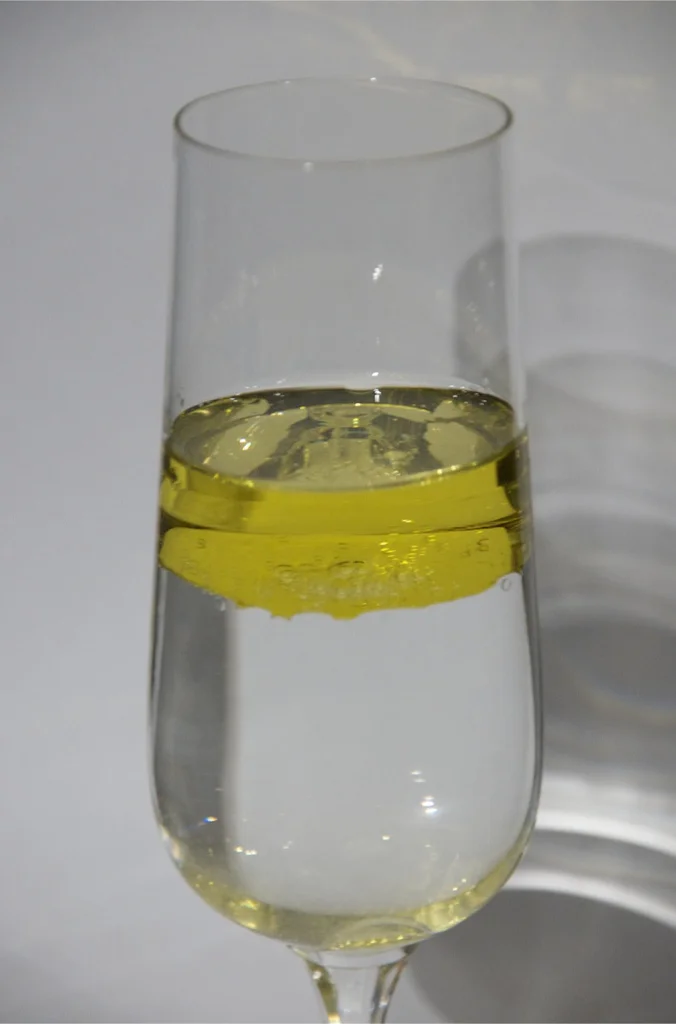
When making moisturizing creams, formulators must address this behavior so that the oil and water phases can coexist in a suitable emulsion.
An emulsion is a system of two liquids that do not readily mix, in which one liquid is broken into droplets and dispersed throughout the other.
2. From one large oil droplet to thousands of tiny droplets
Imagine introducing a single oil droplet into the water phase. To form an emulsion, mechanical energy is applied to deform and break up that droplet.
The process can be understood in three stages:
Bringing the two phases together
Depending on the formulation, the oil phase is added to the water phase or vice versa. Initially, the two phases are not evenly distributed.
Breaking up oil droplets
Mixing or homogenization creates mechanical forces that deform oil droplets and break them into smaller ones.
Stabilizing the dispersion
A suitable emulsifying system helps keep the droplets dispersed and limits their coalescence during manufacturing and storage.
In an oil-in-water system, the user typically sees a uniform cream because the oil droplets are distributed within the continuous phase, together with the other ingredients that build the cream’s structure.
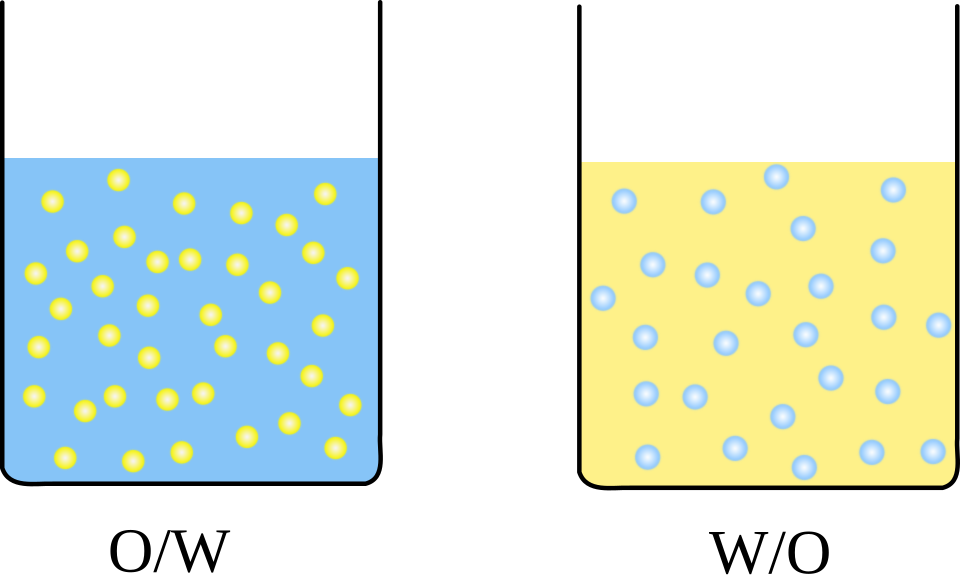
The diagram shows droplets of the dispersed phase within the continuous phase. Their actual size, number and distribution depend on the formulation and emulsification process.
3. What stops oil droplets from merging again?
When one oil droplet is divided into many smaller droplets, the total area of contact between oil and water increases. Suitable ingredients are needed to stabilize the newly formed interfaces.
This is where emulsifiersplay an important role. Depending on their chemistry, emulsifier molecules can accumulate at the oil–water interface, reduce interfacial tension and help prevent droplets from merging.
In a moisturizing cream, structure is also influenced by thickeners, the ratio of the two phases, temperature and mixing method.
Formulators therefore need to consider both droplet breakup and the ability to maintain dispersion over time. These mechanisms are discussed in a review of emulsion stability.
4. How does ultrasound help disperse oil droplets?
In emulsion manufacturing, ultrasound can be used to support homogenization. When a transducer transfers ultrasonic vibrations into a liquid, the acoustic field can generate acoustic cavitation under suitable conditions.
Cavitation bubbles form, oscillate and collapse, creating localized mechanical effects. In an oil–water system, these effects can help deform and break up oil droplets.
How does ultrasound act on an oil droplet?
- Energy transfer: The probe delivers vibrations into the region of liquid being processed.
- Mechanical effects: Phenomena created by the acoustic field, particularly cavitation when it occurs, can cause droplets to deform.
- Droplet breakup: Oil droplets may be divided into smaller droplets.
- Distribution throughout the system: Suitable mixing or recirculation moves different portions of the batch through the treatment zone and distributes the droplets throughout the mixture.
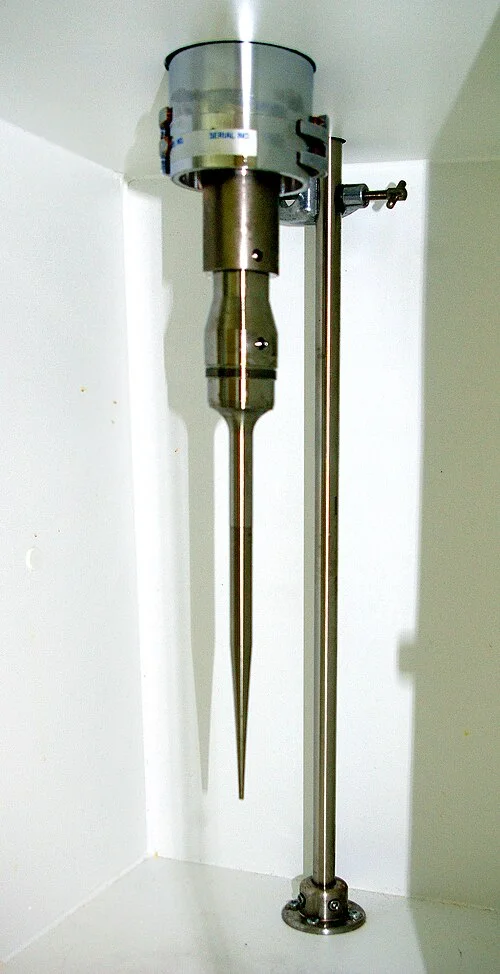
A study of ultrasonic emulsification using soybean oil in water observed droplet breakup during treatment with an ultrasonic probe. The study also showed that the region close to the probe plays an important role in emulsification.
Results can nevertheless differ between formulations. Viscosity, oil content, emulsifier type, temperature and operating conditions all influence droplet formation.
5. From emulsion formation to cream structure
A moisturizing cream contains more than water and oil. Its formulation may also include thickeners, humectants, emulsifiers and other functional ingredients.
During manufacturing, formulators need to determine when ingredients are added, how they are mixed and the order in which the structure is developed. Some systems first form a coarse emulsion, then use a homogenizer to adjust the droplet size distribution.
When considering an ultrasonic step, its effects on both the emulsion and the cream’s base structure must be assessed. Excessive processing or uncontrolled heating may change the properties of some formulations.
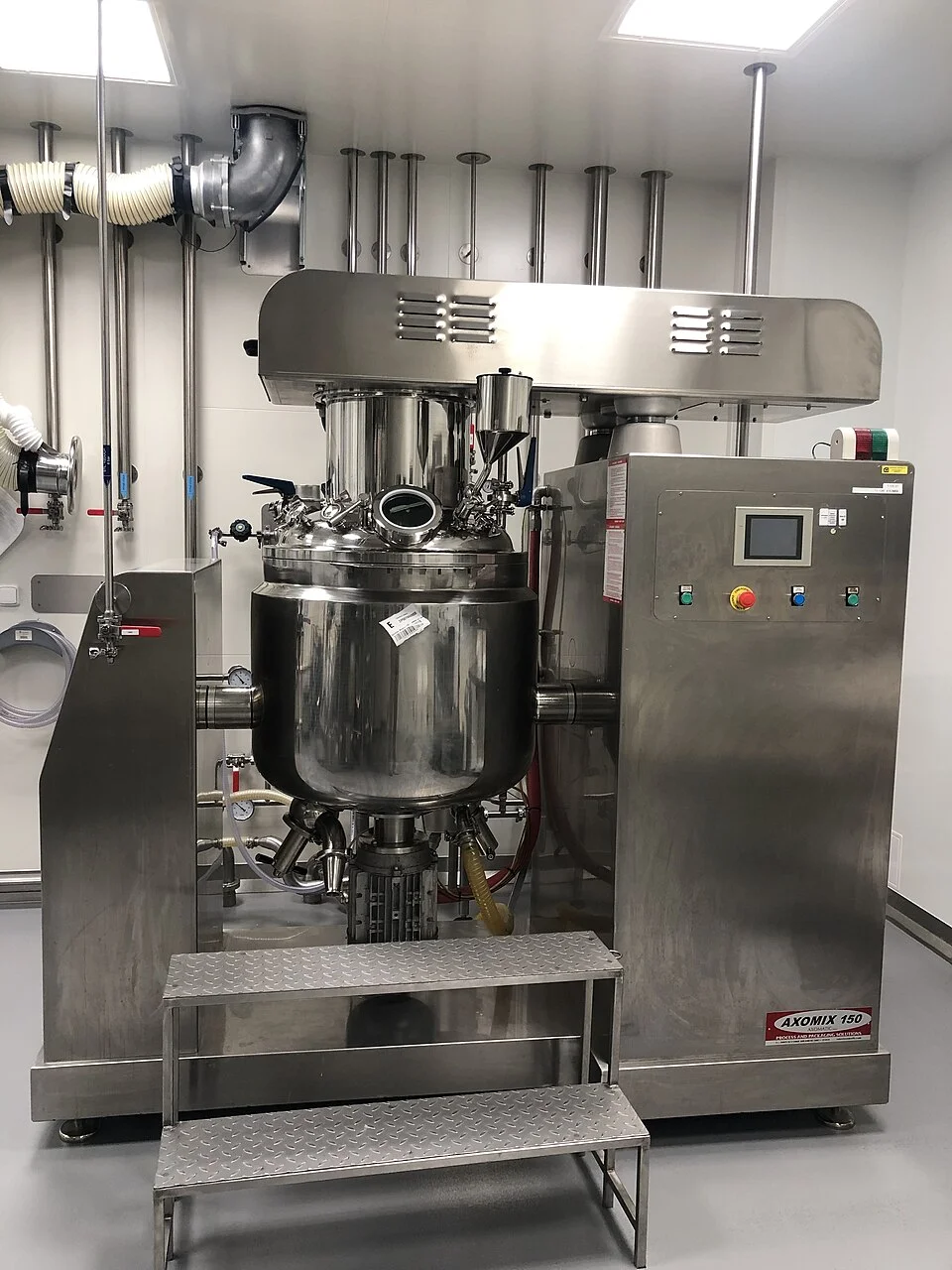
At production scale, the process must be controlled across the whole batch, rather than assessed only near a probe or mixing blade.
6. How can we tell whether oil droplets are well dispersed?
A cream that looks smooth and uniform provides useful sensory information, but appearance alone cannot determine droplet size or predict storage stability.
Several parameters can be monitored to assess the process:
| Parameter | Evaluation method | What it tells us |
|---|---|---|
| Oil droplet size | A sizing technique suited to the sample, potentially combined with microscopy. | Indicates how far the droplets were broken down during processing. |
| Size distribution | Measure droplet-size distribution in a representative sample. | Shows whether the system contains different populations of large and small droplets. |
| Viscosity and structure | Measure under defined temperature and testing conditions. | Helps assess changes in cream texture and structure. |
| Stability | Monitor samples under planned storage conditions. | Identifies tendencies toward flocculation, coalescence or phase separation. |
| Uniformity across sampling locations | Collect samples from several positions within the batch. | Helps assess how evenly ingredients are distributed throughout the batch volume. |
To evaluate the specific benefits of ultrasound, a control sample should be prepared using the same formulation and comparable preparation conditions. Results before and after treatment can then be compared, including temperature changes.
Experimental studies also report that acoustic-field conditions, oil viscosity and interfacial tension can affect droplet breakup. For more detail, see this experimental and simulation study of ultrasonic oil-in-water emulsification.
7. How this relates to MAI moisturizing-cream technology
MAI’s basic list of cream ingredients includes Caprylic/Capric Triglyceride, an oil-phase ingredient commonly used in cosmetic formulations.
When developing an emulsion containing this ingredient, formulators must determine how the oil phase interacts with the other phases, as well as select suitable emulsifiers and processing conditions.
According to MAI’s technology information, ultrasonic homogenization is used in cream manufacturing to support mixing, dispersion and emulsification. This application can be evaluated through droplet size, uniformity and finished-product stability.
To establish how much an ultrasonic step improves any particular MAI formulation, measurements are needed on the actual product and process used.
8. Frequently asked questions
Are smaller oil droplets always better for moisturizing cream?
There is no single ideal droplet size for every cream. The appropriate result depends on the formulation, desired texture, stability requirements and the product being developed.
Can ultrasound completely replace emulsifiers?
Not as a general rule. Ultrasound supplies mechanical effects that create or modify dispersed droplets, while long-term stability must still be designed around the properties of each formulation.
Can ultrasound reduce oil droplets to nanoscale sizes?
Some research systems can produce emulsions with nanoscale droplets. However, results depend on the ingredients and processing conditions. Measurements are required before describing a product as a nanoemulsion.
How can we detect instability in a moisturizing cream?
Look for phase separation or changes in texture, and monitor droplet-size distribution and other relevant parameters during storage studies.
9. Conclusion: What happens to an oil droplet?
In a suitable emulsion, a large oil droplet can be broken into many smaller droplets by mixing and homogenization. Emulsifying ingredients and the base structure help keep these droplets dispersed.
Ultrasound is one possible way to support droplet breakup, but its performance must be established through the actual formulation and test results.
Understanding how oil droplets form and remain stable helps cream developers define mixing objectives, select processing technology and control the quality of each production batch.
Discuss ultrasonic applications in cosmetics manufacturing
VietSonic provides industrial ultrasonic-equipment solutions. If your business is exploring ultrasound for ingredient dispersion, emulsification or homogenization, contact us to discuss your technical requirements.
Hotline: 0938 49 33 66
Email: info.vietsonic@gmail.com