



Design and Manufacturing of Automatic Ultrasonic Welding Lines for Non-Woven Bags and Desiccant Pouches
Based on the actual bag sample, material, and required output, VietSonic integrates roll feeding, web guiding, edge folding, ultrasonic welding, and automatic cutting into a production line tailored to each company’s manufacturing process.
Businesses need more than a welding horn—they need a stable production process
In the production of non-woven bags and desiccant pouch shells, creating a weld is only one part of the process. The material must also be guided straight, maintained at the correct tension, folded in the proper position, continuously welded, and accurately cut to the required length.
Equipment performance therefore depends on the coordinated design of the mechanical system, ultrasonic technology, and control system. This integrated approach is central to how VietSonic develops machinery for non-woven fabric manufacturers and processors.
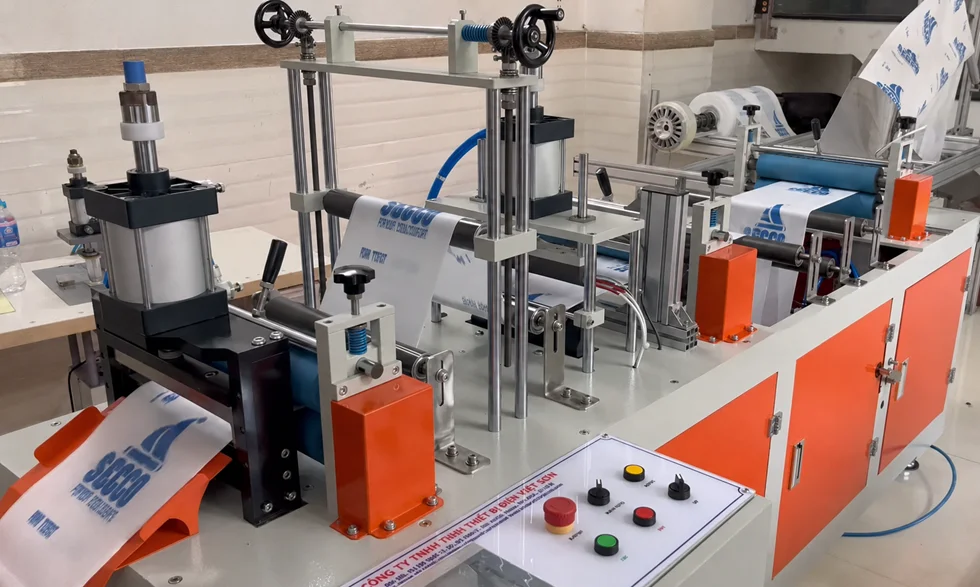
From production requirements to the right machine configuration
Each business uses different materials, bag dimensions, and output specifications. The production line should therefore be engineered from actual product data instead of applying one fixed configuration to every application.
Input material
Determine the material composition, basis weight, thickness, roll width, roll diameter, and ultrasonic weldability.
Product geometry
Design the folding tooling, overlap position, weld width, roller profile, and bag dimensions.
Output requirements
Define the target output, length tolerance, product collection method, and compatibility with downstream equipment.
How does the machine automatically produce bags from roll material?
The material is prepared at the appropriate width, fed through the unwinding system, and passed sequentially through the forming stages. All machine modules must operate in sync to prevent the material from shifting, wrinkling, or moving out of position as the operating speed increases.
Roll feeding and material guiding
The fabric roll is mounted on the feeding shaft. A series of guide rollers feeds the material into the machine and maintains a stable web path before it reaches the forming unit.
Web tension and edge position control
Web tension must be properly distributed to minimize sagging, wrinkling, and edge misalignment during continuous operation.
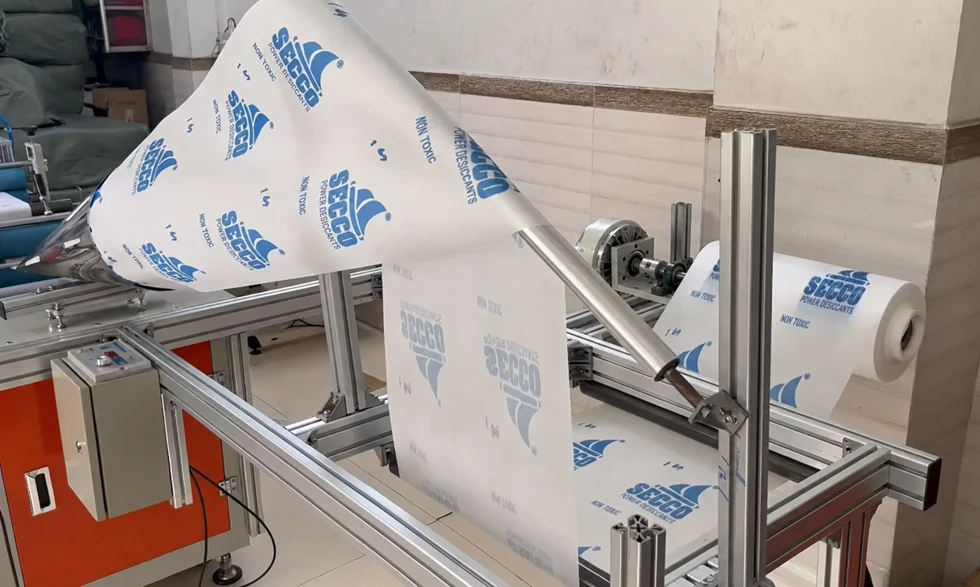
Edge folding and bag body forming
The material passes through folding tooling designed for the product geometry. The fabric edges are guided into the correct overlap position before entering the welding unit.
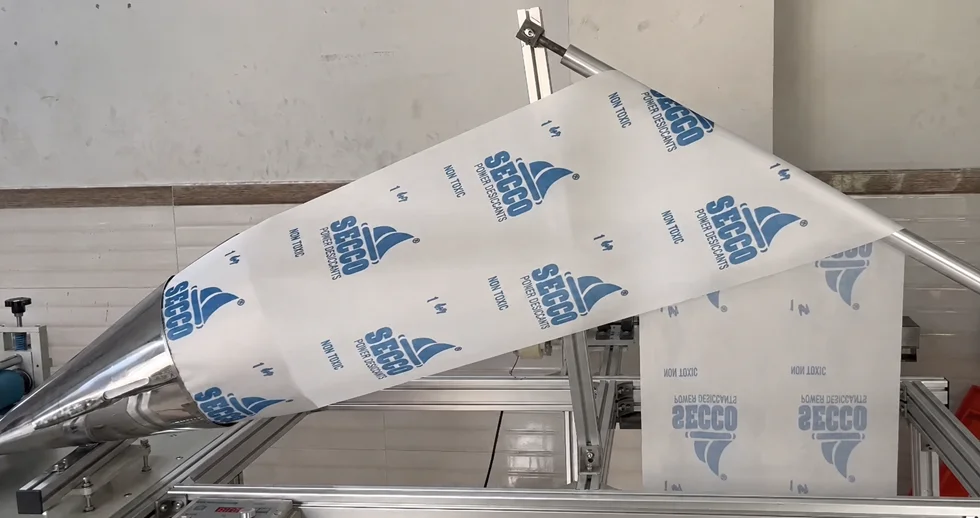
Continuous welding using ultrasonic technology
Ultrasonic vibrations combined with roller pressure create a bond at the contact area. The material edges are continuously welded without sewing thread or adhesive.
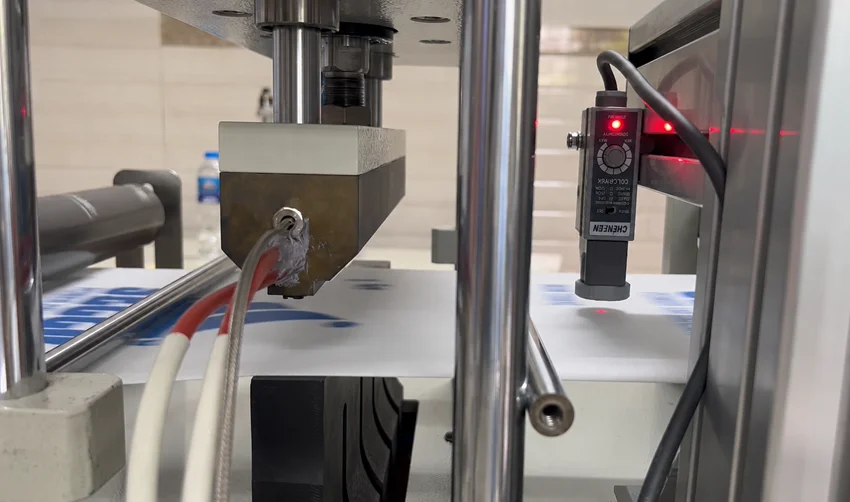
Automatic length measurement and bag cutting
After welding, the puller feeds the material to the cutting unit. The length is set according to the product specifications and synchronized with the production line speed.
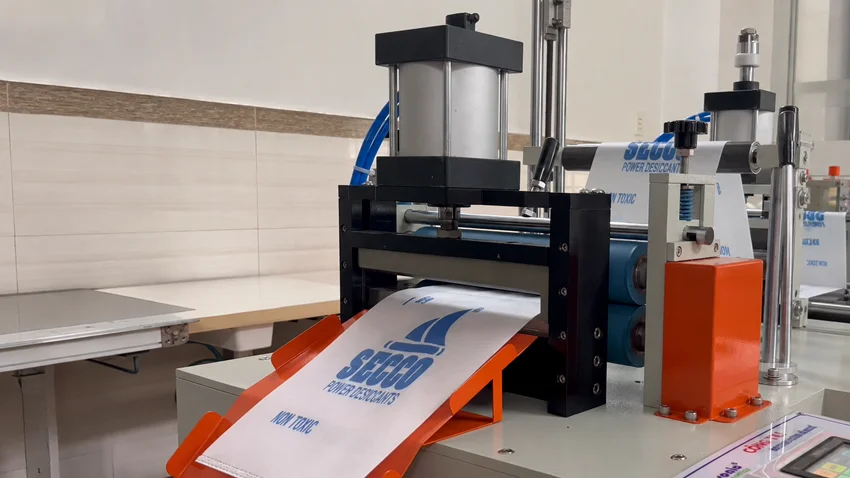
Automatic Ultrasonic Welding Machine for Non-Woven Bags and Desiccant Pouches
The value lies in complete production line synchronization
Stable production line operation requires coordination among multiple functional modules. Selecting a high-power welding horn alone is insufficient if the fabric pulling system, folding unit, applied pressure, and cutting cycle are not designed to work in sync.
Mechanical design
The machine frame, roll shaft, guide rollers, puller, folding tooling, and cutting unit are arranged along the material path.
Ultrasonic technology
The generator, welding horn, roller, pressure, and operating parameters are selected based on actual material samples.
Automatic control
Material feeding, fabric pulling, welding, and cutting speeds are synchronized to minimize variation between products.
Production line integration
The line can be engineered for integration with conveyors, counters, dosing systems, or downstream packaging equipment.
Why is ultrasonic welding suitable for non-woven fabric production?
For non-woven fabrics containing suitable thermoplastic fibers, ultrasonic vibrations generate localized heat at the bonding area. The welding process is fast and can be integrated directly into a continuous web-processing line.
Actual material samples must be tested
Weldability depends on fiber composition, basis weight, thickness, number of layers, and surface coating. Sample testing is therefore essential before determining the required power, roller profile, and machine speed.
The production line can be developed for a wide range of non-woven products
Depending on the folding tooling, weld profile, cutting mechanism, and output requirements, the system can be designed for various product categories.
Desiccant granule pouch shells
Silica gel pouches
Desiccant clay pouches
Activated carbon pouches
Flexible filter media packaging
Roll-fed folded, welded, and cut products
Distinguishing between a pouch-making machine and a complete packaging line
The configuration shown in the video focuses on roll feeding, forming, edge welding, and cutting to produce pouch shells or semi-finished products.
If the application requires dosing desiccant granules, filling the pouches, and sealing the remaining open end, the line must also integrate the appropriate material feeder, dosing system, and packaging unit.
What information should businesses prepare before consultation?
The more closely the information reflects the actual product, the more accurately the production line can be evaluated and configured.
Production Lines Engineered from Actual Product Samples
VietSonic receives material samples, evaluates weldability, and recommends a machine configuration based on bag dimensions, the manufacturing process, and the company’s required output.