


Damage Assessment of Raceway Spalling and WEC Cracks in Wind Turbine Gearbox Bearings
When a wind turbine gearbox exhibits abnormal noise, increased vibration, bearing temperature fluctuations, or metallic debris in the lubrication oil, the bearings are the primary components that must be inspected.
However, simply looking at pitting and spalling on the raceway is not enough to determine the root cause. In many cases, the material loss observed on the surface is merely the final stage of a crack network that has developed from deep within the bearing steel.
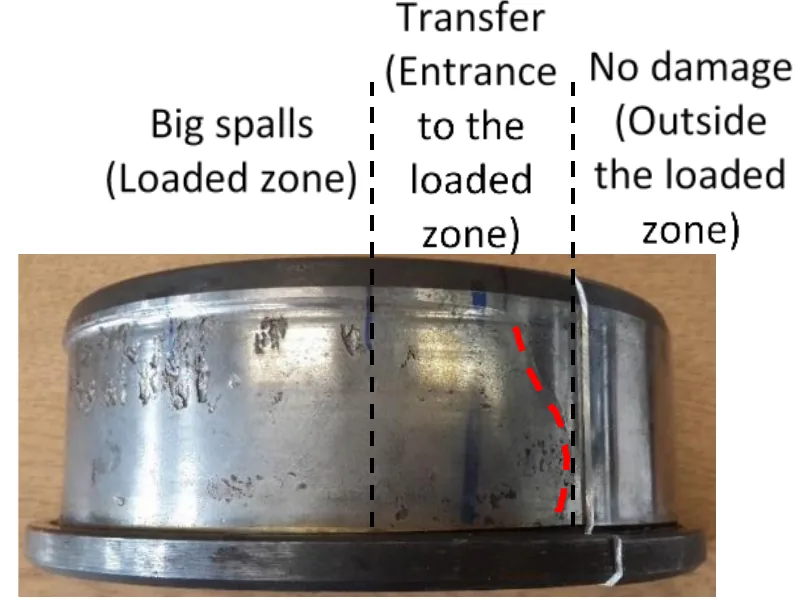
Spalling in the Loaded Zone
The most noticeable form of damage is spalling, deep pitting, and material loss on the inner ring raceway. This damage is typically concentrated in the loaded zone of the planetary bearings.
If the wear pattern is uneven or not parallel to the axial direction, consider the possibility of roller skewing, sliding upon entering the load zone, or asymmetric load distribution.
Causes can be linked to assembly misalignment, housing deformation, shaft runout, improper clearance, or unstable lubricating oil films.
Damage Initiating Below the Surface
After dismounting the bearing, it is necessary to separately inspect the heavily spalled area, the lightly damaged area, and the area with no visible defects. Cross-sectional analysis helps identify damages that cannot be detected through external observation.
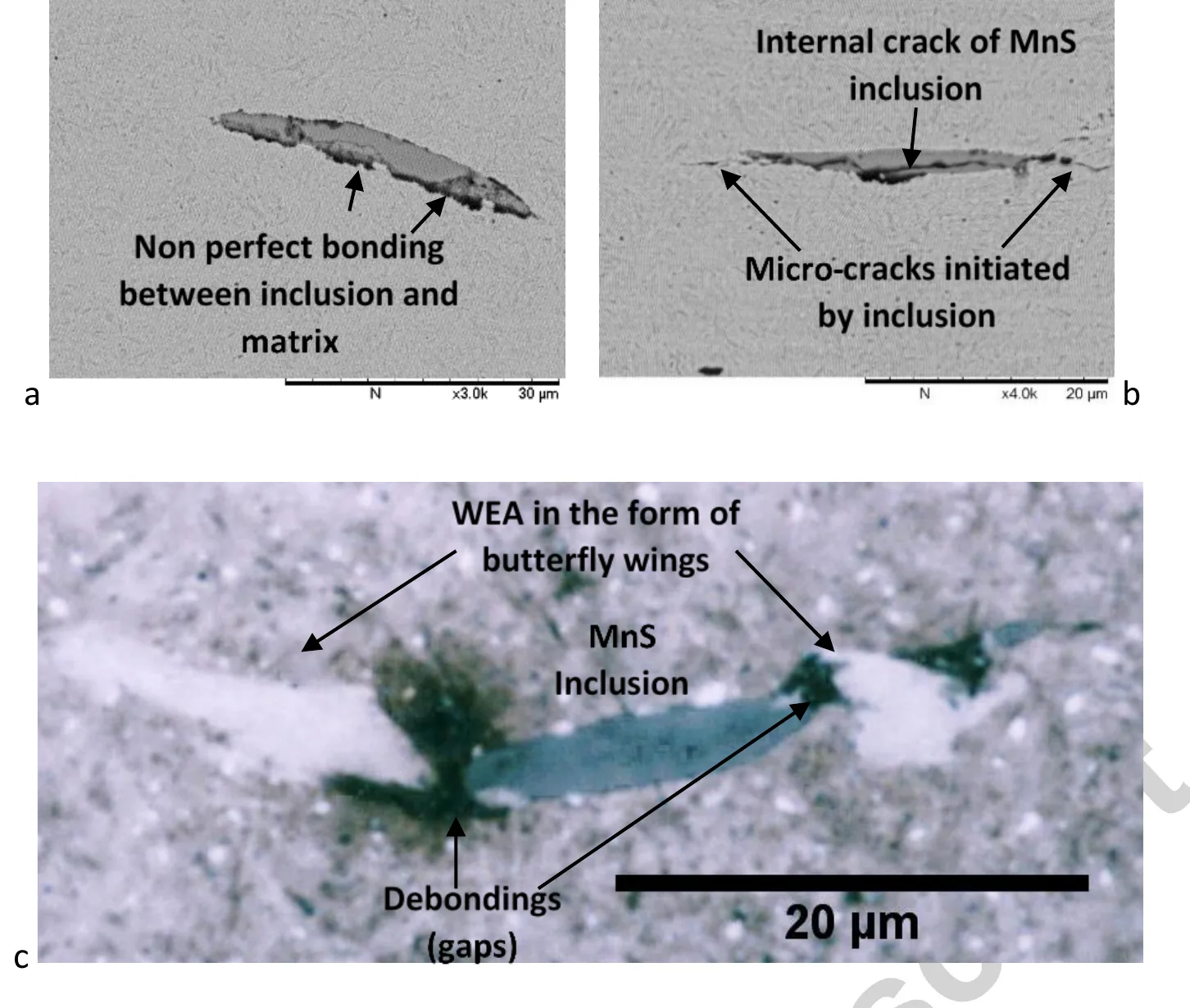
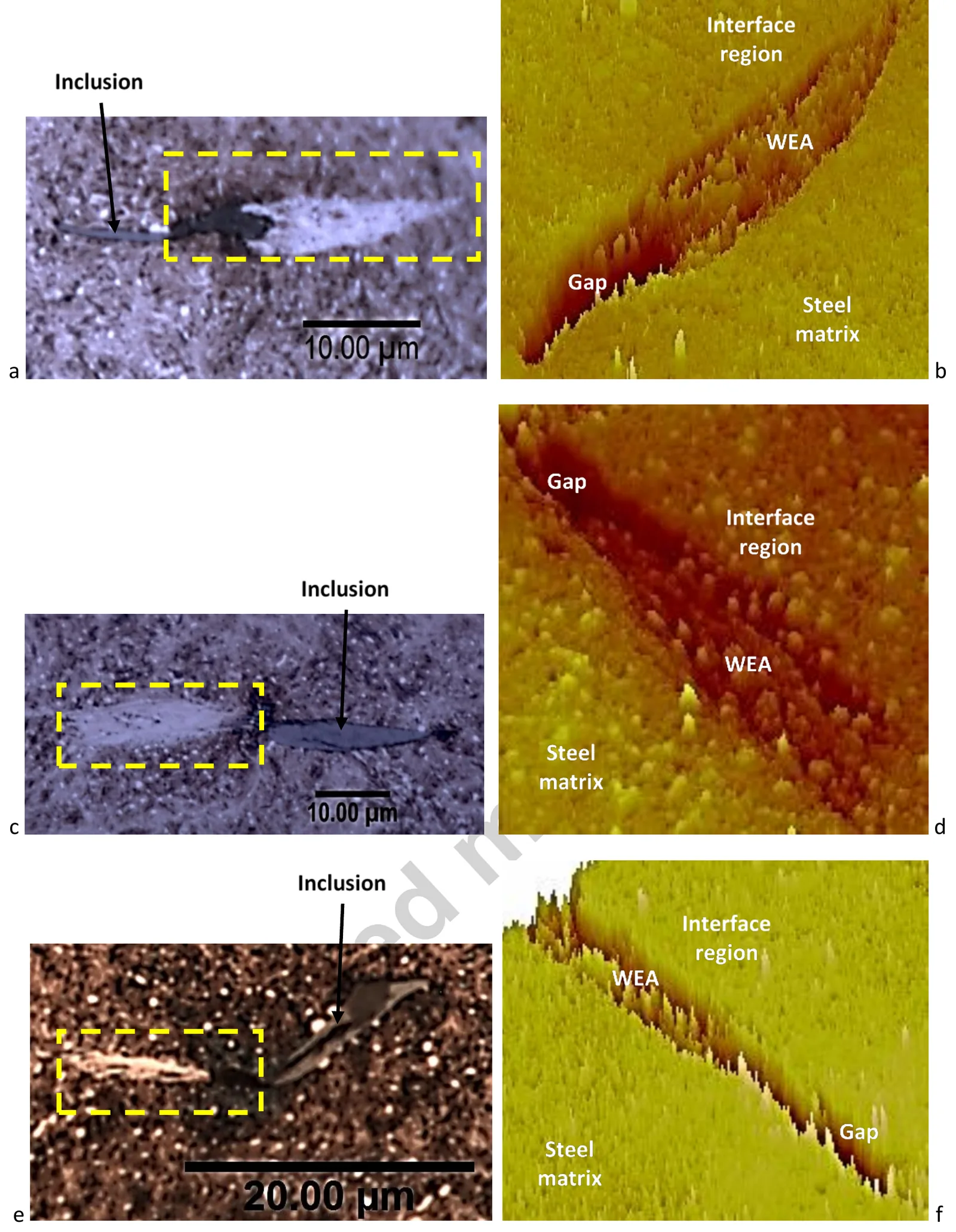
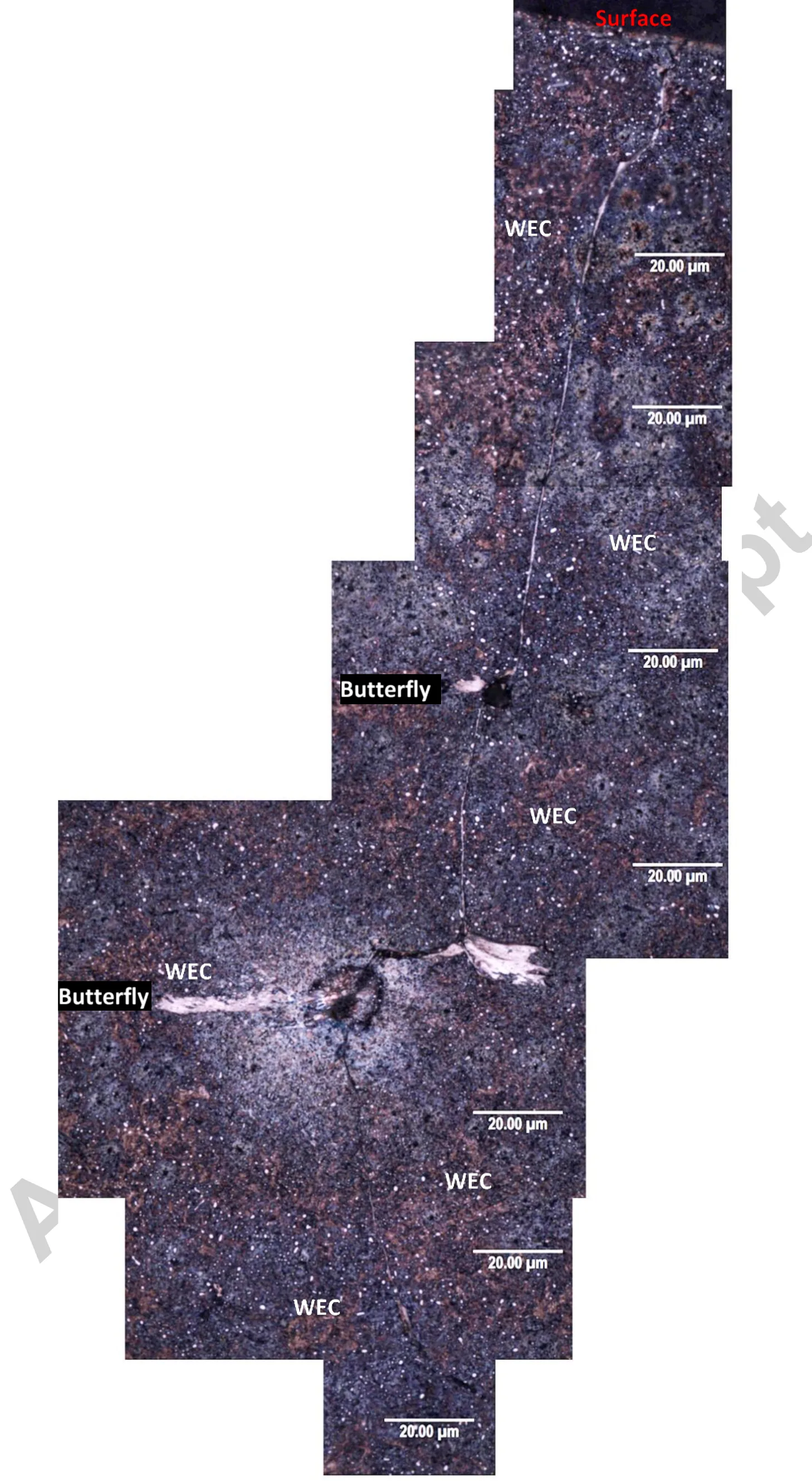
Common forms include non-metallic inclusions losing adhesion with the steel matrix, cracked inclusions, micro-cracks propagating into the steel matrix, butterfly-shaped White Etching Area (WEA) transformations, and White Etching Crack (WEC) networks.
Multiple forms of damage can occur simultaneously, making the actual extent of the damage much larger than the spalled area visible on the raceway.
MnS Inclusions as Micro-Crack Initiators
Bearing steel may contain manganese sulfide inclusions, denoted as MnS. These inclusions do not necessarily cause immediate failure, but the risk increases when the bond between the inclusion and the steel matrix is imperfect, creating micro-gaps at the ends or along the inclusion.
Under cyclic contact loading, local friction, and sliding, these gaps become stress concentration zones. The inclusions can crack; from the interface, micro-cracks propagate into the steel matrix and form WEA zones.
When observed on a cross-section, WEA typically exhibits the shape of one or two butterfly wings extending from the ends of the inclusion.
WEC Networks Leading to Raceway Spalling
White Etching Cracks (WEC) are crack networks associated with white etching microstructural alteration zones in bearing steel. Micro-cracks can initiate around inclusions or at the boundary between WEA and the steel matrix, then interconnect and propagate in multiple directions.
Some cracks propagate almost vertically toward the raceway. When the crack network reaches the surface, the overlying material loses its load-bearing capacity and flakes off in patches.
The raceway begins to pit, scale, and generate metal debris, causing a rapid increase in vibration and noise.
If operation continues, the metal debris can circulate in the oil, causing secondary damage to gears, other bearings, and the lubrication system.
At that point, the scope of repair may no longer be limited to a single bearing, and the entire planetary gear stage must be inspected.
Damage Assessment Must Find the Root Cause
Bearings should not be replaced solely based on signs of spalling. The assessment process requires combining vibration data, temperature, oil analysis results, metal debris morphology, loaded zone location, contact marks, concentricity, runout, assembly clearance, and housing condition.
Material analysis results must be cross-referenced with operational history to determine whether the failure stems from abnormal loading, roller sliding, lack of lubrication, contamination, assembly misalignment, or a combination of material defects and working conditions.
If the bearing is replaced without addressing the root cause, the failure is likely to repeat on the new bearing.
Properly assessing the mechanism of spalling and WEC cracks helps enterprises select the appropriate repair plan, minimize downtime, and avoid unnecessary equipment replacement.
Inspection and Failure Assessment of Wind Turbine Gearbox Bearings
VietSonic provides inspection and failure assessment services for wind turbine bearings and gearboxes; analyzes the mechanisms of raceway spalling, WEA, and WEC cracks; and recommends appropriate inspection, repair, or replacement plans based on actual conditions.
If your equipment is experiencing abnormal vibrations, noise, elevated temperatures, metallic debris in the oil, or repeated bearing failures after replacement, contact VietSonic for consultation on suitable inspection solutions.
VietSonic Ultrasonic Equipment Co., Ltd.
📞 Phone: 0938 49 33 66 – Mr. Hải
📧 Email: info.vietsonic@gmail.com
🌐 Website: vietsonic.vn