



How Is Ultrasound Technology Used in Cosmetics Manufacturing?
In modern cosmetics manufacturing, product quality depends greatly on how well ingredients are mixed and dispersed and how effectively the formulation’s structure is controlled. Ultrasound technology is being researched and applied to support these processes, particularly in the manufacture of skincare creams, serums and emulsions.
Through its mechanical effects in liquids, ultrasound can assist emulsification, break up particle agglomerates and improve ingredient processing. How does this technology work, and which factors must be controlled when introducing it into production?
1. What is ultrasound technology in cosmetics manufacturing?
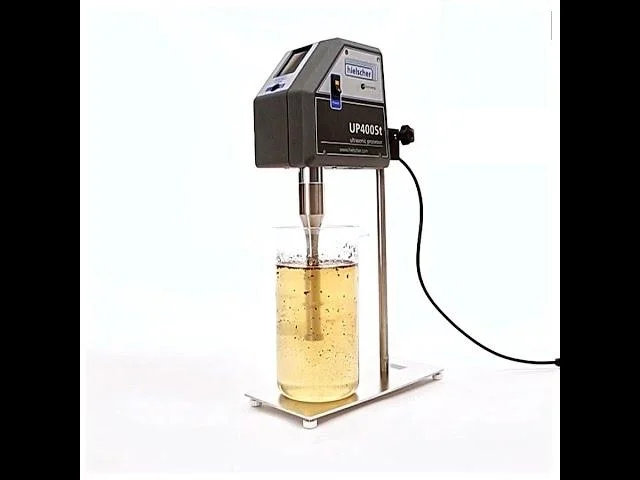
Ultrasound consists of mechanical waves at frequencies above the normal human hearing range, namely above 20 kHz. In manufacturing, certain high-power ultrasonic devices are designed to transfer energy directly into liquids.
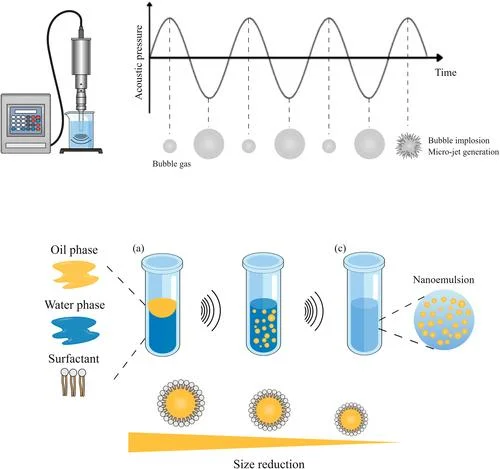
As ultrasonic waves propagate through a liquid, pressure changes can generate tiny gas or vapor bubbles. These bubbles grow, oscillate and may collapse violently under certain conditions. This phenomenon is called acoustic cavitation.
The collapse of cavitation bubbles produces localized mechanical effects, including microstreaming, shear forces and pressure fluctuations. These effects can help break oil droplets into smaller droplets in an emulsion or disrupt particle agglomerates in a liquid.
This mechanism has led to research into ultrasound for many stages of cosmetic ingredient processing. However, outcomes depend on the formulation, ingredient properties and how the equipment delivers energy.
2. Why is ultrasound technology attracting interest in cosmetics manufacturing?
A cream or serum may contain many groups of ingredients with different characteristics: water, oils, humectants, structuring agents, dissolved actives and components that need dispersion.
Several technical issues may arise during mixing:
Uneven ingredient distribution
Agglomerates of difficult-to-disperse ingredients may remain in the mixture and affect product uniformity.
Inconsistent oil-droplet sizes
In emulsions, differences in droplet size and distribution may affect texture and stability.
Difficulty controlling product structure
Viscosity, flow behavior and skin feel depend on both the formulation and processing conditions.
Variation between production batches
Changes in mixing conditions, temperature or processing energy may lead to quality differences between batches.
Ultrasound is one of the technologies worth investigating to address these issues. Selection should be based on the characteristics of the ingredient system and comparison with existing processing methods.
3. Main applications of ultrasound in cosmetics manufacturing
3.1. Supporting emulsification in skincare cream production
Many skincare creams are formulated as emulsions containing oil and water phases. These phases do not completely dissolve into one another, so an appropriate emulsification process and emulsifier system are needed.
During ultrasonic emulsification, mechanical energy may act on oil droplets and divide them into smaller droplets within the continuous phase.
When droplet size and its distribution are appropriately controlled, the emulsion structure may change in a desired direction. However, long-term stability still depends on the emulsifier, viscosity, oil-phase composition and storage conditions.
A 2023 study published in the International Journal of Cosmetic Science examined oil-in-water emulsions treated with ultrasound at different frequencies, illustrating that this technology has a research basis in cosmetic formulation.
3.2. Supporting homogenization of ingredient mixtures
Homogenization aims to achieve relatively uniform distribution and structure throughout an ingredient system.
In suitable formulations, ultrasound can be applied after preliminary mixing to process regions of ingredients or structures that remain nonuniform.
For skincare creams, this process may be investigated to control the distribution of the dispersed phase. However, ultrasonic equipment does not automatically ensure uniform treatment of the entire tank volume. At larger scales, flow, recirculation and equipment geometry are important.
3.3. Dispersing particulate ingredients and agglomerates
Some cosmetic formulations use powdered or particulate ingredients or previously prepared dispersions.
When these particles form clusters, ultrasonic dispersion can help disrupt some agglomerate structures and distribute the particles through a liquid medium.
Breaking up agglomerates must be distinguished from reducing the size of primary particles. To verify particle size after treatment, formulators need appropriate measurement methods.
3.4. Supporting ingredient preparation for serums
Serums can be formulated in various systems, ranging from aqueous solutions and gels to oil-containing emulsions.
For serums containing difficult-to-disperse ingredients or emulsions, ultrasound may be investigated to aid ingredient processing before blending or during a suitable emulsification step.
For solution-based serums whose active ingredients have fully dissolved, ultrasound should be considered according to actual needs. It does not inherently increase an active’s equilibrium solubility or improve the finished product’s performance.
3.5. Supporting extraction of active compounds from plant materials
Beyond cream and serum manufacturing, ultrasound is also studied for preparing botanical extracts.
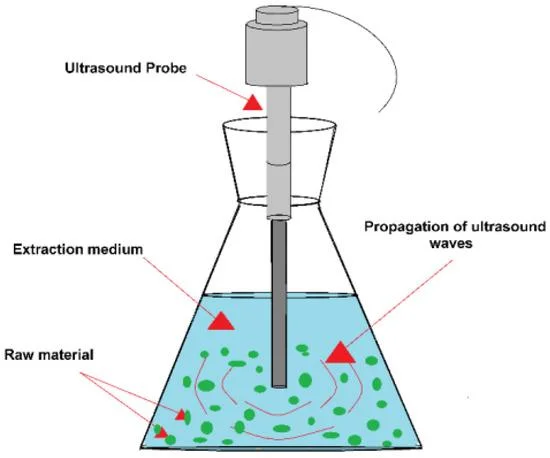
Cavitation and liquid movement can enhance mass transfer between plant materials and solvents, facilitating the release of certain target compounds.
Extraction performance depends on the plant species, solvent, temperature, duration and stability of the target compound. An extraction procedure optimized for one material cannot automatically be applied to another.
4. How does ultrasound affect cosmetic product quality?
Ultrasound’s effects should be evaluated by connecting the processing stage, physical changes and finished-product quality indicators.
| Objective | Evaluation method | Application conditions |
|---|---|---|
| Control emulsion droplet size | Measure droplet size and size distribution | Creams or serums formulated as emulsions |
| Improve dispersion | Microscopic observation and measurement of agglomerate size distribution | Formulations containing a dispersed particulate phase |
| Control texture | Measure viscosity and rheological properties | Creams, gels or structured systems |
| Assess stability | Monitor phase separation, changes in droplet size and related indicators | Emulsions or dispersions |
| Assess reproducibility | Compare multiple batches made with the same formulation and conditions | Development and scale-up stages |
5. Factors to control when using ultrasound
Processing effectiveness depends on more than the equipment’s rated power. An appropriate process must consider the following factors together:
- Ultrasonic frequency: Affects wave propagation and cavitation characteristics in the processing medium.
- Vibration amplitude: Relates to the intensity of the effect near the ultrasonic emitter.
- Processing time: Must be optimized for the objective; longer treatment does not always yield better results.
- Temperature: Must be monitored because processing may heat the mixture and affect heat-sensitive ingredients.
- Volume and viscosity: Affect energy distribution and material flow.
- Equipment configuration: Direct probes, flow-cell systems and other configurations transfer energy differently.
In practice, parameters must be selected through trials on the specific formulation. Parameters from a study or device should not be transferred directly to another manufacturing scale without evaluation.
6. How could ultrasound be applied to Mai skincare creams and serums?
In Mai cosmetics development, ultrasound is a technology that may be investigated to support control of production processes and formulation quality.
For Mai skincare cream
According to the technical information provided, Mai cream’s basic formulation includes ingredients such as Tranexamic Acid, Alpha Arbutin, Vitamin B3, Panthenol, Glycerin, Caprylic/Capric Triglyceride and botanical extracts.
The product documentation mentions ultrasonic homogenization and emulsification. From a technical standpoint, an appropriate evaluation would examine processing of the oil–water system, ingredient distribution and the cream’s structural properties.
To establish actual effectiveness, ultrasound-treated samples must be compared with control samples using the same formulation, while measuring droplet size, viscosity and stability.
For Mai serum
The potential application of ultrasound should be determined once the serum formulation is finalized. If the serum has a dispersed phase or emulsion structure, the corresponding processing steps can be studied.
If the serum is an aqueous solution, the technical problem to be solved should be clearly identified before selecting a technology. This avoids adding unnecessary processing steps.
7. Procedure for evaluating ultrasound in cosmetics manufacturing
For cosmetics research and development teams, an evaluation program may follow these steps:
- Define the objective: Clarify whether emulsification, dispersion, texture or stability needs improvement.
- Evaluate the formulation: Review ingredients, phase system, viscosity, heat sensitivity and current processing conditions.
- Design experiments: Prepare control and ultrasound-treated samples, fully documenting their processing conditions.
- Measure results: Test indicators relevant to the stated objective while monitoring undesirable changes.
- Assess scale-up: Consider energy distribution, thermal control, recirculation, equipment cleaning and batch-to-batch reproducibility.
Only after suitable experimental data are available can the technical benefits and feasibility of using ultrasound in a particular production process be assessed.
8. Frequently asked questions
Can ultrasound completely replace conventional mixers and homogenizers?
Not in every case. With supporting evaluation data, ultrasound may be integrated as an additional step or replace a specific processing stage. Mixing and recirculation may still be necessary on a large scale.
Does using ultrasound produce nanocosmetics?
Not automatically. The attainable size depends on the formulation, equipment and processing conditions. Droplet or particle sizes must be measured to confirm this.
Does ultrasound help active ingredients penetrate the skin better?
Using ultrasound during manufacturing alone is not enough to draw that conclusion. Penetration depends on the active ingredient, formulation and biological factors; separate studies on the finished product are required.
Can ultrasound alter cosmetic active ingredients?
Possibly, depending on the ingredients and processing conditions. Temperature increases or cavitation-related chemical effects may affect some sensitive components. Active-ingredient stability should therefore be assessed after processing.
Does every serum require ultrasonic treatment?
No. Its use depends on the formulation structure and processing objective. A simple solution-based serum may not need this step.
9. Conclusion
Ultrasound offers several potential applications in cosmetics manufacturing, from emulsification, homogenization and ingredient dispersion to assisting the extraction of botanical compounds.
Its value lies in applying controlled effects to liquids and dispersions, giving formulators another option for addressing specific technical challenges.
For skincare creams and serums, the benefits of ultrasound must be demonstrated by appropriate measurements rather than inferred solely from the technology’s name or equipment power rating.
As Mai researches and applies ultrasound in cosmetics, combining knowledge of ingredients, equipment and quality-assessment methods will provide a foundation for developing suitable processes.