



When Is Ultrasound Used in Serum Production?
When making a serum, ingredients need to be dissolved, dispersed, or mixed in a suitable sequence. Some formulas only require conventional stirring, while others need an additional processing step to distribute the ingredients more evenly throughout the mixture.
Ultrasound can be used during these stages. However, the right time to use it depends on what the serum contains and which production issue needs to be addressed.
1. How is a serum made in the first place?
Imagine someone preparing a batch of serum in a laboratory. On the workbench are water, various ingredients, and glass beakers used for mixing.
The operator weighs the ingredients according to the formula, prepares the necessary portions, and adds them to the mixture in a specified order.
Some substances dissolve completely in water. Others tend to form small clumps at first. Certain formulas also contain both oil and water, requiring oil droplets to be distributed throughout the water phase.
As a result, different serums may need different mixing methods. Manufacturers should consider the properties of the ingredients before deciding whether an additional ultrasonic step is necessary.

2. At which stage is ultrasound usually introduced?
In serum production, ultrasound is commonly considered during ingredient preparation or mixing. Three situations are particularly relevant.
When ingredients are difficult to disperse
Some ingredients may clump together when added to a liquid. Ultrasound can help break up these clusters so the material is better distributed throughout the mixture.
When a serum contains oil and water
If the formula requires oil droplets to be formed in water, ultrasound may be applied after initial mixing to help reduce the droplet size.
When developing a new formula
Developers can treat a small sample with ultrasound and compare it with a conventionally stirred sample to determine whether the technology produces a useful change.
3. How does ultrasound affect a serum mixture?
In a probe-type ultrasonic homogenizer, a metal probe is placed in the liquid. When the machine runs, the probe vibrates rapidly and transfers energy into the mixture.
Under suitable conditions, this action creates tiny bubbles that repeatedly form and collapse in the liquid. The resulting local forces can help break up ingredient clusters or reduce the size of oil droplets.
Think of trying to stir a mixture containing clumps that are hard to break apart. Stirring moves the mixture as a whole, while ultrasound adds intense localized action near the probe tip.
However, the result depends on the formula, equipment, and processing conditions. Ultrasound does not automatically improve the solubility of every substance or turn every ingredient into nanoparticles.
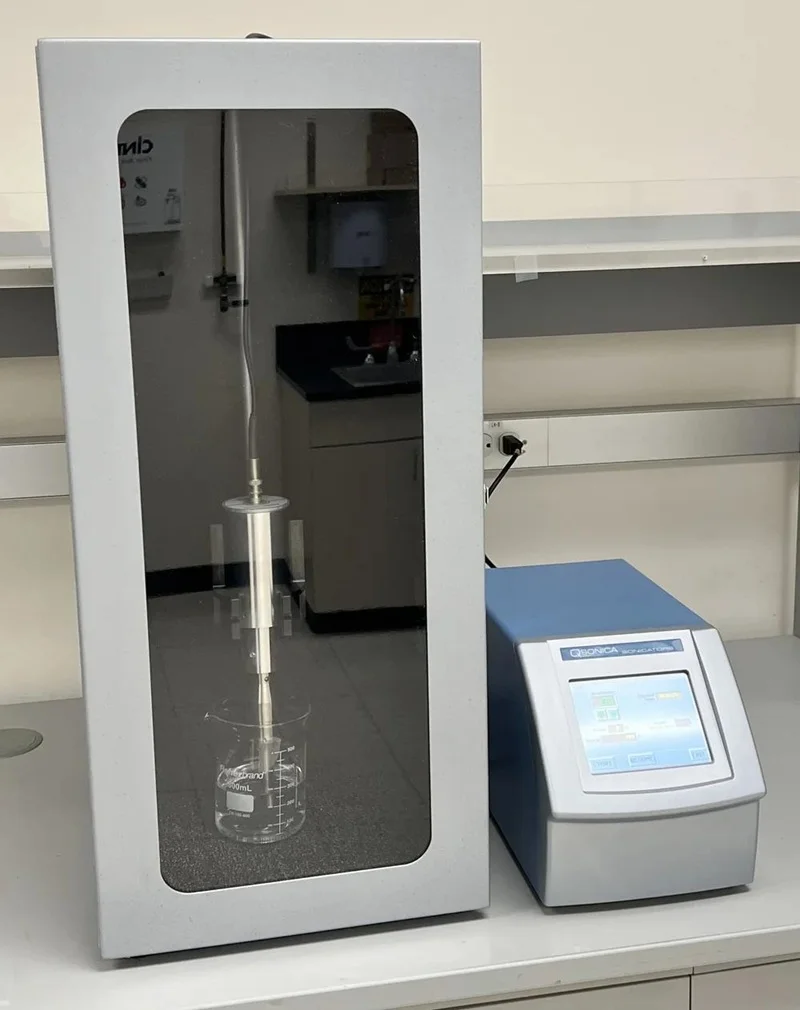
4. What does a process using ultrasound look like?
To make this easier to picture, the following is an example sequence for a serum formula that may require ultrasonic homogenization or dispersion.
Ingredient preparation
Weigh the components according to the formula and identify which ingredients need to be dissolved, dispersed, or prepared separately.
Initial mixing
Use an appropriate stirring method to introduce the ingredients into the liquid and prepare the initial mixture.
Ultrasonic treatment, if needed
Apply ultrasound to the mixture or selected ingredient portion to investigate dispersion or droplet-size reduction. Treatment time and intensity must be tested.
Finish and inspect the mixture
Complete the remaining steps in the formula and check uniformity, appearance, temperature, and other necessary quality indicators.
Assessment before filling
Only when the serum batch meets the process requirements and quality-control criteria does it proceed to filling and packaging.
For large-scale production, one option is to pass the liquid through an ultrasonic processing chamber and then return it to the tank or send it to the next stage. The arrangement must suit the properties of the mixture.

5. Does every type of serum need ultrasound?
No. The word “serum” alone does not tell us whether a formula needs ultrasonic homogenization.
For example, a clear serum whose ingredients have dissolved completely may be produced using conventional stirring. For a serum containing oil droplets or difficult-to-disperse materials, the manufacturer may consider ultrasound.
| Type of serum | Potential role of ultrasound to investigate |
|---|---|
| Clear solution serum | Ultrasound may be unnecessary if the ingredients dissolve well and the mixture meets the requirements. |
| Gel serum | Depending on the formula, ultrasound may be investigated to help disperse certain ingredients before the gel structure forms. |
| Oil-and-water serum | Ultrasound may be used after initial mixing to help reduce the size of oil droplets and distribute them. |
| Serum containing dispersed particles | Ultrasound may help break up particle clusters, but the ingredients must also be checked for unintended structural changes. |
| Entirely oil-based serum | Consider ultrasound only for a specific dissolution or dispersion need; without water in the formula, there is no oil-in-water emulsification step. |
6. Can a serum be bottled immediately after ultrasound treatment?
Suppose two serum samples are prepared using the same formula. The first is stirred conventionally, while the second also undergoes ultrasonic treatment.
Both samples may look uniform to the naked eye. However, to determine whether ultrasound offers a real benefit, the manufacturer needs to check specific indicators.
- Uniformity: Are the ingredients consistently distributed throughout the different parts of the mixture?
- Droplet or particle-cluster size: If this is the treatment goal, do the measurements change in the desired direction?
- Texture: Does the serum retain the required fluidity, thickness, or gel consistency?
- Ingredient quality: Do the ingredients that need protection still meet the required specifications after treatment?
- Stability: Does the mixture show changes in color, phase separation, precipitation, or other changes during monitoring?
In particular, ultrasound can raise the temperature of the liquid. With heat-sensitive ingredients, temperature must be monitored and the effects of treatment assessed.
After ultrasound treatment, the serum must still undergo the necessary finishing and quality-control steps. Ultrasound does not replace production hygiene requirements or a suitable preservative system.
7. Frequently asked questions
Can ultrasound make a serum feel smoother?
In suitable formulas, ultrasound may help produce smaller oil droplets or disperse ingredients more effectively. Any change in perceived smoothness needs to be assessed in the actual product.
Does ultrasound automatically make a serum a nano serum?
No. To establish whether a dispersed system has nanoscale dimensions, the right material must be measured using a suitable method. Using ultrasonic equipment alone is not enough to make that claim.
Does ultrasound help a serum penetrate the skin better?
In production, ultrasound mainly affects how the mixture is processed. The finished serum’s skin penetration or performance must be evaluated separately; neither can be inferred simply from ultrasonic treatment.
8. So when does it make sense to use ultrasound?
The answer depends on the serum formula. If ingredients already dissolve and distribute well, an extra ultrasonic step may not be needed.
If the mixture contains difficult-to-disperse clusters, or the formula requires small oil droplets in water, ultrasound may be worth investigating.
The key is to identify which part of the mixture needs treatment, when to apply it, and how to evaluate the result afterward.
In serum production, ultrasound is truly useful only when it addresses a specific formulation need and the result can be verified.
Learn about ultrasound applications in cosmetics manufacturing
VietSonic provides ultrasonic equipment solutions for liquid-processing applications. If you are exploring ultrasound for mixing, dispersion, or homogenization of cosmetic ingredients, contact VietSonic to discuss a suitable equipment approach.
Hotline: 0938 49 33 66
Email: info.vietsonic@gmail.com