



How to Analyze Wind Turbine Gearbox Bearing Cross-Sections from WEC to Raceway Spalling
When wind turbine gearbox bearings exhibit raceway spalling, many operators simply conclude that “the bearing failed” and replace it. However, the observed material loss zone is merely the final manifestation. The true root cause may lie deep within the steel matrix, where White Etching Crack (WEC) networks have already propagated over a long period.
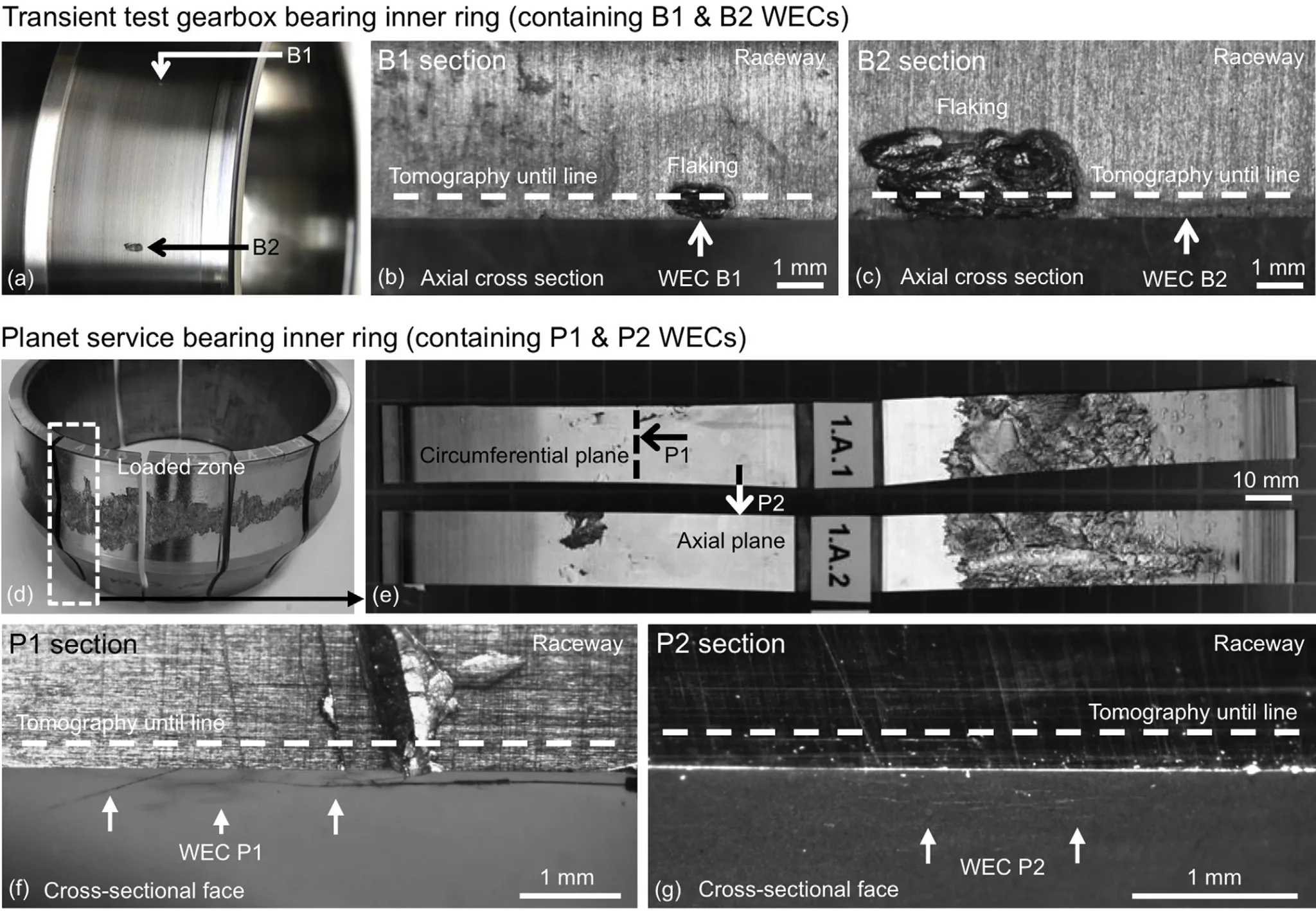
To correctly identify the failure mechanism, it is essential to analyze the bearing cross-section precisely at the loaded zone, the spalling area, and regions suspected of subsurface cracking.
Why Visual Surface Inspection is Insufficient
On the raceway surface, damage may manifest as a single micro-pit, a cluster of spalling, or an extended material loss zone. These surface indications can be linked to contact fatigue, misalignment, slippage, poor lubrication, or subsurface WEC networks.
The external morphology of the spalled area is insufficient to differentiate these failure mechanisms. Two bearings might display nearly identical surface damage, yet their underlying subsurface crack structures can be entirely distinct.
Therefore, before sample cutting, it is crucial to fully document the bearing mounting position, rotational direction, loaded zone, load vector, and spalling morphology.
Small Spalling Zones May Conceal Deep Subsurface Crack Networks
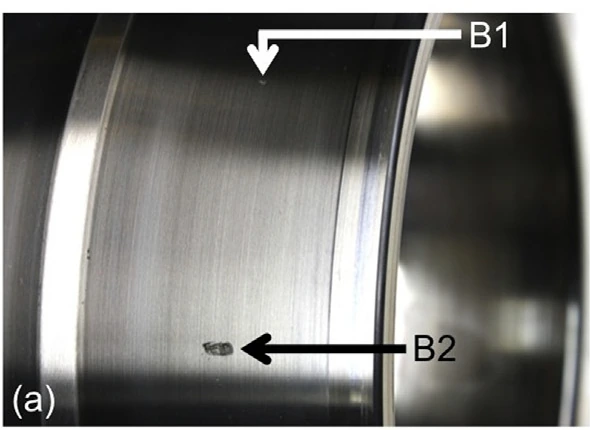
At location B1, the surface displays only a relatively small spalled area. However, the cross-section through this region reveals that WEC networks reside right beneath the raceway.
This explains why damage severity cannot be evaluated solely by the size of the flaked material. A minor surface defect might just be where the crack network has breached the surface, while the internal cracking has already propagated into adjacent zones.
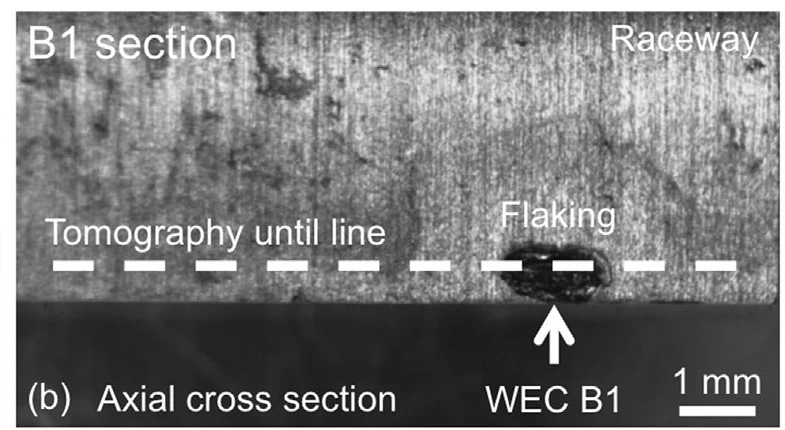
If operation continues, cyclic rolling contact fatigue will cause the crack branches to expand. The overlying steel matrix gradually loses structural support and will eventually flake off into larger patches.
Comparison with Highly Developed Spalling Zones
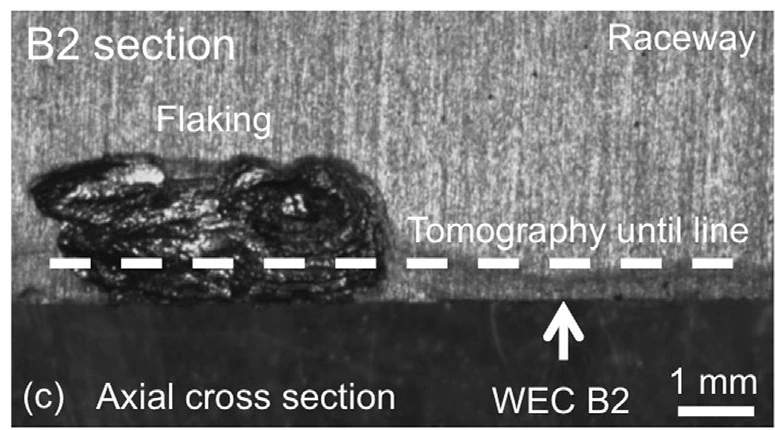
At location B2, a larger and more complex spalled area has developed on the surface. The cross-section reveals pronounced near-surface destruction along with an associated underlying WEC zone.
Comparing B1 and B2 helps identify the transition from a minor spalling point to an extended damage zone. This insight is critical when evaluating the remaining bearings within the same gearbox or sister assets across the fleet.
Samples Must Be Cut Along the Correct Planes
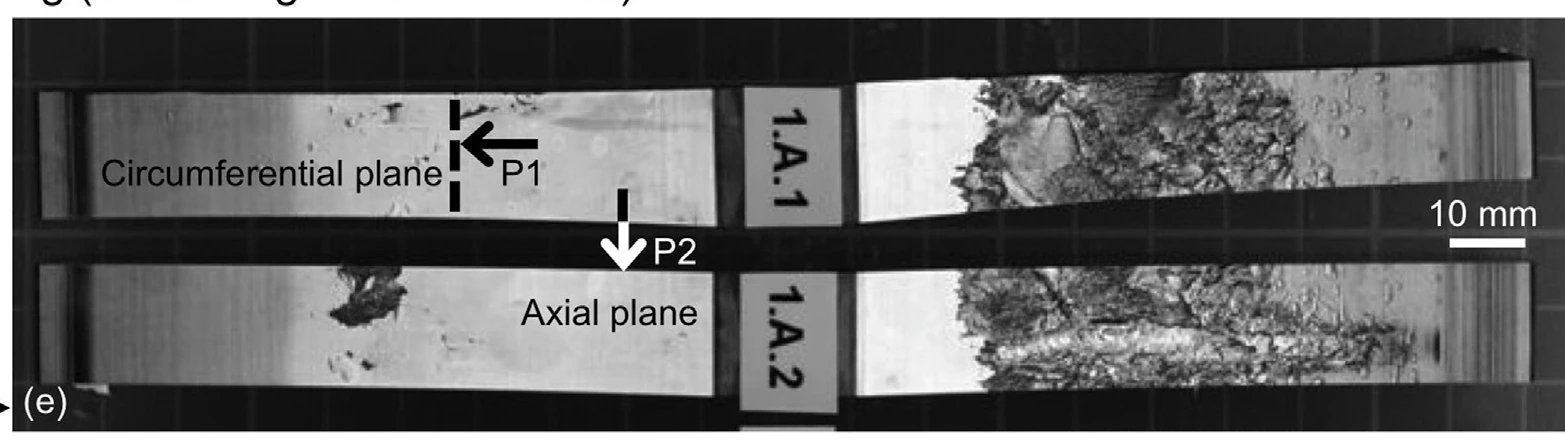
WEC networks possess a three-dimensional architecture. Observing only a single cross-sectional plane risks missing the primary propagation direction of the cracks.
Samples are typically removed along two specific orientations:
- Axial Cross-Section: Observes crack propagation across the raceway width.
- Circumferential Cross-Section: Evaluates the crack network along the rolling direction of the rollers.
The cutting plane must intercept the loaded zone and areas showing abnormalities. For advanced diagnostics, sequential grinding and polishing of multiple layers can track the crack network through varying depths.
When WEC Networks Connect to the Surface
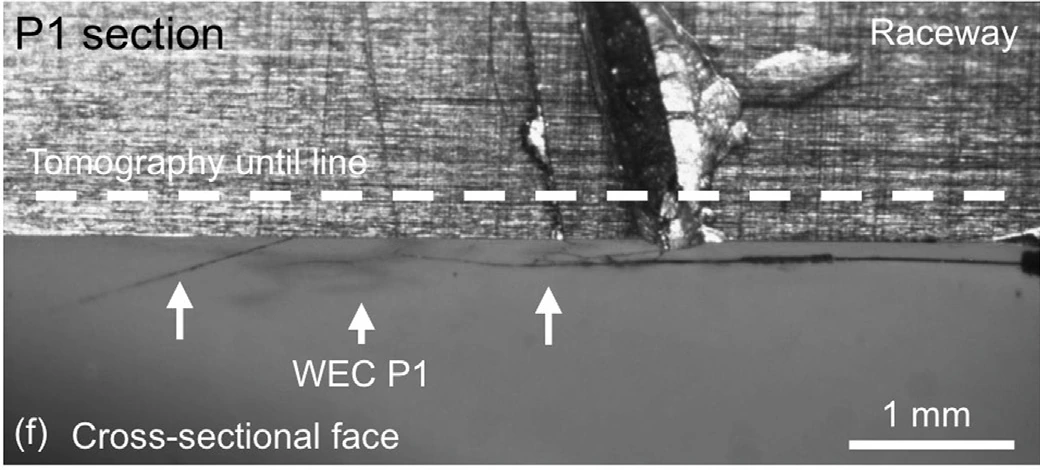
In early stages, WEC networks can be completely embedded within the steel matrix. As the crack network expands, one or more branches propagate up toward the raceway. At the point of interconnection, the surface begins cracking, pitting, and flaking material.
Case P1 demonstrates a crack network successfully linking to the surface and the damaged zone above. This provides vital evidence to confirm the structural relationship between subsurface cracking and observed surface spalling.
Cross-Sectional Analysis Drives Target Root Cause Remedies
Inspection results must be cross-referenced against vibration spectrums, operating temperatures, loading logs, oil conditions, concentricity alignment, and bearing replacement history. The engineering goal is not just confirming WEC presence, but isolating the dynamic drivers accelerating crack network growth.
Our company delivers comprehensive field investigation and failure analysis services for bearings, gearboxes, and industrial rotating machinery—ranging from baseline inspections and target sampling site selection to cross-sectional evaluations, live operational data audits, and tailored engineering solutions.
When bearings exhibit premature spalling or chronic failure post-replacement, cross-sectional analysis stands as an indispensable engineering control to stop looping component replacements without resolving the underlying systemic failure.
If your equipment is facing operational anomalies, running erratically, or requires specialized deep engineering evaluation, contact VietSonic today for an optimized solution tailored to your line.
⚙️
VietSonic Ultrasonic Equipment Co., Ltd.
📞 Phone: 0938 49 33 66 – Mr. Hải
📧 Email: info.vietsonic@gmail.com
🌐 Website: https://vietsonic.vn